Advertisements
Advertisements
प्रश्न
What has been the situation of your village/town/city five to ten years ago and how has it changed since then? Write a short paragraph describing the changes in its size, population, traftlc, buildings, lifestyle etc. Which verb forms would you mainly use to describe the changes? (Hint: Simple Past and Present Perfect forms.)
Advertisements
उत्तर
How has our city changed ?
Our city has greatly changed now. Ten years ago it had a population of eight lakhs. Now it has around fiftee to twenty. There used to be a few thousand cars then. Now every street or road has as many cars as are human beings. There were no new colonies. Now it has several sectors and new multiplexes. Almost everywhere there is a continuous construction activity. Malls, air conditioned showrooms, etc, were just absent then. Now there is an enormity of them. The traffic has increased manifold as has the city’s size. It has swallowed the agricultural land that it once had around it. Almost everywhere one can see a variety of traffic like cars, buses, trucks, tractors, auto-rickshaws and rickshaws. Now the crowd and traffic jams add to the chaos on city roads. This way there is always a great hustle and bustle almost everywhere with enormous growth of the city’s population. No doubt, people’s standard of living has increased with a healthy lifestyle. They are now awakened towards the healthcare trends through yoga, jogging, walking etc.
APPEARS IN
संबंधित प्रश्न
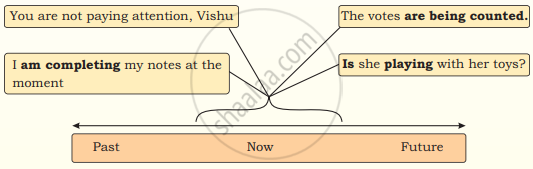
- S + is/am/are + verb + ing
- S + is/am/are + not + verb + ing.
- Is/am/are + S + verb + ing?
- S + is/am/are + being + Verb (past participle)
Look at the incomplete sentences below. Using the information provided, complete each sentence using a suitable tense. Follow the examples:
1947 until now India I has been (be) independent since 1947.
1947 India became (become) independent in 1947.
1. 1947 until now l There --------- (be) manywars.
2. 1991 There ------- (be) a war in the Persian Gulf.
3. 1953 -------- Edmund Hilary and Tensing first (climb) Everest.
4. 1953 until now Many people ________ (climb)Everest.
5. 1983 India --------- (win) the Prudential Cricket World Cup in England.
6. 1983 until now India -------- (win) many limited-overs cricket trophies.
Simple Past Tense-Past Perfect Tense
Underline the main verbs in the sentences below. Then, rewrite the sentences in the correct order of events.
1) The people began to starve.
2) In 1925, a disease destroyed the crops in one village.
3) Later, the village people came to retrieve their children
4) The chief decided to send the children of the village to live in a settlement in the next valley.
5) However, they had married outside the village.
6) This caused a war between the two villages.
__________________
__________________
Now work with your partner and tick (✓) the sentence in which a different tense has been used. In pairs, discuss why this has been done.
Sentence No: 5 uses a different tense because ..................................................................................................................................................
..................................................................................................................................................
Study the following sentences.
1) I didn't know Jim had migrated to the United States.
2) When we arrived at the theatre, the show had already begun.
3) The patient had died before the ambulance reached the hospital.
4) He had got married by the time he started working.
5) I couldn't open the locker because I had mislaid the keys.
6) Byom Bakshi felt that he had seen the man somewhere before.
As you can see, each of the above sentences describes two different actions, events or situations. Work with a partner and list them as shown in the example.
| A. Occurred First | B. Occurred Later |
| 1. Example: Jim had migrated to the United States. | 1. I did not know it. The speaker came to know the fact later.) |
| 2. | 2. |
| 3. | 3. |
| 4. | 4. |
| 5. | 5. |
| 6. | 6. |
What verb forms have been used in (A) and (B) respectively?
A. ....................................................................
B ....................................................................
What conclusion can you draw from your analysis?
...................................................................
...................................................................
Work with apartner
In the following sentences, choose and circle the verb form you think best fits the meaning of each sentence. You have been provided an example.
| 1. Tomorrow | is will be is going to be | Wednesday. |
| 2. The train | has left will have left is going to leave | by the time you reach the station. |
| 3. Hurry! The film | does will is about to | start. |
| 4. The Minister | opens is opening is about to open | the new Art Centrenext week. |
| 5. This time next year, he | will live is living will be living | in Mumbai. |
| 6. I | am going to be will be will have been | a nurse when I grow up |
Use the correct tense form of the verb given in the bracket and rewrite the sentence.
She ________ at her left shoulder for quite some time.
Use the correct tense form of the verb given in the bracket and rewrite the sentence.
She ______ like a dressmaker’s dummy standing there.
Name the Tense of the Verb underlined to include Time (Past/Present/Future) and Aspect (Simple/Continuous/Perfect/Perfect Continuous).
I slept on the floor.
Name the Tense of the Verb underlined to include Time (Past/Present/Future) and Aspect (Simple/Continuous/Perfect/Perfect Continuous).
We were designing the first Macintosh computer.
Name the Tense of the Verb underlined to include Time (Past/Present/Future) and Aspect (Simple/Continuous/Perfect/Perfect Continuous).
I am fine, now.
Name the Tense of the Verb underlined to include Time (Past/Present/Future) and Aspect (Simple/Continuous/Perfect/Perfect Continuous).
I shall be telling you three stories.
Change the Tense as instructed.
My doctor advised me. (Past Perfect Continuous)
Rewrite the sentence as per the instruction given along with it.
I took the baby langur to our backyard.
(Rewrite the sentence in the Past Perfect Tense)
Rewrite the sentence as per the instruction given along with it.
She simply sat there quietly.
(Rewrite the sentence in the Present Continuous Tense)
Read the following sentence carefully, underline the verb and find out the tense in the sentence.
He leaned out eagerly.
Frame sentences using the homograph to show the difference in their meanings:
Train
Rewrite the sentence in future tense:
I am doing it.
