Advertisements
Advertisements
प्रश्न
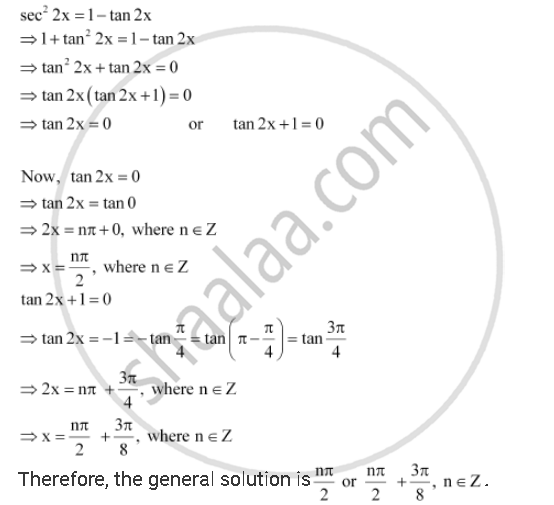
Find the general solution for each of the following equations sec2 2x = 1– tan 2x
Advertisements
उत्तर
संबंधित प्रश्न
Find the general solution of the equation sin x + sin 3x + sin 5x = 0
If \[\cot x \left( 1 + \sin x \right) = 4 m \text{ and }\cot x \left( 1 - \sin x \right) = 4 n,\] \[\left( m^2 + n^2 \right)^2 = mn\]
If \[\sin x + \cos x = m\], then prove that \[\sin^6 x + \cos^6 x = \frac{4 - 3 \left( m^2 - 1 \right)^2}{4}\], where \[m^2 \leq 2\]
Prove that: tan 225° cot 405° + tan 765° cot 675° = 0
Prove that: tan (−225°) cot (−405°) −tan (−765°) cot (675°) = 0
Find x from the following equations:
\[cosec\left( \frac{\pi}{2} + \theta \right) + x \cos \theta \cot\left( \frac{\pi}{2} + \theta \right) = \sin\left( \frac{\pi}{2} + \theta \right)\]
Find x from the following equations:
\[x \cot\left( \frac{\pi}{2} + \theta \right) + \tan\left( \frac{\pi}{2} + \theta \right)\sin \theta + cosec\left( \frac{\pi}{2} + \theta \right) = 0\]
Prove that:
If tan x = \[x - \frac{1}{4x}\], then sec x − tan x is equal to
If tan x + sec x = \[\sqrt{3}\], 0 < x < π, then x is equal to
sin6 A + cos6 A + 3 sin2 A cos2 A =
If x is an acute angle and \[\tan x = \frac{1}{\sqrt{7}}\], then the value of \[\frac{{cosec}^2 x - \sec^2 x}{{cosec}^2 x + \sec^2 x}\] is
sin2 π/18 + sin2 π/9 + sin2 7π/18 + sin2 4π/9 =
If A lies in second quadrant 3tan A + 4 = 0, then the value of 2cot A − 5cosA + sin A is equal to
Which of the following is correct?
Find the general solution of the following equation:
Find the general solution of the following equation:
Find the general solution of the following equation:
Find the general solution of the following equation:
Find the general solution of the following equation:
Solve the following equation:
Solve the following equation:
Solve the following equation:
Solve the following equation:
Solve the following equation:
Solve the following equation:
sin x tan x – 1 = tan x – sin x
Solve the following equation:
3sin2x – 5 sin x cos x + 8 cos2 x = 2
Solve the following equation:
\[2^{\sin^2 x} + 2^{\cos^2 x} = 2\sqrt{2}\]
The number of solution in [0, π/2] of the equation \[\cos 3x \tan 5x = \sin 7x\] is
If \[\cos x = - \frac{1}{2}\] and 0 < x < 2\pi, then the solutions are
The number of values of x in the interval [0, 5 π] satisfying the equation \[3 \sin^2 x - 7 \sin x + 2 = 0\] is
Solve the following equations:
cos 2θ = `(sqrt(5) + 1)/4`
Choose the correct alternative:
If cos pθ + cos qθ = 0 and if p ≠ q, then θ is equal to (n is any integer)
Choose the correct alternative:
If f(θ) = |sin θ| + |cos θ| , θ ∈ R, then f(θ) is in the interval
Solve the equation sin θ + sin 3θ + sin 5θ = 0
Solve 2 tan2x + sec2x = 2 for 0 ≤ x ≤ 2π.
The minimum value of 3cosx + 4sinx + 8 is ______.
