Advertisements
Advertisements
Question
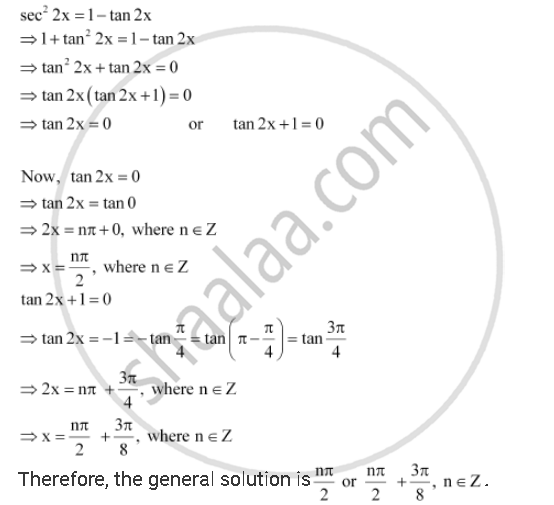
Find the general solution for each of the following equations sec2 2x = 1– tan 2x
Advertisements
Solution
RELATED QUESTIONS
Find the principal and general solutions of the equation `tan x = sqrt3`
Find the principal and general solutions of the equation `cot x = -sqrt3`
Find the general solution of the equation cos 4 x = cos 2 x
Find the general solution of the equation cos 3x + cos x – cos 2x = 0
Find the general solution of the equation sin x + sin 3x + sin 5x = 0
Prove the:
\[ \sqrt{\frac{1 - \sin x}{1 + \sin x}} + \sqrt{\frac{1 + \sin x}{1 - \sin x}} = - \frac{2}{\cos x},\text{ where }\frac{\pi}{2} < x < \pi\]
Prove that
In a ∆ABC, prove that:
Find x from the following equations:
\[x \cot\left( \frac{\pi}{2} + \theta \right) + \tan\left( \frac{\pi}{2} + \theta \right)\sin \theta + cosec\left( \frac{\pi}{2} + \theta \right) = 0\]
Prove that:
\[\tan 4\pi - \cos\frac{3\pi}{2} - \sin\frac{5\pi}{6}\cos\frac{2\pi}{3} = \frac{1}{4}\]
If x = r sin θ cos ϕ, y = r sin θ sin ϕ and z = r cos θ, then x2 + y2 + z2 is independent of
If tan \[x = - \frac{1}{\sqrt{5}}\] and θ lies in the IV quadrant, then the value of cos x is
Find the general solution of the following equation:
Find the general solution of the following equation:
Find the general solution of the following equation:
Find the general solution of the following equation:
Find the general solution of the following equation:
Find the general solution of the following equation:
Find the general solution of the following equation:
Solve the following equation:
\[\sin^2 x - \cos x = \frac{1}{4}\]
Solve the following equation:
Solve the following equation:
\[\sqrt{3} \cos x + \sin x = 1\]
Solve the following equation:
\[\sin x - 3\sin2x + \sin3x = \cos x - 3\cos2x + \cos3x\]
Solve the following equation:
4sinx cosx + 2 sin x + 2 cosx + 1 = 0
Solve the following equation:
3 – 2 cos x – 4 sin x – cos 2x + sin 2x = 0
Write the set of values of a for which the equation
Write the number of points of intersection of the curves
If \[3\tan\left( x - 15^\circ \right) = \tan\left( x + 15^\circ \right)\] \[0 < x < 90^\circ\], find θ.
General solution of \[\tan 5 x = \cot 2 x\] is
Find the principal solution and general solution of the following:
sin θ = `-1/sqrt(2)`
Find the principal solution and general solution of the following:
cot θ = `sqrt(3)`
Solve the following equations:
2 cos2θ + 3 sin θ – 3 = θ
Solve the following equations:
`sin theta + sqrt(3) cos theta` = 1
Solve the following equations:
cot θ + cosec θ = `sqrt(3)`
Choose the correct alternative:
If tan 40° = λ, then `(tan 140^circ - tan 130^circ)/(1 + tan 140^circ * tan 130^circ)` =
The minimum value of 3cosx + 4sinx + 8 is ______.
