Advertisements
Advertisements
प्रश्न
Explain the following term with suitable examples:
Frenkel defect
Advertisements
उत्तर
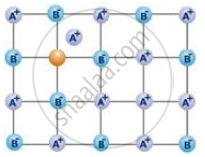
This defect arises when an ion (generally a cation) leaves its lattice site and occupies an interstitial site.

The void or empty space between the lattice points is known as an interstitial site. Fig. depicts a Frenkel flaw. It is evident from the image that instead of having its own proper location in the lattice, one of the A+ ions occupies a spot in the interstitial space. As seen in the illustration, this results in a hole being made in the lattice. Because the number of positive ions equals the number of negative ions, the crystal is nonetheless neutral despite this defect, maintaining the compound’s stoichiometry and electrical neutrality.
Frenkel flaws do not impact the crystal’s density. They conduct electricity in crystals and cause diffusion in solids. The presence of Ag+ ions in the interstitial region of AgBr crystals creates photographic images when exposed to light. Frenkel flaws raise the dielectric constant of crystals. Frenkel flaws cause charges to move closer within the crystal.
Frenkel defects are common in silver halides, e.g., AgCl, AgBr and Agl. They are also found in ZnS crystals.
संबंधित प्रश्न
Explain the following term with a suitable example:
Interstitials
Give reasons : In stoichiometric defects, NaCl exhibits Schottky defect and not Frenkel defect.
Examine the given defective crystal:

Answer the following questions :
(i) What type of stoichiometric defect is shown by the crystal?
(ii) How is the density of the crystal affected by this defect?
(iii) What type of ionic substances show such defect?
What type of defect is shown by NaCl in
stoichiometric defects, and
non-stoichiometric defects?
Defect shown by non-ionic solids is ____________.
Defects in solids can be studied using
Point defect is also known as ____________.
The radius of Cs+ is 169 pm and Cl− is 181 pm. The radius ratio is ____________.
Type of stoichiometric defect shown by ZnS is ____________.
Type of stoichiometric defect shown by AgBr is ____________.
The following diagram shows:
Schottky defect defines imperfection in the lattice structure of ____________.
Which is not correct about the Schottky defects?
Assertion: Due to Frenkel defect, there is no effect on the density of the crystalline solid.
Reason: In Frenkel defect, no cation or anion leaves the crystal.
Cations are present in the interstitial sites in ______.
Frenkel defect is also known as:
(i) stoichiometric defect
(ii) dislocation defect
(iii) impurity defect
(iv) non-stoichiometric defect
Given below are two statements:
Statements I: Frenkel defects are vacancy as well as interstitial defects.
Statements II: Frenkel defect leads of colour in ionic solids due to the presence of F-centers.
Choose the most appropriate answer for the statements from the options given below:
The incorrect statement about the imperfections in solids is ______.
