Advertisements
Advertisements
प्रश्न
Match the defects given in Column I with the statements in given Column II.
| Column I | Column II |
| (i) Simple vacancy defect | (a) shown by non-ionic solids and increases density of the solid. |
| (ii) Simple interstitial defect | (b) shown by ionic solids and decreases density of the solid. |
| (iii) Frenkel defect | (c) shown by non ionic solids and density of the solid decreases. |
| (iv) Schottky defect | (d) shown by ionic solids and density of the solid remains the same. |
Advertisements
उत्तर
| Column I | Column II |
| (i) Simple vacancy defect | (c) shown by non ionic solids and density of the solid decreases. |
| (ii) Simple interstitial defect | (a) shown by non-ionic solids and increases density of the solid. |
| (iii) Frenkel defect | (d) shown by ionic solids and density of the solid remains the same. |
| (iv) Schottky defect | (b) shown by ionic solids and decreases density of the solid. |
APPEARS IN
संबंधित प्रश्न
Explain the following term with suitable examples:
Frenkel defect
non-stoichiometric defects?
Defect shown by non-ionic solids is ____________.
Frenkel defects are not found in alkali metal halides because ____________.
Type of stoichiometric defect shown by ZnS is ____________.
Type of stoichiometric defect shown by AgBr is ____________.
The following diagram shows:
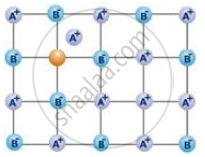
Schottky defect defines imperfection in the lattice structure of ____________.
Assertion: No compound has both Schottky and Frenkel defects.
Reason: Both defects change the density of the solid.
Assertion: Due to Frenkel defect, there is no effect on the density of the crystalline solid.
Reason: In Frenkel defect, no cation or anion leaves the crystal.
Cations are present in the interstitial sites in ______.
Schottky defect is observed in crystals when ______.
Which of the following defects is also known as dislocation defect?
Which of the following statements are not true?
(i) Vacancy defect results in a decrease in the density of the substance.
(ii) Interstitial defects results in an increase in the density of the substance.
(iii) Impurity defect has no effect on the density of the substance.
(iv) Frankel defect results in an increase in the density of the substance.
Which of the following defects decrease the density?
(i) Interstitial defect
(ii) Vacancy defect
(iii) Frankel defect
(iv) Schottky defect
Schottky defect is noticed in ______
Given below are two statements:
Statements I: Frenkel defects are vacancy as well as interstitial defects.
Statements II: Frenkel defect leads of colour in ionic solids due to the presence of F-centers.
Choose the most appropriate answer for the statements from the options given below:
Which type of ‘defect’ has the presence of cations in the interstitial sites?
