Advertisements
Advertisements
प्रश्न
Explain the following term with a suitable example:
Interstitials
Advertisements
उत्तर
- When certain constituent particles, such as atoms or molecules, occupy interstitial positions, we refer to a crystal as having an interstitial defect.
- As shown in the figure, the presence of interstitial particles increases the substance’s density.
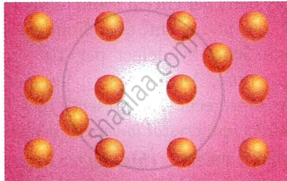
- Non-ionic solids exhibit interstitial flaws and vacancies.
- Ionic solids do not have simple vacancies or interstitial flaws as previously described because they must always maintain electrical neutrality.
- Rather, they display additional flaws referred to as Frenkel and Schottky faults.
- An example of interstitials is Carbon in Iron (Steel); Carbon atoms occupy interstitial sites in the iron lattice, making the metal stronger and harder.
संबंधित प्रश्न
Give reasons : In stoichiometric defects, NaCl exhibits Schottky defect and not Frenkel defect.
What type of defect is shown by NaCl in
stoichiometric defects, and
Out of NaCl and AgCl, which one shows Frenkel defect and why?
Answer the following question.
What type of stoichiometric defect is shown by ZnS and why?
Ionic solids containing large differences in sizes of ions show ____________.
Dislocation defect is also known as ____________.
Frenkel defects are not found in alkali metal halides because ____________.
Schottky defect defines imperfection in the lattice structure of ____________.
Which is not correct about the Schottky defects?
Alkali halids do not show Frenkel defect because ____________.
Which of the following crystals does not exhibit Frenkel defect?
In a Schottky defect ____________.
Schottky defect is observed in crystals when ______.
Which of the following point defects are shown by AgBr(s) crystals?
- Schottky defect
- Frenkel defect
- Metal excess defect
- Metal deficiency defect
Which of the following defects is also known as dislocation defect?
Which of the following statements are not true?
(i) Vacancy defect results in a decrease in the density of the substance.
(ii) Interstitial defects results in an increase in the density of the substance.
(iii) Impurity defect has no effect on the density of the substance.
(iv) Frankel defect results in an increase in the density of the substance.
Why is FeO (s) not formed in stoichiometric composition?
If NaCl is doped with 10–4 mole percent of SrCl2 the concentration of cation vacancies will be
