Advertisements
Advertisements
प्रश्न
Explain the following phrase selected from the story in your own word and work with a partner to make sentence using these phrase:
making up for lost time
Advertisements
उत्तर
The boy had to study two hours more every day to make up for the lost time.
APPEARS IN
संबंधित प्रश्न
As a member of the Student Council of you school, you wish to start an old clothes collection drive. These clothes are to be donate to an orphanage nearby. Write a proposal in not more than 150 words, stating the steps you would take to make it a seccess.
There are two pauses when Kaspar tells Wilhelmine in the last stanza that it was a famous victory. Nay … nay…my little girl, quoth he.What do these pauses show?
Fill in the blank with an appropriate word:
The poet's mother was stung __________ a scorpion.
Give reasons for the following.
The boy king changed his name from Tutankhaten to Tutankhamun.
A short report announcing the death of a person in a newspaper is called an 'obituary'. Where would you find the following
|
a citation |
an epitaph |
a glossary |
|
an abstract |
a postscript |
Find out the information about the qualification and eligibility required in the profession related to wild life such as:
Forest officer / Ranger
Your teacher will speak the words listed below. Write against each a word of opposite meaning.
Examples:
liquid-solid
hard-soft
1. old —————
2. wet —————
3. open —————
4. blunt —————
5. forget —————
Complete the following web diagram.

Match the following.
| Sr. No | A | B |
|
| 1. | Constitution | a. | It is the freedom to go where you want, do what you want, etc. |
| 2. | Liberty | b. | It is the state of being equal, especially in status, rights, or opportunities. |
| 3. | Equality | c. | It is a sense of common brotherhood. |
| 4. | Fraternity | d. | It is an aggregate of fundamental principles or established precedents that constitute the legal basis of a polity, organization, or other types of entity and commonly determine how that entity is to be governed. |
The feeling of a person when he commits a mistake are __________________.
- He tries to justify it.
- __________________
- __________________
- __________________
- _________________
Refer to a standard dictionary and find out the meaning of the following word:
Reporter
You have noticed that many of your classmates are not interested in outdoor games or participating in co-curricular activities. Discuss some ways in which they will be encouraged to participate in activities.
Consult the thesaurus and note down synonyms for 'ordinary'.
- One synonym of the ordinary is banal.
Eg. He finds English poetry very banal. - Similarly, find the meaning and make use of the words trite, routine, cliched, and regular in your own sentences.
‘..... and that’s how I realized that courage and hope can help me overcome any major mishap/problem in life.’ Write an episode/experience from your own life that leads to the above conclusion.
Write a short essay on the following.
My favourite sports event.
Read the script from:
| Joan (Girl) | Good morning, Captain squire ........... (up to) |
| Joan | (Simply) ............. Polly and Jack have promised to come with me. |
Write a summary of that part of the script (in Indirect speech) in 15 to 20 lines.
What are the themes of the singers’ songs?
Complete the paragraph with suitable words from the box.
| around, across, with, along, to, after, next to, into, from. |
One day, as I was walking ______ the bank of the river, I saw my friend running ______ the field. He was calling my name and waving ______ me. I stopped and waited. ______ sometime he reached where I was standing. He said, “I went all ______ the town looking for you. I have some exciting news to share ______ you. Do you remember the old house ______ the neem tree? Guess who is moving ______ that house? Janak Das, the great magician. Now we can learn lots of magic tricks ______ him.”
Have a conversation with your partner based on the picture below. You can start as -
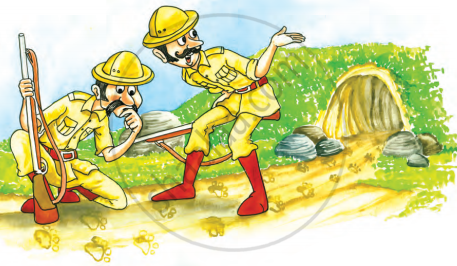
| Hunter 1 | “Look at the footprints in the mud!” |
| Hunter 2 | |
| Hunter 1 | |
| Hunter 2 |
Match the following and write complete sentences in the lines below.
| What was happening? | What happened? | |
| i | I was writing a letter. | the lights went out. |
| ii | Paul was looking out of the window | the bell rang. |
| iii | He was looking for his dog. | he noticed a lovely butterfly. |
| iv | I was just completing the last answer. | he fell off the ladder. |
| v | The man was painting the wall. | I met Arun. |
| vi | Amit was doing his homework. | my pen ran out. |
| vii | My mother was cooking dinner. | ma’am said, “Stop writing.” |
- I was writing a letter when ___________
- ________________
- *When I met Arun, he was looking for his dog.
- *_____________
- __________________
- _____________________
- _____________________
Punctuate the following sentence.
the dog wags its tail when its pleased but a cat waves its tail when its angry.
Who said these words and to whom?
| Who said | To whom | |
| “Wake up, dear! Wake up fast!” | ||
| “Ma, who woke me up today?” | ||
| “Why do you sleep at nine every night?” |
Answer the question by looking at the picture.
Example: What is happening in picture 5?

Find one word from the story that means
to think w ______.
Complete the following stories by using an appropriate word from the box given below –
| my, his, he, your |
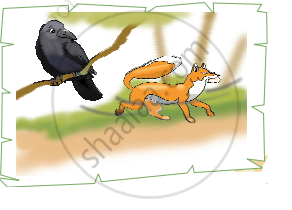
Sitting on a tree a crow was enjoying a piece of bread. A hungry fox wanted to have that bread. said very sweetly, “Dear brother, I've heard that ______ voice is very sweet. Please sing a song for me.” The foolish crow opened ______ beak and the piece of bread fell down. The fox picked it up in ______ mouth and ran away.
Some word have similar sound, but different meaning. Choose the correct word from the option and fill in the blank.
He is our school ______.
What were the strange instruments the nurse carried to the surgery? How did the waiting patients interpret her act?
Write slogan to create awareness of the following topic using the tips given above.
- Junk food
- Labour Day
- Save Water
- Yoga
- Blood Donation
Answer the following question as briefly as possible and with close reference to the relevant text.
How does Prospero prove, “the rarer action is in/virtue than in vengeance” in the final act of The Tempest?
Write the full form for the following.
wasn’t - ______
