Advertisements
Advertisements
प्रश्न
Do magnetic forces obey Newton’s third law. Verify for two current elements dl1 = dlî located at the origin and dl2 = dlĵ located at (0, R, 0). Both carry current I.
Advertisements
उत्तर
In this problem first, we have to find the direction of magnetic field due to one wire at the point on another wire, then the magnetic force on that current carrying wire.
According to Biot-Savart’s law, magnetic field B is parallel to idl × r and idl is the current carrying element having its direction along the direction of flow of current.
Here, for the direction of magnetic field, at dl2, located at (0, R, 0) due to wire dlx is given by B || idl × r or i × j (because point (0, R, 0) lies ony-axis), but i x j = k.
So, the direction of magnetic field at dl2 is along the z-direction.
The direction of magnetic force exerted at dl2 due to the magnetic field of first wire is along the x-axis.
F-i(l × B), i.e., F||(i × k) or along – j direction.
Therefore, force due to dl1 on dl2 is non-zero.
Now, for the direction of magnetic field, at dx, located at (0, 0, 0) due to wire d2 is given by B || idl × r or j × – j (because origin lies on y-direction w.r.t. point (0, R, 0), but j × – j = 0.
So, the magnetic field at dx does not exist.
Force due to dl2 on dl1, is zero.
So, magnetic forces do not obey Newton’s third law. But they obey Newton’s third law if current-carrying elements is placed parallel to each other.
APPEARS IN
संबंधित प्रश्न
Using the concept of force between two infinitely long parallel current carrying conductors, define one ampere of current.
Two long and parallel straight wires A and B carrying currents of 8.0 A and 5.0 A in the same direction are separated by a distance of 4.0 cm. Estimate the force on a 10 cm section of wire A.
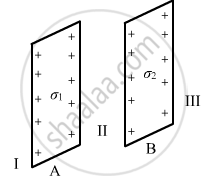
Two infinitely large plane thin parallel sheets having surface charge densities σ1 and σ2 (σ1 > σ2) are shown in the figure. Write the magnitudes and directions of the net fields in the regions marked II and III.
An electron beam projected along the positive x-axis deflects along the positive y-axis. If this deflection is caused by a magnetic field, what is the direction of the field? Can we conclude that the field is parallel to the z-axis?
A charged particle goes undeflected in a region containing an electric and a magnetic field. It is possible that
(a) `vecE" || "vecB , vecv" || " vec E `
(b) `vecE "is not parallel" vecB`
(c) `vecv " || " vecB but vecv "is not parallel"`
(d) `vecE" || " vecB but vecv "is not parallel"`
A long, straight wire carries a current along the z-axis, One can find two points in the x−y plane such that
(a) the magnetic fields are equal
(b) the directions of the magnetic fields are the same
(c) the magnitudes of the magnetic fields are equal
(d) the field at one point is opposite to that at the other point.
A long, straight wire of radius R carries a current distributed uniformly over its cross section. T he magnitude of the magnetic field is
(a) maximum at the axis of the wire
(b) minimum at the axis of the wire
(c) maximum at the surface of the wire
(d) minimum at the surface of the wire.
A current of 10 A is established in a long wire along the positive z-axis. Find the magnetic field \[\vec{B}\] at the point (1 m, 0, 0).
A copper wire of diameter 1.6 mm carries a current of 20 A. Find the maximum magnitude of the magnetic field `vecB` due to this current.
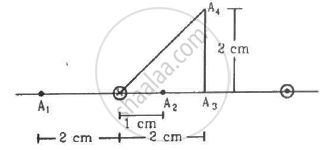
Figure shows two parallel wires separated by a distance of 4.0 cm and carrying equal currents of 10 A along opposite directions. Find the magnitude of the magnetic field B at the points A1, A2, A3.
Two long, straight wires, each carrying a current of 5 A, are placed along the x- and y-axis respectively. The currents point along the positive directions of the axes. Find the magnetic fields at the points (a) (1 m, 1 m), (b) (−1 m, 1 m), (c) (−1 m, −1 m) and (d) (1 m, −1 m).
Define Ampere in terms of force between two current carrying conductors.
Five long wires A, B, C, D and E, each carrying current I are arranged to form edges of a pentagonal prism as shown in figure. Each carries current out of the plane of paper.

- What will be magnetic induction at a point on the axis O? AxisE is at a distance R from each wire.
- What will be the field if current in one of the wires (say A) is switched off?
- What if current in one of the wire (say) A is reversed?
Two long parallel wires kept 2 m apart carry 3A current each, in the same direction. The force per unit length on one wire due to the other is ______.
Two long straight parallel current-carrying conductors are kept ‘a’ distant apart in the air. The direction of current in both the conductors is the same. Find the magnitude of force per unit length and the direction of the force between them. Hence define one ampere.
According to the definition of the ampere, the constant current maintained in each of two infinitely long, straight, parallel conductors of negligible circular cross-section, placed 1 metre apart in a vacuum, produces a force between them equal to:
The SI unit of the permeability of free space (μ₀) is:
The SI unit of the force per unit length (F/L) between two parallel current-carrying conductors is:
If the current Ia in conductor a is doubled while Ib and the distance d remain unchanged, the force per unit length F/L between the conductors:
