Advertisements
Advertisements
प्रश्न
Advertisements
उत्तर
Root Pressure is the pressure exerted on the liquid contents of the cortical cells of the root, under fully turgid condition, forcing a quantity of water into the xylem vessels and through them upwards into the stem up to a certain height.
Demonstration of Root pressure:

(a) Take a well matured healthy herbaceous plant.
(b) The stem of the plant is cut a few centimeters above the base with a sharp knife and attached to a manometer through a rubber tube.
(c) After a few hours, the level of mercury rises in the manometer.
(d) This is due to the pressure created by water exuded from the cut end of the plant on account of root pressure generated due to entry of water in the root cells.
APPEARS IN
संबंधित प्रश्न
Which one of the following is a characteristic NOT related with the suitability of the roots for absorbing water?
Match the items in column I with those in column II
| Column I | Column II | ||
| (a) | Xylem | (i) | semi - permeable |
| (b) | Phloem | (ii) | permeable |
| (c) | Cell membrane | (iii) | downward flow of sap |
| (d) | Root pressure | (iv) | upward flow of water |
| (e) | Cell wall | (v) | guttation |
What would happen to the root hair of a potted plant if the soil was watered with an extremely concentrated solution of sodium chloride?
Choose the correct answer:
The water is translocated upwards from the roots through _____________
What is toxicity ?
Grapes shrink when immersed in a very strong sugar solution.” Explain.
The diagram given below represents the result of an experiment conducted on two freshly taken shoots of a green herbaceous plant. The lower ends dip in the water.
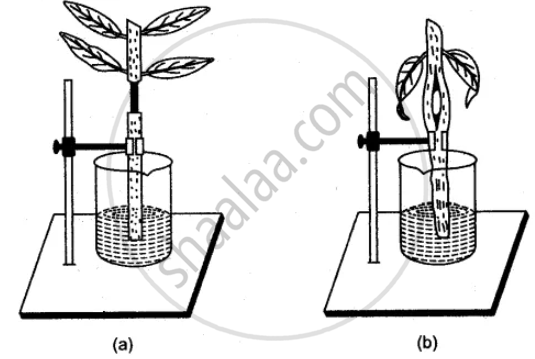
(i) What is the aim of the experiment?
(ii) Some parts of the stem in both the shoots have been removed. Name the conducting tissue in shoot A and in shoot B, that has been removed.
(iii) What are the results of this experiment?
Draw a neat and labelled diagram of the Root tip showing the root hair zone.
Epiphytic plants like orchids absorb water vapours from air with the help of epiphytic roots having special tissue called ____________.
____________plants like orchids absorb water vapours from air with the help of epiphytic roots having special tissue called velamen.
