Advertisements
Advertisements
प्रश्न
Advertisements
उत्तर
Plants die when salt is sprinkled over them due to plasmolysis of cells. The salt makes the solution hypertonic inside the plant cells which lead to shrinkage of cells or exosmosis.
APPEARS IN
संबंधित प्रश्न
Leaves of the sensitive plant wilt and droop down on a slight touch. What mechanism brings about this change?
Name the following:
Condition of cell in which the cell contents are shrunken.
Name the following:
Movement of molecules from a region of high concentration to a region of low concentration.
Choose the correct answer:
If a marine plant is transferred to fresh water, it bursts due to ___________
Mention whether the following statement is true (T) or false (F) and give explanation in support of your answer.
Plasmolysis is reverse of deplasmolysis.
Give at least three uses of water to green plants
The diagram below represents an experimental set up to demonstrate a vital process. Study the same and then answer the questions that follow:
(i) Name the process.
(ii) Define the above named process.
(iii) What would you observe in the experimental setup after an hour or so?
(iv) What control experiment can be set up for the above experiment?
(v) Keeping in mind the root hair cell and its surrounding name the part that corresponds to (1) Concentrated sugar solution, (2) Parchment paper, (3) Water in the beaker.
(vi) Name any other substance that can be used instead of parchment paper in the above experiment.
(vii) Mention two advantages of this process to the plant.
The beaker is divided into two chambers A and B. The big circle represents solute and the small circles solvent.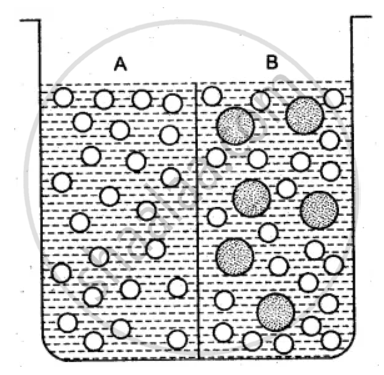
(i) What can you say about the size of the holes in the membrane, if it is to behave semi- permeably between these two?
(ii) Will the solvent molecules pass through the membrane from left to right, from right to left, in either direction or in both directions?
(iii) In which direction will there be a net movement of solvent molecules?
Name the following:
The process by which raisins swell up when placed in a beaker of water.
