Advertisements
Advertisements
प्रश्न
Give Reasons for the following.
Freshwater fish cannot survive in seawater.
Advertisements
उत्तर
The seawater is saline (having more concentration of salts) and acts as a hypertonic solution for the freshwater. So freshwater fish cannot survive in seawater as it causes the plasmolysis of the cells of the fish and ultimately the fish will die.
संबंधित प्रश्न
Give the appropriate biological or technical term for the following.
Movement of molecules of a substance from their higher concentration to lower concentration when they are in direct contact.
Distinguish between the following:
Filtration and diffusion
Explain why:
The leaves of wilted lettuce, if kept in cold water, become crisp.
What is the significance of diffusion?
Give Reasons for the following.
It is necessary to maintain a normal osmotic concentration of the blood.
Give Reasons for the following.
On sprinkling common salt on grass growing in a lawn, the grass is killed.
The beaker is divided into two chambers A and B. The big circle represents solute and the small circles solvent.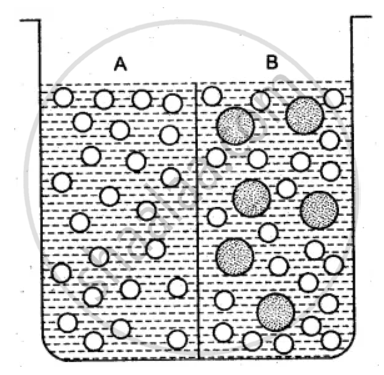
(i) What can you say about the size of the holes in the membrane, if it is to behave semi- permeably between these two?
(ii) Will the solvent molecules pass through the membrane from left to right, from right to left, in either direction or in both directions?
(iii) In which direction will there be a net movement of solvent molecules?
Give Technical Term for the following.
Solutions which have the same osmotic pressure.
Mention, if the following statement is True or False. If false rewrite the wrong statement in its correct form:
During exosmosis, water moves from inside the cell to the outside of the cell.
The given statement is incorrect. Rewrite the correct statement:
Fresh water fish when placed in hypertonic salt solution absorb water and burst.
