Advertisements
Advertisements
प्रश्न
Advertisements
उत्तर
Plants die when salt is sprinkled over them due to plasmolysis of cells. The salt makes the solution hypertonic inside the plant cells which lead to shrinkage of cells or exosmosis.
APPEARS IN
संबंधित प्रश्न
Give the appropriate biological or technical term for the following.
Movement of molecules of a substance from their higher concentration to lower concentration when they are in direct contact.
Name the following:
The condition of a cell placed in a hypotonic solution.
Complete the following statements:
Hypotonic solution is one in which the solution kept outside the cell has lower solute concentration than ……………… the cell.
Show by a series of diagrams, the change which a plant cell will undergo when placed in
Hypotonic salt solution
Name the following:
Two solutions having same concentrations.
Two potato cubes each 1 cm3 in size, were placed separately in two containers (A and B), the container A having water and the other (B) containing concentrated sugar solution. After 24 hours when the cubes were examined, those placed in water were found to be firm and had increased slightly in size and those placed in concentrated sugar solution were found to be soft and somewhat decreased in size. Use the above information to answer the questions that follow:
Name and define the physical process being investigated in this experiment.
The diagram given below is of an experiment just at the start. Study the diagram carefully and answer the following questions :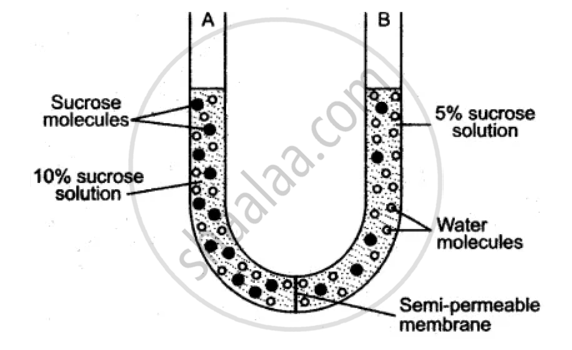
(i) What does the experiment demonstrate?
(ii) Define, the process demonstrated in the experiment.
(iii) What changes are observed after a few hours?
(iv) Give two examples of a semi-permeable membrane.
(v) Which limb of the U-tube contains a more concentrated sucrose solution, A or B?
(vi) Why is the membrane separating the two solutions labeled as semi-permeable membrane?
In an experiment, two sets of apparatus were set up as shown below:
In A there is a concentrated sugar solution inside the thistle funnel and red ink in the water outside the funnel. In B there is a concentrated glucose solution with red ink inside the thistle funnel and water outside the thistle funnel.
In both A and B the level of liquid inside the funnels rises up the tubes. In A the sugar solution turns red and in B, the water turns red.
Study the given observations and answer these questions:

- Name the process by which red ink moves in A and B.
- Which type of pressure forces the water molecules to move towards thistle funnels and cause a rise in the water level?
- Where does this process occur in plants and animals?
- What material could be used as a semi-permeable membrane?
Give Technical Term for the following.
A solution whose concentration is equal to the cell sap.
The given statement is incorrect. Rewrite the correct statement:
Fresh water fish when placed in hypertonic salt solution absorb water and burst.
