Advertisements
Advertisements
प्रश्न
A thin strip of epidermal cells from the fleshy scales of an onion bulb was examined in a drop of water, under a microscope. All the epidermal cells looked alike and the figure alongside represents one of them. The thin strip was then transferred to a drop of strong sugar solution and re-examined under the microscope after about five minutes.

(i) Make a sketch of one of the epidermal cells, as it might appear after immersion in a strong sugar solution. Label any two parts which have undergone a change.
(ii) Give the scientific term for the change shown in Q.(i) above.
(iii) What would you do to bring this cell back to its original condition?
(iv) Give the scientific term used for the recovery of the cell as a result of the step taken in Q.(iii) above.
Advertisements
उत्तर
(i) See figure.

(ii) Plasmolysis.
(iii) We would immerse this cell into freshwater, i.e., hypotonic solution.
(iv) Deplasmolysis.
संबंधित प्रश्न
the exact location of the Lenticels
Explain the mechanism of closing and opening of the stomata.
Mention whether the following statement is true (T) or false (F) and give an explanation in support of your answer.
If the phloem of a twig is removed keeping the xylem intact, the leaves of a twig wilt.
Grapes shrink when immersed in a very strong sugar solution.” Explain.
A few RBC’s were kept in three test tubes containing isotonic, hypotonic and hypertonic solutions. What will be the expected observations after a few hours? Explain.
The below figure shows a root hair: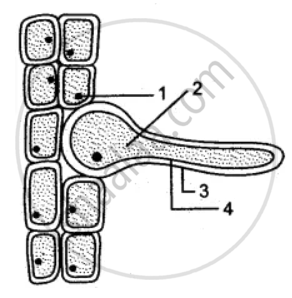
(i) Label the parts 1 to 4.
(ii) What is the role of part 4?
(iii) Why is the root hair one-celled?
(iv) What will happen to the root hair if some fertilizer is added to the soil near the root hair?
Name the following:
The solution outside the cell having lower solute concentration than the fluids.
Multiple Choice Question:
Water will be absorbed by the root hairs when:
Part of the root that absorbs water from the soil is ______.
Draw a neat and proportionate diagram of root hair and label mitochondria, nucleus and vacuole.
