Advertisements
Advertisements
प्रश्न
Mention whether the following statement is true (T) or false (F) and give an explanation in support of your answer.
If the phloem of a twig is removed keeping the xylem intact, the leaves of a twig wilt.
विकल्प
True
False
Advertisements
उत्तर
This statement is false.
Explanation:
The leaves of the twig remain turgid since its xylem is intact and xylem is responsible for water conduction in plants.
APPEARS IN
संबंधित प्रश्न
State whether the following statement is true or false. Rewrite the false statement correctly.
Water absorption mainly occurs through the root-hair.
Name the following:
The process by which water enters root hairs.
Study the diagram given below and answer the questions that follow:

- Name the process being studied in the above experiment.
- Explain the process mentioned in (a) above
- Why is oil placed over water?
- What do we observe with regard to the level of water when this set-up is placed in (1) bright sunlight, (2) humid conditions and (3) windy days?
- Mention any three adaptations found in plants to foster the process mentioned in (a) above
What would happen to the root hair of a potted plant if the soil was watered with an extremely concentrated solution of sodium chloride?
Three plants (a), (b) and (c) were placed in beakers containing coloured water. The water in each beaker was covered with a layer of oil. The leaves were removed from plant (b), while plant (c) was exposed to strong light.
(i) In which plant, (a), (b) or (c) would the water move up the fastest?
(ii) In which plant (a), (b) or (c), would the water move up slowly?
(iii) Why was the water covered with a layer of oil?
(iv) What is being investigated by this experiment?

Choose the correct answer:
Swelling of wooden doors during rains is caused by ___________
The diagram below represents a layer of epidermal cells showing a fully grown root hair. Study the diagram and answer the questions that follow:

Mention one distinct difference between the parts labelled A and B.
The alongside diagram A shows a root hair growing through the soil particles. Diagram B is the root hair of an aquatic plant.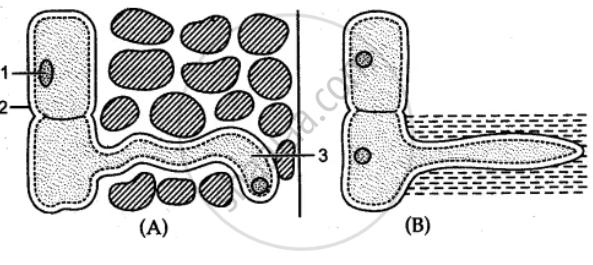
(i) Name the parts 1,2,3.
(ii) Name two substances which enter the root hair. What are their uses?
(iii) By what process do these substances enter the root hair?
(iv) Account for the different shapes of root hairs in the two diagrams.
Mention, if the following statement is True or False. If false rewrite the wrong statement in its correct form:
Xylem is the water-conducting tissue in plants.
How many regions are there in a typical root?
