Advertisements
Advertisements
प्रश्न
Balance the following ionic equations.
\[\ce{Cr2O^{2-}7 + H^{+} + I- -> Cr^{3+} + I2 + H2O}\]
Advertisements
उत्तर
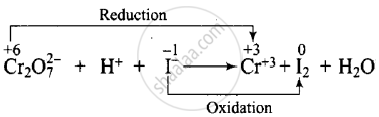
Dividing the equation into two half-reactions:
Oxidation half-reaction: \[\ce{I- -> I2}\]
Reduction half-reaction: \[\ce{CrO7^{2-} -> Cr^{3+}}\]
Balancing oxidation and reduction half-reactions separately as:
Oxidation half-reaction:
\[\ce{I- -> I2}\]
\[\ce{2I- -> I2}\]
\[\ce{2I- -> I2 + 2e-}\] ......(i)
Reduction half-reaction:
\[\ce{CrO^{2-}7 -> Cr^{3+}}\]
\[\ce{Cr2O^{2-}7 -> 2Cr^{3+}}\]
\[\ce{Cr2O^{2-}7 + 6e- -> 2Cr^{3+}}\]
\[\ce{Cr2O^{2-}7 + 14H^{+} + 6e- -> \underset{(acidic medium)}{2Cr^{3+} + 7H2O}}\] .....(ii)
To balance the electrons, multiply equation (i) by 3 and add to equation (ii)
\[\ce{Cr2O^{2-}7 + 14H^{+} + 6I- -> 2Cr^{3+} + 3I2 + 7H2O}\]
APPEARS IN
संबंधित प्रश्न
Balance the following equation in basic medium by ion-electron method and oxidation number methods and identify the oxidising agent and the reducing agent.
\[\ce{P4(s) + OH–(aq) —> PH3(g) + HPO^–_2(aq)}\]
Chlorine is used to purify drinking water. Excess of chlorine is harmful. The excess of chlorine is removed by treating with sulphur dioxide. Present a balanced equation for this redox change taking place in water.
Balance the following reaction by oxidation number method.
\[\ce{Cr2O^2-_{7(aq)} + SO^2-_{3(aq)}->Cr^3+_{ (aq)} + SO^2-_{4(aq)}(acidic)}\]
Balance the following redox equation by half-reaction method.
\[\ce{H2C2O_{4(aq)} + MnO^-_{4(aq)}->CO2_{(g)} + Mn^2+_{( aq)}(acidic)}\]
Identify coefficients 'x' and 'y' for the following reaction.
\[\ce{{x}H2O2_{(aq)} + ClO^-_{4(aq)} -> 2O2_{(g)} + ClO^-_{2(aq)} + {y}H2O_{(l)}}\]
What is the change in oxidation number of Sulphur in following reaction?
\[\ce{MnO^-_{4(aq)} + SO^{2-}_{3(aq)} -> MnO^{2-}_{4(aq)} + SO^{2-}_{4(aq)}}\]
Identify the oxidising agent in the following reaction:
\[\ce{CH4_{(g)} + 2O2_{(g)} -> CO2_{(g)} + 2H2O_{(l)}}\]
Consider the reaction:
\[\ce{6 CO2(g) + 6H2O(l) → C6 H12O6(aq) + 6O2(g)}\]
Why it is more appropriate to write these reaction as:
\[\ce{6CO2(g) + 12H2O(l) → C6 H12O6(aq) + 6H2O(l) + 6O2(g)}\]
Also, suggest a technique to investigate the path of the redox reactions.
Write balanced chemical equation for the following reactions:
Dichlorine heptaoxide \[\ce{(Cl2O7)}\] in gaseous state combines with an aqueous solution of hydrogen peroxide in acidic medium to give chlorite ion \[\ce{(ClO^{-}2)}\] and oxygen gas. (Balance by ion-electron method)
Identify the redox reactions out of the following reactions and identify the oxidising and reducing agents in them.
\[\ce{HgCl2 (aq) + 2KI (aq) -> HgI2 (s) + 2KCl (aq)}\]
Identify the redox reactions out of the following reactions and identify the oxidising and reducing agents in them.
\[\ce{PCl3 (l) + 3H2O (l) -> 3HCl (aq) + H3PO3 (aq)}\]
In acidic medium, reaction, \[\ce{MNO^-_4 → Mn^2+}\] an example of ____________.
In the reaction of oxalate with permanganate in an acidic medium, the number of electrons involved in producing one molecule of CO2 is ______.
Consider the following reaction:
\[\ce{xMnO^-_4 + yC2O^{2-}_4 + zH^+ -> xMn^{2+} + 2{y}CO2 + z/2H2O}\]
The values of x, y, and z in the reaction are, respectively:
\[\ce{H2O2 -> 2H^+ + O2 + 2e^-}\]; E0 = −0.68 V.
This equation represents which of the following behaviour of H2O2?
On balancing the given redox reaction,
\[\ce{aCr2O7^2- + Bso3^2- (aq) + CH+ (aq) -> 2aCr^3+ (aq) + bSO4^2- (aq) + c(H2O(1)/2}\]
the coefficients a, b and c are found to be, respectively:
