Advertisements
Advertisements
प्रश्न
Balance the following equation in basic medium by ion-electron method and oxidation number methods and identify the oxidising agent and the reducing agent.
\[\ce{Cl_2O_{7(g)} + H_2O_{2(aq)} -> ClO-_{2(aq)} + O_{2(g)} + H+_{(aq)}}\]
Advertisements
उत्तर
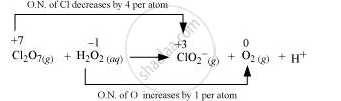
The oxidation number of Cl decreases from + 7 in Cl2O7 to + 3 in `"ClO"_2^-` and the oxidation number of O increases from – 1 in H2O2 to zero in O2. Hence, in this reaction, Cl2O7 is the oxidizing agent and H2O2 is the reducing agent.
Ion–electron method:
The oxidation half equation is:
\[\ce{H2 ^{-1}O_{2(g)} -> ^{0}O_{2(g)}}\]
The oxidation number is balanced by adding 2 electrons as:
\[\ce{H_2O_{2(aq)} -> O_{2(g)} + 2e-}\]
The charge is balanced by adding 2OH– ions as:
\[\ce{H_2O_{2(aq)} -> + 2OH-_{(aq)} -> O_{2(g)} + 2e-}\]
The oxygen atoms are balanced by adding 2H2O as:
\[\ce{H_2O_{2(aq)} + 2OH-_{(aq)} -> O_{2(g)} + 2H_2O_{(l)} + 2e-}\] ....(i)
The reduction half equation is:
\[\ce{^{+7}Cl2O_{7(g)} -> ^{+3}ClO-_{2(aq)}}\]
The Cl atoms are balanced as:
\[\ce{Cl2O_{7(g)} -> 2ClO-_{2(aq)}}\]
The oxidation number is balanced by adding 8 electrons as:
\[\ce{Cl2O_{7(g)} + 8e- -> 2ClO-_{2(aq)}}\]
The charge is balanced by adding 6OH– as:
\[\ce{Cl_2O_{7(g)} + 8e- -> 2ClO-_{2(aq)} + 6OH-_{(aq)}}\]
The oxygen atoms are balanced by adding 3H2O as:
\[\ce{Cl_2O_{7(g)} + 3H_2O_{(l)} 8e- -> 2ClO-_{2(aq)} + 6OH-_{(aq)}}\] (ii)
The balanced equation can be obtained by multiplying equation (i) with 4 and adding equation (ii) to it as:
\[\ce{Cl_2O_{7(g)} + 4H_2O_{2(aq)} + 2OH-_{aq)} -> 2ClO-_{2(aq)} + 4O_{2(g)} + 5H_2O_{(l)}}\]
Oxidation number method:
Total decrease in oxidation number of Cl2O7 = 4 × 2 = 8
Total increase in oxidation number of H2O2 = 2 × 1 = 2
By multiplying H2O2 and O2 with 4 to balance the increase and decrease in the oxidation number, we get:
\[\ce{Cl_2O_{7(g)} + 4H_2O_{2(aq)} -> ClO-_{2(aq)} + 4O_{2(g)}}\]
The Cl atoms are balanced as:
\[\ce{Cl_2O_{7(g)} + 4H_2O_{2(aq)} -> 2ClO-_{2(aq)}+ 4O_{2(g)}}\]
The O atoms are balanced by adding 3H2O as:
\[\ce{Cl_2O_{7(g)} + 4H_2O_{2(aq)} -> 2ClO-_{2(aq)} + 4O_{2(g)} + 3H_2O_{(l)}}\]
The H atoms are balanced by adding 2OH– and 2H2O as:
\[\ce{Cl_2O_{7(g)} + 4H_2O_{2(aq)} + 2OH-_{(aq)} -> 2ClO-_{2(aq)} + 4O_{2(g)} + 5H_2O_{(l)}}\]
This is the required balanced equation.
APPEARS IN
संबंधित प्रश्न
Balance the following redox reactions by ion-electron method:
- \[\ce{MnO-_4 (aq) + I– (aq) → MnO2 (s) + I2(s) (in basic medium)}\]
- \[\ce{MnO-_4 (aq) + SO2 (g) → Mn^{2+} (aq) + HSO-_4 (aq) (in acidic solution)}\]
- \[\ce{H2O2 (aq) + Fe^{2+} (aq) → Fe^{3+} (aq) + H2O (l) (in acidic solution)}\]
- \[\ce{Cr_2O^{2-}_7 + SO2(g) → Cr^{3+} (aq) + SO^{2-}_4 (aq) (in acidic solution)}\]
The Mn3+ ion is unstable in solution and undergoes disproportionation to give Mn2+, MnO2, and H+ ion. Write a balanced ionic equation for the reaction.
Balance the following reaction by oxidation number method.
\[\ce{Cr2O^2-_{7(aq)} + SO^2-_{3(aq)}->Cr^3+_{ (aq)} + SO^2-_{4(aq)}(acidic)}\]
Balance the following reaction by oxidation number method.
\[\ce{H2SO4_{(aq)} + C_{(s)} -> CO2_{(g)} + SO2_{(g)} + H2O_{(l)}(acidic)}\]
Balance the following reaction by oxidation number method.
\[\ce{Bi(OH)_{3(s)} + Sn(OH)^-_{3(aq)}->Bi_{(s)} + Sn(OH)^2-_{6(aq)}(basic)}\]
Balance the following redox equation by half-reaction method.
\[\ce{Bi(OH)_{3(s)} + SnO^2-_{2(aq)}->SnO^2-_{3(aq)} + Bi^_{(s)}(basic)}\]
Which of the following is INCORRECT for the following reaction?
\[\ce{2Zn_{(s)} + O2_{(g)} -> 2ZnO_{(s)}}\]
Which of the following is a redox reaction?
Consider the reaction:
\[\ce{6 CO2(g) + 6H2O(l) → C6 H12O6(aq) + 6O2(g)}\]
Why it is more appropriate to write these reaction as:
\[\ce{6CO2(g) + 12H2O(l) → C6 H12O6(aq) + 6H2O(l) + 6O2(g)}\]
Also, suggest a technique to investigate the path of the redox reactions.
Write balanced chemical equation for the following reactions:
Permanganate ion \[\ce{(MnO^{-}4)}\] reacts with sulphur dioxide gas in acidic medium to produce \[\ce{Mn^{2+}}\] and hydrogen sulphate ion.
Write balanced chemical equation for the following reactions:
Dichlorine heptaoxide \[\ce{(Cl2O7)}\] in gaseous state combines with an aqueous solution of hydrogen peroxide in acidic medium to give chlorite ion \[\ce{(ClO^{-}2)}\] and oxygen gas. (Balance by ion-electron method)
Balance the following equations by the oxidation number method.
\[\ce{Fe^{2+} + H^{+} + Cr2O^{2-}7 -> Cr^{3+} + Fe^{3+} + H2O}\]
Balance the following equations by the oxidation number method.
\[\ce{I2 + S2O^{2-}3 -> I- + S4O^{2-}6}\]
Identify the redox reactions out of the following reactions and identify the oxidising and reducing agents in them.
\[\ce{3HCl (aq) + HNO3 (aq) -> Cl2 (g) + NOCl (g) + 2H2O (l)}\]
Identify the redox reactions out of the following reactions and identify the oxidising and reducing agents in them.
\[\ce{HgCl2 (aq) + 2KI (aq) -> HgI2 (s) + 2KCl (aq)}\]
Identify the redox reactions out of the following reactions and identify the oxidising and reducing agents in them.
\[\ce{4NH3 (g) + 3O2 (g) -> 2N2 (g) + 6H2O (g)}\]
Balance the following ionic equations.
\[\ce{MnO^{-}4 + SO^{2-}3 + H^{+} -> Mn^{2+} + SO^{2-}4 + H2O}\]
In acidic medium, reaction, \[\ce{MNO^-_4 → Mn^2+}\] an example of ____________.
