Advertisements
Advertisements
प्रश्न
Calculate the oxidation number of sulphur, chromium and nitrogen in H2SO5, `"Cr"_2"O"_7^(2-)` and `"NO"_3^-`. Suggest structure of these compounds. Count for the fallacy.
Advertisements
उत्तर
1)
+1 x -2
\[\ce{H2SO5}\]
2(+1) + 1(x) + 5(-2) = 0
⇒ 2 + x - 10 = 0
⇒ x = + 8
However, the O.N. of S cannot be +8. S has six valence electrons. Therefore, the O.N. of S cannot be more than +6.
The structure of H2SO5 is shown as follows:
\[\begin{array}{cc}
\ce{^{-2}O}\phantom{...........}\\
||\phantom{.........}\\
\ce{^{+1}H - ^{-2}O - S^{\text{x}} - ^{-1}O - ^{-1}O - ^{+1}H}\\
||\phantom{.........}\\
\ce{^{-2}O}\phantom{............}\end{array}\]
Now, 2(+1) + 1(x) + 3(-2) + 2(-1) = 0
⇒ 2 + x - 6 - 2 = 0
⇒ x = +6
Therefore, the O.N. of S is +6.
2)
x 2-
\[\ce{Cr2 O^{2-}_7}\]
2(x) + 7(-2) = -2
⇒ 2x - 14 = -2
⇒ x = +6
Here, there is no fallacy about the O.N. of Cr in `"Cr"_2"O"_7^(2-)`.
The structure of `"Cr"_2"O"_7^(2-)` is shown as follows:
\[\begin{array}{cc}
\ce{^{2-}O}\phantom{...........}\ce{^{2-}O}\phantom{....}\\
||\phantom{..............}||\phantom{..}\\
\ce{^{2-}O = Cr^{+6} - ^{2-}O - Cr^{+6} - O^{2-}}\\
|\phantom{..............}|\phantom{...}\\
\ce{_{1-}O^-}\phantom{.........}\ce{_{1-}O^-}\phantom{....}\end{array}\]
Here, each of the two Cr atoms exhibits the O.N. of +6.
3)
x 2-
\[\ce{N O^-_3}\]
1(x) + 3(-2) = -1
⇒ x - 6 = -1
⇒ x = +5
Here, there is no fallacy about the O.N. of N in `"NO"_3^(-)`
The structure of `"NO"_3^(-)` is shown as follows
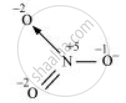
The N atom exhibits the O.N. of +5.
APPEARS IN
संबंधित प्रश्न
How do you count for the following observations?
Though alkaline potassium permanganate and acidic potassium permanganate both are used as oxidants, yet in the manufacture of benzoic acid from toluene we use alcoholic potassium permanganate as an oxidant. Why? Write a balanced redox equation for the reaction.
In Ostwald’s process for the manufacture of nitric acid, the first step involves the oxidation of ammonia gas by oxygen gas to give nitric oxide gas and steam. What is the maximum weight of nitric oxide that can be obtained starting only with 10.00 g. of ammonia and 20.00 g of oxygen?
Choose the correct option.
For the following redox reactions, find the correct statement.
\[\ce{Sn^{2⊕} + 2Fe^{3⊕}->Sn^{4⊕} + 2Fe^{2⊕}}\]
Balance the following reaction by oxidation number method.
\[\ce{Cr2O^2-_{7(aq)} + SO^2-_{3(aq)}->Cr^3+_{ (aq)} + SO^2-_{4(aq)}(acidic)}\]
Balance the following reaction by oxidation number method.
\[\ce{MnO^-_{4(aq)} + Br^-_{ (aq)}->MnO2_{ (s)} + BrO^-_{3(aq)}(basic)}\]
Balance the following redox equation by half-reaction method.
\[\ce{H2C2O_{4(aq)} + MnO^-_{4(aq)}->CO2_{(g)} + Mn^2+_{( aq)}(acidic)}\]
Which of the following is INCORRECT for the following reaction?
\[\ce{2Zn_{(s)} + O2_{(g)} -> 2ZnO_{(s)}}\]
Identify coefficients 'x' and 'y' for the following reaction.
\[\ce{{x}H2O2_{(aq)} + ClO^-_{4(aq)} -> 2O2_{(g)} + ClO^-_{2(aq)} + {y}H2O_{(l)}}\]
What is the change in oxidation number of Sulphur in following reaction?
\[\ce{MnO^-_{4(aq)} + SO^{2-}_{3(aq)} -> MnO^{2-}_{4(aq)} + SO^{2-}_{4(aq)}}\]
Balance the following equations by the oxidation number method.
\[\ce{I2 + NO^{-}3 -> NO2 + IO^{-}3}\]
Balance the following equations by the oxidation number method.
\[\ce{I2 + S2O^{2-}3 -> I- + S4O^{2-}6}\]
Identify the redox reactions out of the following reactions and identify the oxidising and reducing agents in them.
\[\ce{3HCl (aq) + HNO3 (aq) -> Cl2 (g) + NOCl (g) + 2H2O (l)}\]
Identify the redox reactions out of the following reactions and identify the oxidising and reducing agents in them.
\[\ce{PCl3 (l) + 3H2O (l) -> 3HCl (aq) + H3PO3 (aq)}\]
Identify the redox reactions out of the following reactions and identify the oxidising and reducing agents in them.
\[\ce{4NH3 (g) + 3O2 (g) -> 2N2 (g) + 6H2O (g)}\]
Balance the following ionic equations.
\[\ce{Cr2O^{2-}7 + Fe^{2+} + H+ -> Cr^{3+} + Fe^{3+} + H2O}\]
The weight of CO is required to form Re2(CO)10 will be ______ g, from 2.50 g of Re2O7 according to given reaction
\[\ce{Re2O7 + CO -> Re2(CO)10 + CO2}\]
Atomic weight of Re = 186.2; C = 12 and O = 16.
\[\ce{H2O2 -> 2H^+ + O2 + 2e^-}\]; E0 = −0.68 V.
This equation represents which of the following behaviour of H2O2?
