Advertisements
Advertisements
प्रश्न
Answer in brief.
Explain one application of electromagnet.
Advertisements
उत्तर
Electromagnets are used for various purposes on a day to day basis. For example, electromagnets are used in the large cranes which are used in waste yards. Electromagnets are also widely used in numerous electromechanical and electronic devices. Some of the common uses are given below.
- Uses in Home Appliances: Most of the electric appliances used in the home use electromagnetism as the basic working principle. Some electromagnet uses in the home include the electric fan, electric doorbell, induction cooker, magnetic locks, etc. In an electric fan, the electromagnetic induction keeps the motor rotating on and on making the blade of the fan to rotate. Also in an electric doorbell when the button is pressed, due to the electromagnetic forces the coil gets energized and the bell sounds.
- Uses in Medical Field: The uses of electromagnets are also seen in the medical field. MRI scan which is short for Magnetic Resonance Imaging is a device that uses electromagnets. The device can scan all the tiny details in the human body with the help of electromagnetism.
-
Uses in Memory Storage Devices and Computer Hardware: The data in ebook gadgets and phones are stored in the electromagnetic format in the form of bytes and bits. The computer hardware is also having a magnetic tape which works on the principle of electromagnetism. Even in the olden days’ electromagnets had a huge role in the data storage of VCP and VCR.
APPEARS IN
संबंधित प्रश्न
What are permanent magnets? Give one example ?
Write two characteristics of a material used for making permanent magnets ?
Why is the core of an electromagnet made of ferromagnetic materials?
A tangent galvanometer is connected directly to an ideal battery. If the number of turns in the coil is doubled the deflection will
If the current is doubled, the deflection is also doubled in
A very long bar magnet is placed with its north pole coinciding with the centre of a circular loop carrying as electric current i. The magnetic field due to the magnet at a point on the periphery of the wire is B. The radius of the loop is a. The force on the wire is
Two long bare magnets are placed with their axes coinciding in such a way that the north pole of the first magnet is 2.0 cm from the south pole of the second. If both the magnets have a pole strength of 10 Am, find the force exerted by one magnet of the other.
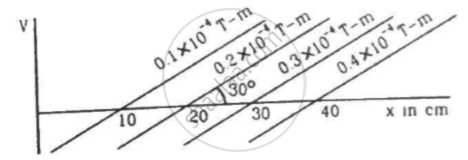
Figure shows some of the equipotential surfaces of the magnetic scalar potential. Find the magnetic field B at a point in the region.
A bar magnet has a length of 8 cm. The magnetic field at a point at a distance 3 cm from the centre in the broadside-on position is found to be `4 xx 10^-6 "T"`.Find the pole strength of the magnet.
Why is it not possible to make permanent magnets from paramagnetic materials?
The magnetic moment of the assumed dipole at the earth's centre is 8.0 × 10²² A m2. Calculate the magnetic field B at the geomagnetic poles of the earth. Radius of the earth is 6400 km.
A moving-coil galvanometer has a 50-turn coil of size 2 cm × 2 cm. It is suspended between the magnetic poles producing a magnetic field of 0.5 T. Find the torque on the coil due to the magnetic field when a current of 20 mA passes through it.
A short magnet produces a deflection of 37° in a deflection magnetometer in Tan-A position when placed at a separation of 10 cm from the needle. Find the ratio of the magnetic moment of the magnet to the earth's horizontal magnetic field.
The magnetometer of the previous problem is used with the same magnet in Tan-B position. Where should the magnet be placed to produce a 37° deflection of the needle?
A deflection magnetometer is placed with its arms in north-south direction. How and where should a short magnet having M/BH = 40 A m2 T−1 be placed so that the needle can stay in any position?
A bar magnet takes π/10 second the complete one oscillation in an oscillation magnetometer. The moment of inertia of the magnet about the axis of rotation is 1.2 × 10⁻⁴ kg m2 and the earth's horizontal magnetic field is 30 μT. Find the magnetic moment of the magnet.
The combination of two bar magnets makes 10 oscillations per second in an oscillation magnetometer when like poles are tied together and 2 oscillations per second when unlike poles are tied together. Find the ratio of the magnetic moments of the magnets. Neglect any induced magnetism.
A short magnet oscillates in an oscillation magnetometer with a time period of 0.10 s where the earth's horizontal magnetic field is 24 μT. A downward current of 18 A is established in a vertical wire placed 20 cm east of the magnet. Find the new time period.
A bar magnet makes 40 oscillations per minute in an oscillation magnetometer. An identical magnet is demagnetized completely and is placed over the magnet in the magnetometer. Find the time taken for 40 oscillations by this combination. Neglect any induced magnetism.
A short magnet makes 40 oscillations per minute when used in an oscillation magnetometer at a place where the earth's horizontal magnetic field is 25 μT. Another short magnet of magnetic moment 1.6 A m2 is placed 20 cm east of the oscillating magnet. Find the new frequency of oscillation if the magnet has its north pole (a) towards north and (b) towards south.
Soft iron is used to make the core of the transformer because of its ______.
Which property of soft iron makes it useful for preparing electromagnet?
The relation b/w magnetic susceptibility xm and relativ~ permeability µr is
A wire of length 2 m carrier of lamp is bend to form a circle. The magnetic moment of a coil is :-
Which magnetic properties are desirable for making a permanent magnet?
