Advertisements
Advertisements
प्रश्न
State two advantages of an electromagnet over a permanent magnet.
Advertisements
उत्तर
- An electromagnet can produce a strong magnetic field.
- The strength of the magnetic field of an electromagnet can easily be changed by changing the current in its solenoid.
APPEARS IN
संबंधित प्रश्न
Magnetic scalar potential is defined as `U(vec r_2) - U(vec r_1) = - ∫_vec(r_1)^vec(r_2)` `vec (B) . dvec(l)`
Apply this equation to a closed curve enclosing a long straight wire. The RHS of the above equation is then `-u_0 i` by Ampere's law. We see that `U(vec(r_2)) ≠ U(vec(r_1))` even when `vec r_2 =vec r_1` .Can we have a magnetic scalar potential in this case?
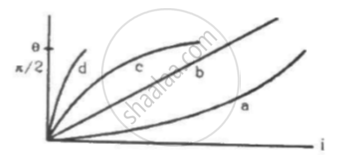
Which of the following four graphs may best represent the current-deflection relation in a tangent galvanometer?
A uniform magnetic field of `0.20 xx 10^-3 "T"` exists in the space. Find the change in the magnetic scalar potential as one moves through 50 cm along the field.
The coercive force for a certain permanent magnet is 4.0 × 10⁴ A m−1. This magnet is placed inside a long solenoid of 40 turns/cm and a current is passed in the solenoid to demagnetise it completely. Find the current.
The magnetic moment of the assumed dipole at the earth's centre is 8.0 × 10²² A m2. Calculate the magnetic field B at the geomagnetic poles of the earth. Radius of the earth is 6400 km.
The magnetometer of the previous problem is used with the same magnet in Tan-B position. Where should the magnet be placed to produce a 37° deflection of the needle?
A bar magnet makes 40 oscillations per minute in an oscillation magnetometer. An identical magnet is demagnetized completely and is placed over the magnet in the magnetometer. Find the time taken for 40 oscillations by this combination. Neglect any induced magnetism.
A thin diamagnetic rod is placed vertically between the poles of an electromagnet. When the current in the electromagnet is switched on, then the diamagnetic rod is pushed up, out of the horizontal magnetic field. Hence the rod gains gravitational potential energy. The work required to do this comes from ______.
Assertion: Electromagnetic are made of soft iron.
Reason: Coercivity of soft iron is small.
Which of the following is most suitable for the core of an electromagnet?
