Advertisements
Advertisements
प्रश्न
Account for the following.
Ethylamine is soluble in water whereas aniline is not.
State reasons for the following:
Ethylamine is soluble in water whereas aniline is insoluble in water.
Advertisements
उत्तर १
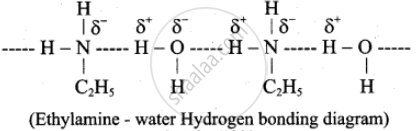
Ethylamine, when added to water, forms intermolecular H-bonds with water and therefore it is soluble in water. But aniline does not form an H-bond with water to a very large extent due to the presence of a large hydrophobic –C6H5 group. Hence, aniline is insoluble in water.
उत्तर २
Ethylamine (C2H5NH2) exhibits solubility in water because the –NH group effectively forms hydrogen bonds with water molecules, due to the increased electron density on the nitrogen atom resulting from the +I inductive effect of the –C2H5 group. Also, the hydrocarbon part, –C2H5, is small and contributes much to hydrophobicity.
In Aniline (C6H5NH2), the –NH2 group is involved in resonance with the directly attached benzene ring, hence limiting its ability to form effective hydrogen bonds with water. Secondly, the benzene ring is substantial and generally hydrophobic. Hence, the net result is the insolubility of aniline in water.
संबंधित प्रश्न
What are amines?
When aniline reacts with acetic anhydride the product formed is ____________.
Which of the following amines does not undergo acetylation?
Write a short note on the following.
Ammonolysis
How will you convert diethylamine into N, N-diethyl acetamide?
How will you convert diethylamine into N-nitrosodiethylamine?
The main product is formed by treating an alkyl or benzyl halide with excess ammonia ____________.
Account for the following:
Aniline does not undergo Friedel-Crafts reaction.
Write short note on Ammonolysis.
Write a short note on the following.
Ammonolysis
