Advertisements
Advertisements
प्रश्न
A bag contains 8 red and 5 white balls. Three balls are drawn at random. Find the probability that all the three balls are white
Advertisements
उत्तर
Given that: Number of red balls = 8
Number of white balls = 5
P(All the three balls are white) = `(""^5C_3)/(""^13C_3)`
= `((5!)/(3!2!))/((13!)/(3!101))`
= `(5!)/(3!21) xx (3!10!)/(13!)`
= `(5!)/(2!) xx (10!)/(13 xx 12 xx 11 xx 10!)`
= `(5 xx 4 xx 3 xx 2!)/(21) xx 1/(13 xx 12 xx 11)`
= `(5 xx 4 xx 3)/(13 xx 12 xx 11)`
= `5/143`
APPEARS IN
संबंधित प्रश्न
A coin is tossed twice, what is the probability that at least one tail occurs?
A die is thrown, find the probability of following events:
- A prime number will appear,
- A number greater than or equal to 3 will appear,
- A number less than or equal to one will appear,
- A number more than 6 will appear,
- A number less than 6 will appear.
A card is selected from a pack of 52 cards.
- How many points are there in the sample space?
- Calculate the probability that the card is an ace of spades.
- Calculate the probability that the card is
- an ace
- black card.
A fair coin with 1 marked on one face and 6 on the other and a fair die are both tossed. Find the probability that the sum of numbers that turn up is (i) 3 (ii) 12
In a lottery, person chooses six different natural numbers at random from 1 to 20, and if these six numbers match with the six numbers already fixed by the lottery committee, he wins the prize. What is the probability of winning the prize in the game? [Hint: order of the numbers is not important.]
Fill in the blank in following table:
| P(A) | P(B) | P(A ∩ B) | P(A ∪ B) |
| 0.5 | 0.35 | .... | 0.7 |
4 cards are drawn from a well-shuffled deck of 52 cards. What is the probability of obtaining 3 diamonds and one spade?
From the employees of a company, 5 persons are selected to represent them in the managing committee of the company. Particulars of five persons are as follows:
| S. No. | Name | Sex | Age in years |
| 1. | Harish | M | 30 |
| 2. | Rohan | M | 33 |
| 3. | Sheetal | F | 46 |
| 4. | Alis | F | 28 |
| 5. | Salim | M | 41 |
A person is selected at random from this group to act as a spokesperson. What is the probability that the spokesperson will be either male or over 35 years?
If 4-digit numbers greater than 5,000 are randomly formed from the digits 0, 1, 3, 5, and 7, what is the probability of forming a number divisible by 5 when, the digits are repeated?
Two unbiased dice are thrown. Find the probability that the sum of the numbers obtained on the two dice is neither a multiple of 2 nor a multiple of 3
A box contains 100 bulbs, 20 of which are defective. 10 bulbs are selected for inspection. Find the probability that: all 10 are defective
A box contains 100 bulbs, 20 of which are defective. 10 bulbs are selected for inspection. Find the probability thatat least one is defective
A box contains 100 bulbs, 20 of which are defective. 10 bulbs are selected for inspection. Find the probability that none is defective
An urn contains twenty white slips of paper numbered from 1 through 20, ten red slips of paper numbered from 1 through 10, forty yellow slips of paper numbered from 1 through 40, and ten blue slips of paper numbered from 1 through 10. If these 80 slips of paper are thoroughly shuffled so that each slip has the same probability of being drawn. Find the probabilities of drawing a slip of paper that is red or yellow and numbered 1, 2, 3 or 4
Three squares of chessboard are selected at random. The probability of getting 2 squares of one colour and other of a different colour is ______.
One mapping (function) is selected at random from all the mappings of the set A = {1, 2, 3, ..., n} into itself. The probability that the mapping selected is one to one is ______.
Four candidates A, B, C, D have applied for the assignment to coach a school cricket team. If A is twice as likely to be selected as B, and B and C are given about the same chance of being selected, while C is twice as likely to be selected as D, what are the probabilities that A will not be selected?
The accompanying Venn diagram shows three events, A, B, and C, and also the probabilities of the various intersections (for instance, P(A ∩ B) = .07). Determine `P(B ∩ barC)`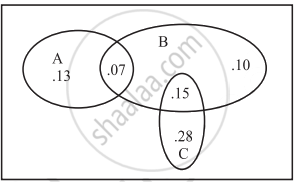
The accompanying Venn diagram shows three events, A, B, and C, and also the probabilities of the various intersections (for instance, P(A ∩ B) = .07). Determine P(A ∪ B)
The accompanying Venn diagram shows three events, A, B, and C, and also the probabilities of the various intersections (for instance, P(A ∩ B) = .07). Determine Probability of exactly one of the three occurs
If the letters of the word ASSASSINATION are arranged at random. Find the probability that four S’s come consecutively in the word
If the letters of the word ASSASSINATION are arranged at random. Find the probability that two I’s and two N’s come together
If the letters of the word ASSASSINATION are arranged at random. Find the probability that all A’s are not coming together
If the letters of the word ASSASSINATION are arranged at random. Find the probability that no two A’s are coming together
6 boys and 6 girls sit in a row at random. The probability that all the girls sit together is ______.
The probabilities that a typist will make 0, 1, 2, 3, 4, 5 or more mistakes in typing a report are, respectively, 0.12, 0.25, 0.36, 0.14, 0.08, 0.11.
The sum of probabilities of two students getting distinction in their final examinations is 1.2
A box contains 10 red marbles, 20 blue marbles and 30 green marbles. 5 marbles are drawn from the box, what is the probability that atleast one will be green?
