Topics
Basic Concepts in Economics
- Branches of Science
- Natural Science
- Social Science
- Concept of Economics
- Kautilya's Views on Economics
- Types of Economic Systems
- Capitalism
- Socialism
- Mixed Economy
- Introduction to Microeconomics and Macroeconomics
- Microeconomics
- Basic Concepts of Microeconomics > Want
- Basic Concepts of Microeconomics > Goods and Services
- Basic Concepts of Microeconomics > Utility
- Basic Concepts of Microeconomics > Value
- Basic Concepts of Microeconomics > Wealth
- Microeconomics > Personal Income
- Basic Concepts of Microeconomics > Personal Disposable Income
- Microeconomics > Economic Activity
- Types of Income
- Concept of Economic Good
- Macroeconomics
- Cyclical Unemployment
- Difference Between Economic Growth and Economic Development
Money
Partition Values
The Economy of Maharashtra
- Formation and Economic Progress of Maharashtra
- Administrative Divisions of Maharashtra
- Important Features of the Economy of Maharashtra
- Economic Development of Maharashtra
- Agricultural Sector
- Industrial Growth in Maharashtra
- Service Sector
- Core Areas of Service Sector
- Economic Infrastructure of Maharashtra
- Social Infrastructure of Maharashtra
- Measures for Social Infrastructure: Education
- Measures for Social Infrastructure: Health Services
- Co – operative Movement in Maharashtra
- Symbols of Educational Schemes in India
- Tourism in Maharashtra
- Hospitality
- Entertainment Industry
Rural Development in India
Population in India
- Concept of Population in India
- Trends in Population Growth
- Theories of Population Growth
- Population Explosion in India
- Types of Population Based on Resource Availability
- Birth Rate
- Death Rate
- Survival Rate
- Legal Age of Marriage for Males and Females in Different Countries
- The Population as a Human Resource
- Role of Human Resources in Economic Development
Unemployment in India
- Concept of Unemployment
- Important Terms of Employment and Unemployment
- Types of Unemployment
- Rural Unemployment
- Urban Unemployment
- Extent of Unemployment in India
- State-Wise Unemployment Rates in India
- Causes of Unemployment
- General Measures to Reduce Unemployment
- Effects of Unemployment
- Government Measures for Employment Generation
Poverty in India
- Concept of Poverty in India
- Prof. Amartya Sen’s Views on Poverty
- Multi-dimensional Poverty
- Key Concepts of Poverty
- Countries with Highest Extreme Poverty Rates
- Poverty Line
- Informal Sector and Related Activities
- Income Pyramid
- Types of Poverty
- Extent of Poverty in India
- Estimates of Poverty
- Causes of Poverty
- Effects of Poverty
- Sustainable Development Goals
- Understanding Maharashtra’s Tri Colour Family Ration Cards
- Eradication of Poverty
- Poverty Alleviation Programmes and Their Target Sectors
- Tracking Anti-Poverty Efforts
Economic Policy of India since 1991
- Economic Transition of India
- Main Objectives of the Economic Policy of 1991
- Features of the Economic Policy of 1991
- Public Bank Vs Private Banks Vs Foreign Banks
- Components of New Economic Policy
- Liberalisation
- Privatisation
- Globalisation
- Evaluation of the Economic Policy of 1991
- Corporate Social Responsibility
Economic Planning in India
- India’s Planning Commission
- Economic Planning in India
- Overview of the Bombay, People’s, and Gandhian Plans
- Features of Economic Planning
- Five Year Plans (FYP)
- 12th Five Year Plan (2012-2017)
- Levels of National Family Health Survey (NFHS)
- NITI Aayog (National Institution for Transforming India)
- Planning Commission VS NITI Aayog
- Introduction
- Key Objectives
- Implementation Strategies
- MTDC and Mahabhraman Scheme
- Tourism Policy Structure
- Real-Life Application
- Key Point Summary
Maharashtra State Board: Class 11
Introduction
Maharashtra, a major Indian state, attracts tourists from India and abroad due to its diverse heritage and vibrant culture. In 2016, the government introduced a strategic tourism policy to position Maharashtra as a top tourist destination by 2025.
Maharashtra State Board: Class 11
Key Objectives
- To designate tourism as a priority sector for economic development and high employment generation.
- Achieve sector growth of 10% per annum and raise tourism’s share in the state GDP to 15%.
- Attract investments of ₹30,000 crore in tourism infrastructure.
- Create one million new jobs through tourism initiatives by 2025.
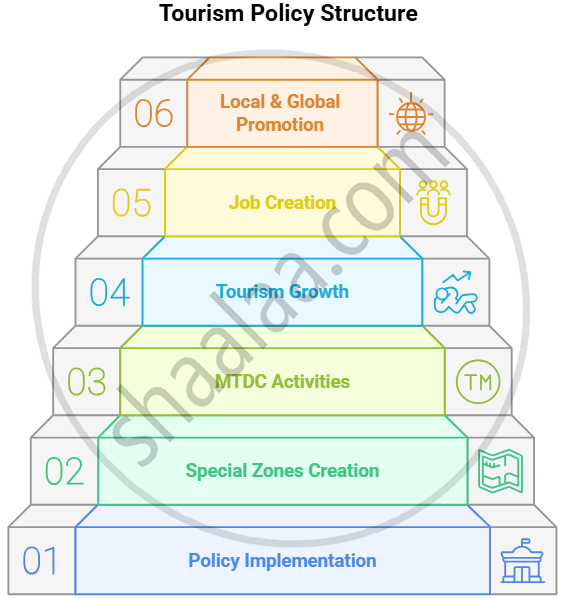
- Develop special tourism zones and growth corridors for focused development: Nagpur, Aurangabad, and Sindhudurg.
Maharashtra State Board: Class 11
Implementation Strategies
| Strategy | Description |
|---|---|
| Sector Growth | Encourage Mega Projects and MSMEs, improve state-wide infrastructure, and ease business. |
| Job Creation | Skill development schemes, incentives, and rural/agro/adventure tourism thrust. |
| Institutional Mechanism | Three-tier system (state, committee, district) for governance and project clearance. |
| Special Zones & Corridors | Identify/promote priority regions and links via highways for better connectivity. |
| PPP Model | Projects via Public-Private Partnership for growth and innovation. |
| Marketing & Promotion | Integrated campaigns, digital platforms, themed events and festivals. |
Maharashtra State Board: Class 11
MTDC and Mahabhraman Scheme
- MTDC (Maharashtra Tourism Development Corporation): The chief implementing agency for tourism policy. Conducts flagship festivals such as Ellora and Elephanta and promotes new tourism concepts (village, food, adventure).
- Mahabhraman Scheme: Unites agro-tourism (farm experiences), tribal tours, food festivals, village stays, and adventure/tourism routes under one initiative.
Maharashtra State Board: Class 11
Tourism Policy Structure
Maharashtra State Board: Class 11
Real-Life Application
Just as Goa uses beach tourism, Maharashtra leverages its caves, forts, and rural festivals (Ellora, Elephanta, Mahabhraman) to promote unique visitor experiences.
Maharashtra State Board: Class 11
Key Point Summary
- Maharashtra’s 2016 Tourism Policy is transforming the sector with strategic investment, promotional events, and comprehensive infrastructure development.
- MTDC and the Mahabhraman scheme bring together diverse tourism options, from heritage sites to rural/tribal tours, boosting jobs and local culture.
