Advertisements
Chapters
1: Rational and Irrational Numbers
Unit 2: Commercial Mathematics
2: Compound Interest (Stage 1) [Basic Concepts]
3: Compound Interest (Stage 2) [Applications]
Unit 3: Algebra
4: Expansions
5: Factorisation
6: Simultaneous (Linear) Equations [Including Problems]
7: Indices [Exponents]
8: Logarithms
Unit 4: Geometry
9: Triangles [Congruency in Triangles]
10: Isosceles Triangles [Including Inequalities]
11: Mid-point Theorem and Its Converse [Including Intercept Theorem]
12: Pythagoras Theorem [Proof and Simple Applications with Converse]
▶ 13: Rectilinear Figures [Quadrilaterals: Parallelogram, Rectangle, Rhombus, Square and Trapezium]
14: Construction of Polygons (Using ruler and compass only)
15: Area Theorems [Proof and Use]
16: Circle
Unit 5: Statistics and Graph Work
17: Statistics
18: Mean and Median [For Ungrouped Data Only]
Unit 6: Mensuration
19: Area and Perimeter of Plane Figures
20: Solids [Surface Area and Volume of 3-D Solids]
Unit 7: Trigonometry
21: Trigonometrical Ratios [Sine, Consine, Tangent of an Angle and their Reciprocals]
22: Solution of Right Triangles [Simple 2-D Problems Involving One Right-angled Triangle]
Unit 8: Co-Ordinate
23: Co-ordinate Geometry
24: Graphical Solution [Solution of Simultaneous Linear Equations, Graphically]
25: Distance Formula
![Selina solutions for Concise Mathematics [English] Class 9 ICSE chapter 13 - Rectilinear Figures [Quadrilaterals: Parallelogram, Rectangle, Rhombus, Square and Trapezium] - Shaalaa.com](/images/concise-mathematics-english-class-9-icse_6:e09935b48e334a1e8f06ebb2011509f8.jpg "Selina solutions for Concise Mathematics [English] Class 9 ICSE chapter 13 - Rectilinear Figures [Quadrilaterals: Parallelogram, Rectangle, Rhombus, Square and Trapezium]")
Advertisements
Solutions for Chapter 13: Rectilinear Figures [Quadrilaterals: Parallelogram, Rectangle, Rhombus, Square and Trapezium]
Below listed, you can find solutions for Chapter 13 of CISCE Selina for Concise Mathematics [English] Class 9 ICSE.
Selina solutions for Concise Mathematics [English] Class 9 ICSE 13 Rectilinear Figures [Quadrilaterals: Parallelogram, Rectangle, Rhombus, Square and Trapezium] Exercise 13 (A) [Pages 190 - 191]
Multiple Choice Type: Choose the correct answer from the options given below.
One angle of a seven-sided polygon is 114°, and each of the other six angles is x°. Then the magnitude of x is ______.
131°
132°
135°
130°
In a parallelogram ABCD, ∠A − ∠C is equal to ______.
90°
120°
0°
180°
If each interior angle of a polygon is 144°, the number of sides in it is ______.
5
10
6
7
The sum of the interior angles of a regular polygon is equal to six times the sum of its exterior angles. The number of sides of the polygon is ______.
14
10
12
16
An exterior angle and an interior angle of a regular polygon are in the ratio 2 : 7. The number of sides in the polygon is ______.
12
6
4
9
The sum of the interior angles of a polygon is four times the sum of its exterior angles.
Find the number of sides in the polygon.
The angles of a pentagon are in the ratio 4: 8: 6: 4: 5.
Find each angle of the pentagon.
One angle of a six-sided polygon is 140o and the other angles are equal.
Find the measure of each equal angle.
In a polygon, there are 5 right angles and the remaining angles are equal to 195o each. Find the number of sides in the polygon.
Three angles of a seven-sided polygon are 132o each and the remaining four angles are equal. Find the value of each equal angle.
Two angles of an eight-sided polygon are 142o and 176o. If the remaining angles are equal to each other; find the magnitude of each of the equal angles.
In a pentagon ABCDE, AB is parallel to DC and ∠A: ∠E : ∠D = 3: 4: 5. Find angle E.
AB, BC, and CD are the three consecutive sides of a regular polygon. If BAC = 15°;
Find:
- Each interior angle of the polygon.
- Each exterior angle of the polygon.
- The number of sides of the polygon.
The ratio between an exterior angle and an interior angle of a regular polygon is 2 : 3. Find the number of sides in the polygon.
Selina solutions for Concise Mathematics [English] Class 9 ICSE 13 Rectilinear Figures [Quadrilaterals: Parallelogram, Rectangle, Rhombus, Square and Trapezium] Exercise 13 (B) [Pages 197 - 198]
Multiple Choice Type: Choose the correct answer from the options given below.
A quadrilateral ABCD is a trapezium if ______.
AB = DC
AD = ВС
∠A + ∠C = 180°
∠B + ∠C = 180°
If the diagonals of a square ABCD intersect each other at point O, the triangle OAB is ______.
an equilateral triangle.
a right-angled but not an isosceles triangle.
an isosceles but not a right-angled triangle.
an isosceles right-angled triangle.
A quadrilateral in which the diagonals are equal and bisect each other at right angles is a ______.
rectangle which is not a square.
rhombus which is not a square.
square.
kite which is not a square.
Which of the following is not true for a parallelogram?
Opposite sides are equal
Opposite angles are equal
Opposite angles are bisected by the diagonals
Diagonals bisect each other
If the diagonals of a quadrilateral bisect each other at right angle, the quadrilateral is a ______.
square
rhombus
parallelogram
rectangle
State, 'true' or 'false'
The diagonals of a rectangle bisect each other.
True
False
State, 'true' or 'false'
The diagonals of a quadrilateral bisect each other.
True
False
State, 'true' or 'false'
The diagonals of a parallelogram bisect each other at right angle.
True
False
State, 'true' or 'false'
Each diagonal of a rhombus bisects it.
True
False
State, 'true' or 'false'
The quadrilateral, whose four sides are equal, is a square.
True
False
State, 'true' or 'false'
Every rhombus is a parallelogram.
True
False
State, 'true' or 'false'
Every parallelogram is a rhombus.
True
False
State, 'true' or 'false'
Diagonals of a rhombus are equal.
True
False
State, 'true' or 'false'
If two adjacent sides of a parallelogram are equal, it is a rhombus.
True
False
State, 'true' or 'false'
If the diagonals of a quadrilateral bisect each other at right angle, the quadrilateral is a square.
True
False
In the figure, given below, AM bisects angle A and DM bisects angle D of parallelogram ABCD. Prove that: ∠AMD = 90°.

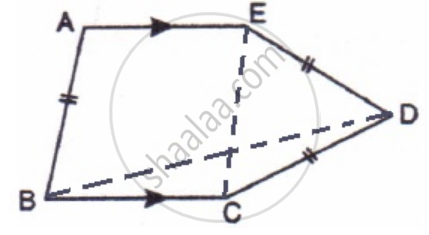
In the following figure, AE and BC are equal and parallel and the three sides AB, CD, and DE are equal to one another. If angle A is 102°.
Find angles AEC and BCD.
In a square ABCD, diagonals meet at O. P is a point on BC such that OB = BP.
Show that:
- ∠POC = `[ 22 ( 1°)/( 2 ) ]`
- ∠BDC = 2 ∠POC
- ∠BOP = 3 ∠CPO
The given figure shows a square ABCD and an equilateral triangle ABP. 
Calculate: (i) ∠AOB
(ii) ∠BPC
(iii) ∠PCD
(iv) Reflex ∠APC
In the given figure ABCD is a rhombus with angle A = 67°

If DEC is an equilateral triangle, calculate:
- ∠CBE
- ∠DBE
In the following figures, ABCD is a parallelogram.
find the values of x and y.
In the following figures, ABCD is a parallelogram.
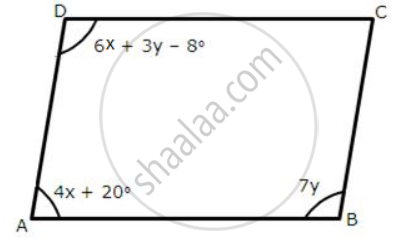
Find the values of x and y.
The angles of a quadrilateral are in the ratio 3: 4: 5: 6. Show that the quadrilateral is a trapezium.
In a parallelogram ABCD, AB = 20 cm and AD = 12 cm. The bisector of angle A meets DC at E and BC produced at F.
Find the length of CF.
Selina solutions for Concise Mathematics [English] Class 9 ICSE 13 Rectilinear Figures [Quadrilaterals: Parallelogram, Rectangle, Rhombus, Square and Trapezium] Exercise 13 (C) [Pages 202 - 203]
Multiple Choice Type:
If the opposite sides of a quadrilateral are equal, the quadrilateral is ______.
rectangle
parallelogram
square
rhombus
If the opposite angles of a quadrilateral are equal, the quadrilateral is a ______.
rectangle
parallelogram
square
rhombus
If three angles of a quadrilateral are equal to 90° each, then the quadrilateral is a ______.
rectangle
square
parallelogram
rhombus
If three angles of a quadrilateral are equal, then the quadrilateral is ______.
rectangle
rhombus
not a parallelogram
parallelogram
BEC is an equilateral triangle inside the square ABCD. The value of angle ECD is ______.
60°
30°
75°
45°
E is the mid-point of side AB and F is the mid-point of side DC of parallelogram ABCD. Prove that AEFD is a parallelogram.
The diagonal BD of a parallelogram ABCD bisects angles B and D. Prove that ABCD is a rhombus.
The alongside figure shows a parallelogram ABCD in which AE = EF = FC.
Prove that:
- DE is parallel to FB
- DE = FB
- DEBF is a parallelogram.

In the alongside diagram, ABCD is a parallelogram in which AP bisects angle A and BQ bisects angle B.

Prove that:
- AQ = BP
- PQ = CD
- ABPQ is a parallelogram.
In the given figure, ABCD is a parallelogram.
Prove that: AB = 2 BC.
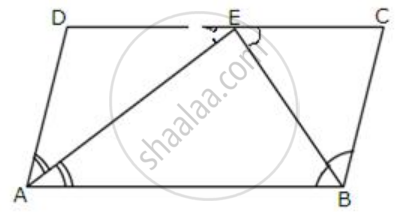
Prove that the bisectors of opposite angles of a parallelogram are parallel.
Prove that the bisectors of interior angles of a parallelogram form a rectangle.
Prove that the bisectors of the interior angles of a rectangle form a square.
In parallelogram ABCD, the bisector of angle A meets DC at P and AB = 2 AD.
Prove that:
(i) BP bisects angle B.
(ii) Angle APB = 90o.
Points M and N are taken on the diagonal AC of a parallelogram ABCD such that AM = CN. Prove that BMDN is a parallelogram.
In the following figure, ABCD is a parallelogram. 
Prove that:
(i) AP bisects angle A.
(ii) BP bisects angle B
(iii) ∠DAP + ∠BCP = ∠APB
ABCD is a square. A is joined to a point P on BC and D is joined to a point Q on AB. If AP = DQ;
prove that AP and DQ are perpendicular to each other.
In a quadrilateral ABCD, AB = AD and CB = CD.
Prove that:
- AC bisects angle BAD.
- AC is the perpendicular bisector of BD.
Selina solutions for Concise Mathematics [English] Class 9 ICSE 13 Rectilinear Figures [Quadrilaterals: Parallelogram, Rectangle, Rhombus, Square and Trapezium] TEST YOURSELF [Pages 203 - 205]
Multiple Choice Type: Choose the correct answer from the options given below.
The angles of a pentagon are in the ratio 2 : 5 : 6 : 4 : 3. The largest angle is ______.
54°
135°
162°
108°
At a vertex of a regular polygon, exterior angle is 120°. Then the number of sides of this polygon is ______.
3
4
5
6
A quadrilateral ABCD is a trapezium if ______.
AB = DC
AD = ВС
∠A + ∠C = 180°
∠B + ∠C = 180°
In parallelogram ABCD, diagonals AC and BD intersect each other at point O. Then, ______.
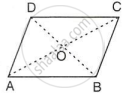
AC = BD
∠AOB = 90°
The four triangles formed are congruent
AC and BD bisect each other
Statement (1): The sum of the interior angles of a regular polygon is twice the sum of its exterior angles. The number of sides in the polygon is 6.
Statement (2): (2n − 4) × 90° = 2 × 360°
Both the statements are true.
Both the statements are false.
Statement 1 is true, and statement 2 is false.
Statement 1 is false, and statement 2 is true.
Statement (1): Through each vertex of a hexagon, 3 diagonals can be drawn.
Statement (2): The number of diagonals through a vertex of a polygon = the number of sides in the polygon − 3.
Both the statements are true.
Both the statements are false.
Statement 1 is true, and statement 2 is false.
Statement 1 is false, and statement 2 is true.
Assertion (A): If the diagonals of a quadrilateral bisect each other at right angles, then the quadrilateral is a rhombus.
Reason (R): A quadrilateral whose diagonals bisect each other at right angles must be a square.
A is true, R is false.
A is false, R is true.
Both A and R are true, and R is the correct reason for A.
Both A and R are true, and R is the incorrect reason for A.
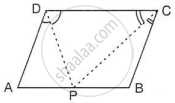
Assertion (A): In parallelogram ABCD, PD bisects ∠ADC and PC bisects angle ∠DCB; then ∠DPC = 90°.
Reason (R): `∠PDC = 1/2 xx ∠ADC`,
`∠PDC = 1/2 xx ∠BCD`,
`∠PDC + ∠PDC = 1/2 xx (∠ADC + ∠BCD)`
A is true, R is false.
A is false, R is true.
Both A and R are true, and R is the correct reason for A.
Both A and R are true, and R is the incorrect reason for A.
The difference between an exterior angle of (n - 1) sided regular polygon and an exterior angle of (n + 2) sided regular polygon is 6°. Find the value of n.
Two alternate sides of a regular polygon, when produced, meet at the right angle.
Find:
(i)The value of each exterior angle of the polygon;
(ii) The number of sides in the polygon.
In parallelogram ABCD, AP and AQ are perpendiculars from the vertex of obtuse angle A as shown.
If ∠x: ∠y = 2 : 1.
find angles of the parallelogram.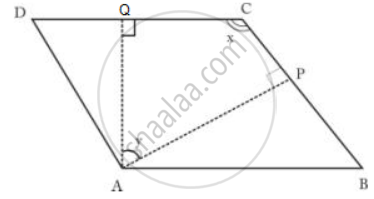
In the given figure, AP is the bisector of ∠A and CQ is the bisector of ∠C of parallelogram ABCD. 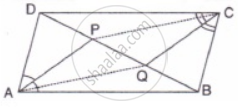
Prove that APCQ is a parallelogram.
In case of a parallelogram
prove that:
(i) The bisectors of any two adjacent angles intersect at 90o.
(ii) The bisectors of the opposite angles are parallel to each other.
The diagonals of a rectangle intersect each other at right angles. Prove that the rectangle is a square.
In the following figure, ABCD and PQRS are two parallelograms such that ∠D = 120° and ∠Q = 70°.
Find the value of x.
In the following figure, ABCD is a rhombus and DCFE is a square.
If ∠ABC =56°, find:
(i) ∠DAE
(ii) ∠FEA
(iii) ∠EAC
(iv) ∠AEC
In parallelogram ABCD, E is the mid-point of side AB and CE bisects angle BCD. Prove that:
- AE = AD,
- DE bisects and ∠ADC and
- Angle DEC is a right angle.
In parallelogram ABCD, X and Y are midpoints of opposite sides AB and DC respectively. Prove that:
(i) AX = YC
(ii) AX is parallel to YC
(iii) AXCY is a parallelogram.
Case-Study Based Question
Prashant had a plot of land in the shape of a quadrilateral. He constructed his house in the middle by joining the midpoints of the four sides of the land and used the remaining four portions at the four ends for different purposes, like a small garden, swimming pool, etc.
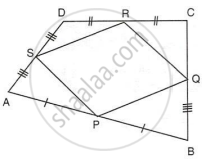
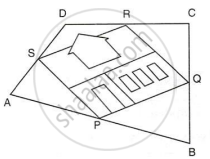
- What type of a quadrilateral is PQRS?
- What are the lengths of adjacent sides of the quadrilateral PQRS, if their ratio is 1 : 2 and the perimeter of the quadrilateral is 180 m?
- In quadrilateral PQRS, if ∠PSQ = 30° and ∠QRS = 110°, find ∠SQP.
Gautam had two sticks of equal length. He named them AB and CD. He then placed these two sticks in three different ways and joined their four vertices as shown below.
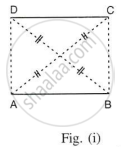
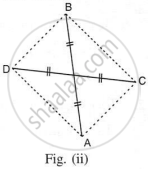
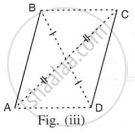
- What type of quadrilateral is in:
- Fig. (i)?
- Fig. (ii)?
- Fig. (iii)?
- What is the sum of consecutive angles in Fig. (iii)?
- If ∠BAD = 70° in Fig. (iii), then what is the measure of ∠CDA?
Solutions for 13: Rectilinear Figures [Quadrilaterals: Parallelogram, Rectangle, Rhombus, Square and Trapezium]
Selina solutions for Concise Mathematics [English] Class 9 ICSE chapter 13 - Rectilinear Figures [Quadrilaterals: Parallelogram, Rectangle, Rhombus, Square and Trapezium]
Shaalaa.com has the CISCE Mathematics Concise Mathematics [English] Class 9 ICSE CISCE solutions in a manner that help students grasp basic concepts better and faster. The detailed, step-by-step solutions will help you understand the concepts better and clarify any confusion. Selina solutions for Mathematics Concise Mathematics [English] Class 9 ICSE CISCE 13 (Rectilinear Figures [Quadrilaterals: Parallelogram, Rectangle, Rhombus, Square and Trapezium]) include all questions with answers and detailed explanations. This will clear students' doubts about questions and improve their application skills while preparing for board exams.
Further, we at Shaalaa.com provide such solutions so students can prepare for written exams. Selina textbook solutions can be a core help for self-study and provide excellent self-help guidance for students.
Concepts covered in Concise Mathematics [English] Class 9 ICSE chapter 13 Rectilinear Figures [Quadrilaterals: Parallelogram, Rectangle, Rhombus, Square and Trapezium] are .
Using Selina Concise Mathematics [English] Class 9 ICSE solutions Rectilinear Figures [Quadrilaterals: Parallelogram, Rectangle, Rhombus, Square and Trapezium] exercise by students is an easy way to prepare for the exams, as they involve solutions arranged chapter-wise and also page-wise. The questions involved in Selina Solutions are essential questions that can be asked in the final exam. Maximum CISCE Concise Mathematics [English] Class 9 ICSE students prefer Selina Textbook Solutions to score more in exams.
Get the free view of Chapter 13, Rectilinear Figures [Quadrilaterals: Parallelogram, Rectangle, Rhombus, Square and Trapezium] Concise Mathematics [English] Class 9 ICSE additional questions for Mathematics Concise Mathematics [English] Class 9 ICSE CISCE, and you can use Shaalaa.com to keep it handy for your exam preparation.
