Advertisements
Chapters
2: Classical Genetics
3: Chromosomal Basis of Inheritance
4: Principles and Processes of Biotechnology
5: Plant Tissue Culture
6: Principles of Ecology
▶ 7: Ecosystem
8: Environmental Issues
9: Plant Breeding
10: Economically Useful Plants and Entrepreneurial Botany
![Samacheer Kalvi solutions for Biology (Botany) [English] Class 12 TN Board chapter 7 - Ecosystem - Shaalaa.com](/images/biology-botany-english-class-12-tn-board_6:5f2b1b2038084cf381bfa42c826a928c.jpg "Samacheer Kalvi solutions for Biology (Botany) [English] Class 12 TN Board chapter 7 - Ecosystem")
Advertisements
Solutions for Chapter 7: Ecosystem
Below listed, you can find solutions for Chapter 7 of Tamil Nadu Board of Secondary Education Samacheer Kalvi for Biology (Botany) [English] Class 12 TN Board.
Samacheer Kalvi solutions for Biology (Botany) [English] Class 12 TN Board 7 Ecosystem Evaluation [Pages 151 - 153]
Choose the most suitable answer from the given four alternatives and write the option code and the corresponding answer
Which of the following is not an abiotic component of the ecosystem?
Bacteria
Humus
Organic compounds
Inorganic compounds
Which of the following is/are not a natural ecosystem?
Forest ecosystem
Rice field
Grassland ecosystem
Desert ecosystem
Pond is a type of
forest ecosystem
grassland ecosystem
marine ecosystem
fresh water ecosystem
Pond ecosystem is
not self-sufficient and self-regulating
not self sufficient and self regulating
self sufficient and not self regulating
self sufficient and self regulating
Profundal zone is predominated by heterotrophs in a pond ecosystem, because of
with effective light penetration
no effective light penetration
complete absence of light
a and b
Solar energy used by green plants for photosynthesis is only
2 – 8%
2 – 10%
3 – 10%
2 – 9%
Which of the following ecosystem has the highest primary productivity?
Pond ecosystem
Lake ecosystem
Grassland ecosystem
Forest ecosystem
Ecosystem consists of
decomposers
producers
consumers
all of the above
Which one is in descending order of a food chain
Producers → Secondary consumers → Primary consumers → Tertiary consumers
Tertiary consumers → Primary consumers → Secondary consumers → Producers
Tertiary consumers → Secondary consumers → Primary consumers → Producers
Tertiary consumers → Producers → Primary consumers → Secondary consumers
Significance of food web is/are
it does not maintain stability in nature
it shows patterns of energy transfer
it explains species interaction
b and c
The following diagram represents
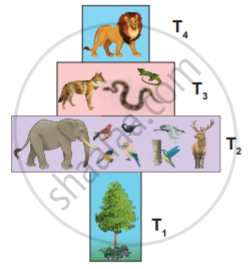
pyramid of number in a grassland ecosystem
pyramid of number in a pond ecosystem
pyramid of number in a pond ecosystem
pyramid of biomass in a pond ecosystem
Which of the following is/are not the mechanism of decomposition
Eluviation
Catabolism
Anabolism
Fragmentation
Which of the following is not a sedimentary cycle
Nitrogen cycle
Phosphorous cycle
Sulphur cycle
Calcium cycle
Which of the following are not regulating services of ecosystem services
- Genetic resources
- Recreation and aesthetic values
- Invasion resistance
- Climatic regulation
i and iii
ii and iv
i and ii
i and iv
Productivity of profundal zone will below. Why?
Discuss the gross primary productivity is more efficient than net primary productivity
Pyramid of energy is always upright. Give reasons.
What will happen if all producers are removed from ecosystem?
Construct the food chain with the following data.
Hawk, plants, frog, snake, grasshopper.
Name of the food chain which is generally present in all types of ecosystem. Explain and write their significance.
The shape of pyramid in a particular ecosystem is always different in shape. Explain with example.
Generally, human activities are against the ecosystem, whereas you a student how will you help to protect the ecosystem?
Generally, in summer, the forest area affected by natural fire. Over a period of time, it recovers itself by the process of successions. Find out the types of succession and explain.
Draw a pyramid from the following details and explain in brief.
Quantities of organisms are given-Hawks-50, plants-1000. rabbit and mouse-250 +250, pythons and lizard- 100 + 50 respectively.
Various stages of succession are given below. From that rearrange them accordingly. Find out the type of succession and explain in detail.
Reed-swamp stage, phytoplankton stage, shrub stage, submerged plant stage, forest stage, submerged free-floating stage, marsh meadow stage.
Solutions for 7: Ecosystem
Samacheer Kalvi solutions for Biology (Botany) [English] Class 12 TN Board chapter 7 - Ecosystem
Shaalaa.com has the Tamil Nadu Board of Secondary Education Mathematics Biology (Botany) [English] Class 12 TN Board Tamil Nadu Board of Secondary Education solutions in a manner that help students grasp basic concepts better and faster. The detailed, step-by-step solutions will help you understand the concepts better and clarify any confusion. Samacheer Kalvi solutions for Mathematics Biology (Botany) [English] Class 12 TN Board Tamil Nadu Board of Secondary Education 7 (Ecosystem) include all questions with answers and detailed explanations. This will clear students' doubts about questions and improve their application skills while preparing for board exams.
Further, we at Shaalaa.com provide such solutions so students can prepare for written exams. Samacheer Kalvi textbook solutions can be a core help for self-study and provide excellent self-help guidance for students.
Concepts covered in Biology (Botany) [English] Class 12 TN Board chapter 7 Ecosystem are Plant Succession.
Using Samacheer Kalvi Biology (Botany) [English] Class 12 TN Board solutions Ecosystem exercise by students is an easy way to prepare for the exams, as they involve solutions arranged chapter-wise and also page-wise. The questions involved in Samacheer Kalvi Solutions are essential questions that can be asked in the final exam. Maximum Tamil Nadu Board of Secondary Education Biology (Botany) [English] Class 12 TN Board students prefer Samacheer Kalvi Textbook Solutions to score more in exams.
Get the free view of Chapter 7, Ecosystem Biology (Botany) [English] Class 12 TN Board additional questions for Mathematics Biology (Botany) [English] Class 12 TN Board Tamil Nadu Board of Secondary Education, and you can use Shaalaa.com to keep it handy for your exam preparation.
