Advertisements
Online Mock Tests
Chapters
2: Polynomials
3: Pair of Linear Equations in Two Variables
4: Quadratic Equations
5: Arithmetic Progressions
6: Co-ordinate Geometry
7: Triangles
8: Circles
9: Constructions
10: Trigonometric Ratios
11: Trigonometric Identities
▶ 12: Heights and Distances
13: Areas Related to Circles
14: Surface Areas and Volumes
15: Statistics
16: Probability
![R.D. Sharma solutions for Mathematics [English] Class 10 chapter 12 - Heights and Distances - Shaalaa.com](/images/mathematics-english-class-10_6:df8cedf76b7f4149972b35ec991c0c9d.jpg "R.D. Sharma solutions for Mathematics [English] Class 10 chapter 12 - Heights and Distances")
Advertisements
Solutions for Chapter 12: Heights and Distances
Below listed, you can find solutions for Chapter 12 of CBSE, Karnataka Board R.D. Sharma for Mathematics [English] Class 10.
R.D. Sharma solutions for Mathematics [English] Class 10 12 Heights and Distances EXERCISE 12.1 [Pages 12.19 - 12.23]
BASIC
A tower stands vertically on the ground. From a point on the ground 20 m away from the foot of the tower, the angle of elevation of the top of the tower is 60°. What is the height of the tower?
The angle of elevation of a ladder leaning against a wall is 60° and the foot of the ladder is 9.5 m away from the wall. Find the length of the ladder.
A ladder 15 metres long just reaches the top of a vertical wall. If the ladder makes an angle of 60° with the wall, find the height of the wall.
A vertical tower stands on a horizontal plane and is surmounted by a vertical flag-staff. At a point on the plane 70 metres away from the tower, an observer notices that the angles of elevation of the top and the bottom of the flagstaff are respectively 60° and 45°. Find the height of the flag-staff and that of the tower.
Two points A and B are on the same side of a tower and in the same straight line with its base. The angles of depression of these points from the top of the tower are 60° and 45° respectively. If the height of the tower is 15 m, then find the distance between these points.
A vertical tower stands on a horizontal plane and is surmounted by a vertical flag-staff of height 5 metres. At a point on the plane, the angles of elevation of the bottom and the top of the flag-staff are respectively 30° and 60°. Find the height of the tower.
The angle of elevation of a tower from a point on the same level as the foot of the tower is 30°. On advancing 150 metres towards the foot of the tower, the angle of elevation of the tower becomes 60°. Show that the height of the tower is 129.9 metres (Use `sqrt3 = 1.732`).
The angle of elevation of the top of a tower as observed from a point in a horizontal plane through the foot of the tower is 32°. When the observer moves towards the tower a distance of 100 m, he finds the angle of elevation of the top to be 63°. Find the height of the tower and the distance of the first position from the tower. [Take tan 32° = 0.6248 and tan 63° = 1.9626]
The angle of elevation of the top of a tower from a point A on the ground is 30°. Moving a distance of 20 metres towards the foot of the tower to a point B the angle of elevation increases to 60°. Find the height of the tower and the distance of the tower from the point A.
From the top of a 15 m high building, the angle of elevation of the top of a tower is found to be 30°. From the bottom of the same building, the angle of elevation of the top of the tower is found to be 60°. Find the height of the tower and the distance between tower and the building.
On a horizontal plane, there is a vertical tower with a flagpole on the top of the tower. At a point 9 meters away from the foot of the tower the angle of elevation of the top and bottom of the flagpole are 60° and 30° respectively. Find the height of the tower and the flagpole mounted on it.
An observer, 1.5 m tall, is 28.5 m away from a tower 30 m high. Determine the angle of elevation of the top of the tower from his eye.
A 1.5 m tall boy is standing at some distance from a 30 m tall building. The angle of elevation from his eyes to the top of the building increases from 30° to 60° as he walks towards the building. Find the distance he walked towards the building.
The shadow of a tower standing on a level ground is found to be 40 m longer when Sun’s altitude is 30° than when it was 60°. Find the height of the tower.
From a point on the ground, the angles of elevation of the bottom and the top of a transmission tower fixed at the top of a 20 m high building are 45° and 60° respectively. Find the height of the tower. (Use `sqrt3` = 1.73)
The angles of depression of the top and bottom of 8 m tall building from the top of a multistoried building are 30° and 45° respectively. Find the height of the multistoried building and the distance between the two buildings.
A statue, 1.6 m tall, stands on a top of pedestal, from a point on the ground, the angle of elevation of the top of statue is 60° and from the same point the angle of elevation of the top of the pedestal is 45°. Find the height of the pedestal.
From the top of a 120 m high tower, a man observes two cars on the opposite sides of the tower and in straight line with the base of tower with angles of depression as 60° and 45°. Find the distance between the cars. (Take `sqrt(3) = 1.732`)
From the top of a 7 m high building, the angle of elevation of the top of a cable tower is 60° and the angle of depression of its foot is 45°. Determine the height of the tower.
As observed from the top of a 75 m high lighthouse from the sea-level, the angles of depression of two ships are 30° and 45°. If one ship is exactly behind the other on the same side of the lighthouse, find the distance between the two ships.
The angle of elevation of the top of a building from the foot of the tower is 30° and the angle of elevation of the top of the tower from the foot of the building is 60°. If the tower is 50 m high, find the height of the building.
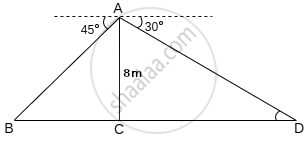
From a point on a bridge across a river, the angles of depression of the banks on opposite side of the river are 30° and 45° respectively. If the bridge is at the height of 30 m from the banks, find the width of the river.
The angle of elevation of the top of a hill at the foot of a tower is 60° and the angle of elevation of the top of the tower from the foot of the hill is 30°. If height of the tower is 50 m, find the height of the hill.
Two boats approach a lighthouse in mid-sea from opposite directions. The angles of elevation of the top of the lighthouse from two boats are 30° and 45° respectively. If the distance between two boats is 100 m, find the height of the lighthouse.
From the top of a 45 m high light house, the angles of depression of two ships, on the opposite side of it, are observed to be 30° and 60°. If the line joining the ships passes through the foot of the light house, find the distance between the ships. (Use `sqrt3` =1.73)
Two ships are sailing in the sea on either side of a lighthouse. The angles of depression to the two ships as observed from the top of the lighthouse are 60° and 45°, respectively. If the distance between the ships is `100 ((1 + sqrt(3))/sqrt(3))` m, then find the height of the lighthouse.
Two men on either side of the cliff 80 m high observe the angles of an elevation of the top of the cliff to be 30° and 60° respectively. Find the distance between the two men.
An aeroplane is flying at a height of 210 m. Flying at this height at some instant the angles of depression of two points in a line in opposite directions on both the banks of the river are 45° and 60°. Find the width of the river. (Use `sqrt(3) = 1.73`)
A flag-staff stands on the top of a 5 m high tower. From a point on the ground, the angle of elevation of the top of the flag-staff is 60° and from the same point, the angle of elevation of the top of the tower is 45°. Find the height of the flag-staff.
A pole 6m high is fixed on the top of a tower. The angle of elevation of the top of the pole observed from a point P on the ground is 60° and the angle of depression of the point P from the top of the tower is 45°. Find the height of the tower and the distance of point P from the foot of the tower. (Use `sqrt3` = 1.73)
The horizontal distance between two poles is 15 m. The angle of depression of the top of first pole as seen from the top of second pole is 30°. If the height of the second pole is 24 m, find the height of the first pole. Use`[sqrt3=1.732]`
The angles of depression of two ships from the top of a lighthouse and on the same side of it are found to be 45° and 30° respectively. If the ships are 200 m apart, find the height of the lighthouse.
The angles of elevation of the top of a tower from two points at a distance of 4 m and 9 m from the base of the tower and in the same straight line with it are complementary. Prove that the height of the tower is 6 m.
From a point on a bridge across a river, the angles of depression of the banks on opposite sides of the river are 30° and 45°. If the bridge is at a height of 8 m from the banks, then find the width of the river.
BASED ON LOTS
The angle of elevation of the top of a chimney from the foot of a tower is 60° and the angle of depression of the foot of the chimney from the top of the tower is 30°. If the height of the tower is 40 metres, find the height of the chimney.
According to pollution control norms, the minimum height of a smoke-emitting chimney should be 100 metres. State if the height of the above-mentioned chimney meets the pollution norms. What value is discussed in this question?
From the top of a building AB, 60 m high, the angles of depression of the top and bottom of a vertical lamp-post CD are observed to be 30° and 60° respectively. Find
- the horizontal distance between AB and CD,
- the height of the lamp-post,
- the difference between the heights of the building and the lamp-post.
A moving boat is observed from the top of a 150 m high cliff moving away from the cliff. The angle of depression of the boat changes from 60° to 45° in 2 minutes. Find the speed of the boat in m/h.
A man in a boat rowing away from a lighthouse 100 m high takes 2 minutes to change the angle of elevation of the top of the lighthouse from 60° to 30°. Find the speed of the boat in metres per minute. [Use `sqrt3` = 1.732]
If the angle of elevation of a cloud from a point h metres above a lake is α and the angle of depression of its reflection in the lake be β, prove that the distance of the cloud from the point of observation is `(2h sec alpha)/(tan beta - tan alpha)`
From an aeroplane vertically above a straight horizontal road, the angles of depression of two consecutive milestones on opposite sides of the aeroplane are observed to be α and β. Show that the height in miles of the aeroplane above the road is given by `(tan alpha tan beta)/(tan alpha + tan beta)`
A ladder rests against a wall at an angle α to the horizontal. Its foot is pulled away from the wall through a distance a so that it slides a distance b down the wall making an angle β with the horizontal. Show that `a/b = (cos alpha - cos beta)/(sin beta - sin alpha)`
From the top of a light house, the angles of depression of two ships on the opposite sides of it are observed to be α and β. If the height of the light house be h metres and the line joining the ships passes through the foot of the light house, show that the distance between the ship is
`(h (tan ∝+tan ß))/ (tan ∝+tan ∝)`
From the top of a tower h m high, the angles of depression of two objects, which are in line with the foot of the tower are α and β (β > α). Find the distance between the two objects.
A window of a house is h metres above the ground. From the window, the angles of elevation and depression of the top and the bottom of another house situated on the opposite side of the lane are found to be α and β, respectively. Prove that the height of the other house is h(1+ tan α tan β) metres.
The lower window of a house is at a height of 2 m above the ground and its upper window is 4 m vertically above the lower window. At certain instant the angles of elevation of a balloon from these windows are observed to be 60° and 30° respectively. Find the height of the balloon above the ground.
One observer estimates the angle of elevation to the basket of a hot air balloon to be 60°, while another observer 100 m away estimates the angle of elevation to be 30°. Find:
- The height of the basket from the ground.
- The distance of the basket from the first observer's eye.
- The horizontal distance of the second observer from the basket.
The angle of elevation of the top of a tower 24 m high from the foot of another tower in the same plane is 60°. The angle of elevation of the top of the second tower from the foot of the first tower is 30°. Find the distance between two towers and the height of the other tower. Also, find the length of the wire attached to the tops of both the towers.
The angle of elevation of an airborne helicopter from a point A on the ground is 45°. After a flight of 15 seconds, the angle of elevation of the helicopter changes to 30°. If the helicopter is flying at a constant height of 2000 m, find the speed of the helicopter. (Take `sqrt(3) = 1.732`)
R.D. Sharma solutions for Mathematics [English] Class 10 12 Heights and Distances VERY SHORT ANSWER TYPE QUESTIONS (VSAQS) [Pages 12.25 - 12.26]
Answer each of the following questions either in one word or one sentence or as per requirement of the questions:
BASIC
The height of a tower is 10 m. What is the length of its shadow when Sun's altitude is 45°?
If the ratio of the height of a tower and the length of its shadow is `sqrt3:1`, what is the angle of elevation of the Sun?
What is the angle of elevation of the Sun when the length of the shadow of a vetical pole is equal to its height?
From a point on the ground, 20 m away from the foot of a vertical tower, the angle elevation of the top of the tower is 60°, What is the height of the tower?
If the angles of elevation of the top of a tower from two points at a distance of 4 m and 9 m from the base of the tower in the same straight line with it are complementary, find the height of the tower.
In the following figure, what are the angles of depression from the observing position O1 and O2of the object at A?
The tops of two towers of height x and y, standing on level ground, subtend angles of 30º and 60º respectively at the centre of the line joining their feet, then find x : y.
The angle of elevation of the top of a tower at a point on the ground is 30º. What will be the angle of elevation, if the height of the tower is tripled?
AB is a pole of height 6 m standing at a point B and CD is a ladder inclined at angle of 600 to the horizontal and reaches upto a point D of pole . If AD = 2.54 m , find the length of the ladder.
An observer , 1.7 m tall , is` 20 sqrt3` m away from a tower . The angle of elevation from the eye of an observer to the top of tower is 300 . Find the height of the tower.
An observer, 1.5 m tall, is 28.5 m away from a 30 m high tower. Determine the angle of elevation of the top of the tower from the eye of the observer.
The ratio of the length of a vertical rod and the length of its shadow is `1 : sqrt(3)`. What is the angle of elevation of the sun at that moment?
The length of the shadow of a tower on the plane ground is `sqrt(3)` times the height of the tower. Find the angle of elevation of the sun.
Find the length of the shadow on the ground of a pole of height 18m when angle of elevation θ of the sun is such that tan θ = `6/7`.
R.D. Sharma solutions for Mathematics [English] Class 10 12 Heights and Distances FILL IN THE BLANK TYPE QUESTIONS (FBQs) [Page 12.26]
BASIC
If a pole 6 m high casts a shadow `2sqrt(3)` m long on the ground, then the Sun's elevation is ______.
The angle of elevation of the sun when the shadow of a pole h meter high is `sqrt(3)h` meters long is ______.
If the height of a tower and the distance of the point of observation from its foot, both, are increased by 10%, then the angle of elevation of its top remains ______.
If the elevation of the sun changes from 30° to 60°, then the difference between the lengths of shadows of a pole 15 m high is ______.
On the level ground, the angle of elevation of a tower is 30°. On moving 20 meters nearer, the angle of elevation is 60°. The height of the tower is ______.
Solutions for 12: Heights and Distances
R.D. Sharma solutions for Mathematics [English] Class 10 chapter 12 - Heights and Distances
Shaalaa.com has the CBSE, Karnataka Board Mathematics Mathematics [English] Class 10 CBSE, Karnataka Board solutions in a manner that help students grasp basic concepts better and faster. The detailed, step-by-step solutions will help you understand the concepts better and clarify any confusion. R.D. Sharma solutions for Mathematics Mathematics [English] Class 10 CBSE, Karnataka Board 12 (Heights and Distances) include all questions with answers and detailed explanations. This will clear students' doubts about questions and improve their application skills while preparing for board exams.
Further, we at Shaalaa.com provide such solutions so students can prepare for written exams. R.D. Sharma textbook solutions can be a core help for self-study and provide excellent self-help guidance for students.
Concepts covered in Mathematics [English] Class 10 chapter 12 Heights and Distances are .
Using R.D. Sharma Mathematics [English] Class 10 solutions Heights and Distances exercise by students is an easy way to prepare for the exams, as they involve solutions arranged chapter-wise and also page-wise. The questions involved in R.D. Sharma Solutions are essential questions that can be asked in the final exam. Maximum CBSE, Karnataka Board Mathematics [English] Class 10 students prefer R.D. Sharma Textbook Solutions to score more in exams.
Get the free view of Chapter 12, Heights and Distances Mathematics [English] Class 10 additional questions for Mathematics Mathematics [English] Class 10 CBSE, Karnataka Board, and you can use Shaalaa.com to keep it handy for your exam preparation.
