Advertisements
Advertisements
Questions
The angle of elevation of the top of a tower from a point A on the ground is 30°. Moving a distance of 20 metres towards the foot of the tower to a point B the angle of elevation increases to 60°. Find the height of the tower and the distance of the tower from the point A.
The angle of elevation of the top of a tower from a point A on the ground is 30°. On moving a distance of 20 m towards the foot of the tower to a point B, the angle of elevation increases to 60°. Find the height of the tower and distance of the tower from the point A.
Advertisements
Solution
Let h be the height of the tower and the angle of elevation of the top of the tower from a point A on the ground is 30° and on moving with distance 20 m towards the foot of tower on the point B is 60°.
Let AB = 20 and BC = x
Now we have to find the height of tower and distance of tower from point A.
So, we use trigonometrical ratios.
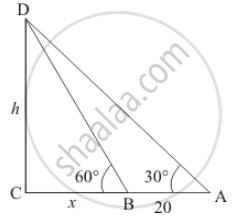
In ΔDBC
⇒ `tan D = (CD)/(BC)`
⇒ `tan 60^circ = (CD)/(BC)`
⇒ `sqrt(3) = h/x`
⇒ `x = h/sqrt(3)`
Again in ΔDAC
⇒ `tan A = (CD)/(BC + BA)`
⇒ `tan 30^circ = h/(x + 20)`
⇒ `1/sqrt(3) = h/(x + 20)`
⇒ `x = sqrt(3)h - 20`
⇒ `h/sqrt(3) + 20 = sqrt(3)h`
⇒ `h/sqrt3 - sqrt3h = -20`
⇒ `h - 3h = -20sqrt(3)`
⇒ `-2h = -20sqrt(3)`
⇒ `h = 10sqrt(3)`
⇒ h = 17.32
⇒ `x = (10sqrt(3))/sqrt(3)`
⇒ x = 10
So distance
⇒ AC = x + 20
⇒ AC = 30
Hence, the required height is 17.32 m and distance is 30 m.
