Advertisements
Advertisements
Questions
The angle of elevation of the top of a chimney from the foot of a tower is 60° and the angle of depression of the foot of the chimney from the top of the tower is 30°. If the height of the tower is 40 metres, find the height of the chimney.
According to pollution control norms, the minimum height of a smoke-emitting chimney should be 100 metres. State if the height of the above-mentioned chimney meets the pollution norms. What value is discussed in this question?
The angle of elevation of the top of a chimney from the foot of a tower is 60° and the angle of depression of the foot of the chimney from the top of the tower is 30°. If the height of the tower is 40 m, find the height of the chimney. According to pollution control norms, the minimum height of a smoke emitting chimney should be 100 m. State if the height of the above mentioned chimney meets the pollution norms. What value is discussed in this question?
Advertisements
Solution
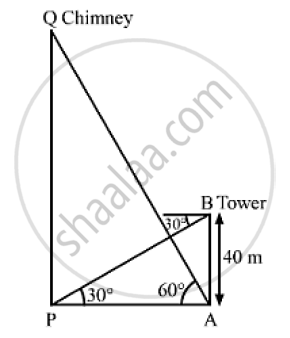
Let PQ be the chimney and AB be the tower.
We have,
AB = 40 m, ∠APB = 30° and ∠PAQ = 60°
In ΔABP,
`tan 30^circ = (AB)/(AP)`
`⇒ 1/sqrt(3) = 40/(AP)`
`⇒ AP = 40sqrt(3) m`
Now, in ΔAPQ,
` tan 60^circ = (PQ)/(AP)`
`⇒ sqrt(3) = (PQ)/(40sqrt(3))`
`PQ = 40sqrt(3) xx sqrt(3)`
PQ = 120 m
So, the height of the chimney is 120 m.
Now, DQ = PQ – PD
= 120 m – 40 m
= 80 m
`AP = BD = 40sqrt(3) m`
In ΔBDQ
`BQ = sqrt((DQ)^2 + (BD)^2)`
= `sqrt((80)^2 + (40sqrt(3))^2)`
= `sqrt(6400 + 4800)`
= `sqrt(11200)`
= `40sqrt(7) m`
Thus, length of wire tied from the top of the chimney to the top of tower is `40sqrt(7) m`.
