Advertisements
Chapters
2: Tissues
3: Improvements In Food Resources
4: Diversity in Living Organisms
Advertisements
Solutions for Chapter 1: The Fundamental Unit of Life : Cell
Below listed, you can find solutions for Chapter 1 of CBSE P S Verma and V K Agarwal for Biology Part 3 [English] Class 9.
P S Verma and V K Agarwal solutions for Biology Part 3 [English] Class 9 1 The Fundamental Unit of Life : Cell Very Short Answer Type Questions [Pages 41 - 42]
(Carrying 1 mark each)
What is a ‘cell’?
What is a prokaryotic cell?
What is a eukaryotic cell?
Who coined the term “cell” ?
Name the book in which Robert Hooke published his work.
Give One Word Answers.
Name the scientist who first studied living cell.
Name two factors on which shape of the cell depends.
Name the smallest cell.
Name the largest cell.
Name the longest cell in the human body.
How many cells are present in human body?
Name the structure from which all multicellular organisms develop.
Give two examples of prokaryotic cells?
Give one example of unicellular organism.
Give one example of multicellular organism.
Who proposed the "Cell theory"?
Schleiden and Schwarnn
Watson and Crick
Mendel and Morgan
Robert Hooke
What is a light microscope?
What is electron microscope?
Is the plasma membrane living or dead?
What is plasma mebrane?
Define the cell.
What is protoplasm?
Name the biomolecules present in plasma membrane.
What is meant by selectively permeable membrane?
What type of organization is found in the plasma membrane?
Define diffusion.
What is osmosis?
What would happen if the plasma membrane ruptures or breaks down?
What is the main function of plasma membrane?
What is endosmosis?
What is exosmosis?
Define hypertonic solution.
Define the following term:
Hypotonic solution
Define isotonic solutions.
What is endocytosis?
What is exocytosis?
Write down names of three types of endocytosis.
What is Active transport?
Is the plant cell wall living or dead?
Name the two organelles in a plant cell that contain their own genetic material and ribosomes.
Name the following:
Kitchen of a cell
Name the following:
Power house of cell
What is the chemical composition of cell wall in plants and fungi respectively?
What is the main function of the following organelles?
Ribosome
What is the main function of the following organelles?
Cell wall
Name the cell organelle in which following structures is present:
Cristae
Name the cell organelle in which following structure is present:
Stroma
Name the cell organelle in which following structure is present:
Centriole
Name the cell organelle in which following structure is present:
Chromosome
What is the main function of the following organelles?
Golgi bodies
What is the main function of the following organelles?
Vacuole
What cell organelle is responsible for release of energy as ATP?
What is the full form of ATP?
Name the nucleic acids that are present in an animal cell.
Do the plant cells contain centriole?
Write main differences between plant and animal cells.
P S Verma and V K Agarwal solutions for Biology Part 3 [English] Class 9 1 The Fundamental Unit of Life : Cell Short Answer Type Questions [Pages 42 - 43]
(Carrying 2 marks each)
Distinguish between prokaryotic and enkaryotic cells
Write down differences between organ and organelle.
Write down differences between nucleus and nucleoid
Differences between light microscope and electron microscope.
Give a brief account of discovery of the cell.
Describe the proteins of plasma membrane
Enumerate functions of plasma membrane.
Give an example of diffusion across plasma membrane.
Set up an experiment to demonstrate osmosis.
Write down the differences between diffusion and osmosis.
Write a note on endocytosis.
What would happen when eukaryotic cells are placed in hypotonic solutions?
What would happen when eukaryotic cells are placed in hypertonic solutions?
What would happen when eukaryotic cells are placed in isotonic solutions?
Name the Following:
Smallest Cell Organelle
Name the Following:
Largest Cell Organelle
Name the Following:
ER studded with ribosomes
Name the following:
Functional segments of the DNA molecule
Distinguish between the following:
Chromoplast and chloroplast
Distinguish between the following:
Ribosome and centrosome
Write main differences between plant and animal cells.
What will happen in a cell if its nucleus is removed? Give reasons in support of your answer.
Explain why do spinach look green, papaya yellow and edible part of water melon red?
Write Down Two Main Functions of Endoplasmic Reticulum.
Write down two main functions of Lysosome.
Name the following.
The cell organelle which synthesizes protein.
Name the following.
The type of plastid which stores food.
"Lysosomes are known as suicide bags". Why?
Define the term Cell inclusions.
Define the following term:
Cytosol
Define the following term:
Protoplasm
Define the following term:
Nucleoplasm
Where do the ribosomes get synthesized?
Write short note on
Mitochondria
Write short note on
Plastids
Write names of cell organelles.
What are three main functional regions of the cell?
What is the location of following in the cell:
Chromatin
What is the location of following in the cell:
Chromosome
What is the location of following in the cell:
Tonoplast
What is the location of following in the cell:
Nucleolus
What are the genes?
Where are genes located in the cell?
Lysosomes are also called digestive bags. Why?
Which organelle is the "power plant" of eukaryotic cell. Write in brief its functions.
What are centrioles?
Write about centrioles function.
Where do lipids and proteins constituting the plasma membrane get synthesised?
Draw a well labelled diagram of typical prokaryotic cell?
What does the term plasmolysed mean when used to describe a cell?
P S Verma and V K Agarwal solutions for Biology Part 3 [English] Class 9 1 The Fundamental Unit of Life : Cell Long Answer Type Questions [Page 43]
(Carrying 5 marks each)
Describe with a diagram the fluid mosaic organisation of the plasma membrane.
Draw a well labelled diagram of animal cell and mention one function of the main cell organelles.
Give an illustrated account of nucleus.
Write short note on the following:
Golgi apparatus
Write short note on
Mitochondria
P S Verma and V K Agarwal solutions for Biology Part 3 [English] Class 9 1 The Fundamental Unit of Life : Cell Multiple Choice Questions (MCQs) [Pages 43 - 45]
The smallest known cell is ______.
Yeast
Ovum
Mycoplasma
Nerve cell
Identify the organelle present only in animal cell.
Chloroplast
Nucleus
Centriole
Vacuole
The cell organelle that has DNA.
Mitochondria
Chloroplast
Nucleus
All of these
Vacuoles ______.
Disrupt water balance in animals
Provide flexibility to plant cells
Are small-sized in animal cells and large-sized in plant cells
All of these
Silver nitrate solution is used to study
endoplasmic reticulum
golgi apparatus
nucleus
mitochondria
Which cell organelle plays a crucial role in detoxifying many poisons and drugs in a cell?
Golgi apparatus
Lysosomes
Smooth endoplasmic reticulum
Vacuoles
Ribosomes may not be found attached to ______.
Endoplasmic reticulum
Nuclear membrane
Golgi bodies
All of these
Which one is the energy currency in living organisms?
Glucose
Pyruvate
ATP
ADP
The barrier between the cytoplasm and the outer environment in an animal cell is ______.
Cell wall
Plasma membrane
Cytoplasm
Nuclear membrane
Plasmolysis in a plant cell is defined as
break down (lysis ) of plasma membrane in hypotonic medium
shrinkage of cytoplasm in hypertonic medium
shrinkage of nucleoplasm
none of them
Proteins and lipids, essential for building plasma membrane are synthesized by ______.
Plasma membrane
Endoplasmic reticulum
Golgi apparatus
Plastids
The matrix of a chloroplast is called ______.
Plasma
Granum
Stroma
Lamella
Organisms produce new cells for ______.
Growth
Reproduction
Both growth and reproduction
None of these
The best material for the study of mitosis in laboratory is ______.
Anther
Root tip
Leaf tip
Ovary
New cells originate ______.
By fragmentation of a pre-existing cell
By regeneration of old cells
By cell division of a pre-existing cell
From inorganic and organic materials of the body
A type of cell division, in which daughter cells have half number of chromosomes.
Mitosis
Binary fission
Meiosis
Crossing over
The essential feature of meiosis is ______.
Formation of spindle fibres
Crossing over
Movement of chromosomes
Division of the nucleus
Chromosomes do not occur in pairs in ______.
Zygote
Somatic cell
Gametes
Cells of reproductive organs
The outer membrane is absent in ______.
Mitochondria
Ribosomes
Lysosomes
Plastids
A lysosome is called a “suicidal bag” because it ______.
Can digest parts of its own cell
Contains hydrolytic enzymes
Contains a food vacuole
Has parasitic activity
A nucleoid is found in ______.
mycoplasma and green algae
bacteria and blue-green algae
blue-green algae and red algae
bacteria and green algae
Chromosomes are made up of
DNA
protein
DNA and protein
RNA
Lysosome arises from
endoplasmic reticulum
Golgi apparatus
nucleus
mitochondria
P S Verma and V K Agarwal solutions for Biology Part 3 [English] Class 9 1 The Fundamental Unit of Life : Cell Questions Based on High Order Thinking Skills (HOTS) [Pages 45 - 46]
Cell inclusions are ______.
non-living materials present in the cytoplasm
another name of cell organelles
cytoskeletal framework of cell
combined name for cell wall and plasma membrane
Which of these is wrongly matched?
chloroplasts - chlorophyll
elaioplasts - starch
amyloplasts - carbohydrates
What will happen if chloroplast is taken out of the cell and illuminated?
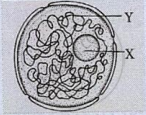
- Identify the figure given alongside.
- Label X and Y.
- What is the function of X?
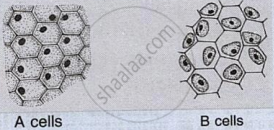
- Identify A- and B-cells.
- What will happen if B-cells are kept in hypotonic solution?
- What will happen if A cells are kept in hypertonic solution?
What will happen if excess amount of fertilizer is added to a green lawn?
What will happen if salt is added to cut pieces of raw mango?
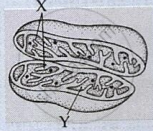
- Label X and Y.
- What is the function of X?
- What is the composition of Y?
- Identify the above diagram and what is its common name?
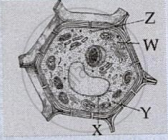
- Label W, X, Y, and Z.
- What is the covering membrane of X known as?
- Which of them contain hydrolytic enzymes?
- Which one of them takes part in storage, modification and packaging of various chemicals?
- Name the phenomenon which helps fresh water unicellular organisms (e.g., Amoeba) continuously gain water in their bodies. Also name the mechanisms by which these organisms throw out excess of water from their bodies.
- Give at least two examples in plants where a similar phenomenon is used to gain water.
The chief role of nucleolus in a nucleus concerns ______.
formation of chromosomes
DNA replication
ribosomal RNA synthesis
chromatic separation
Ribosomes are attached to ______.
DNA
endoplasmic reticulum
chloroplast membrane
mitochondrial membrane
Function of centriole is ______.
formation of spindle fibres in cell division
formation of chromosomes
storage of reserve food
initiation of protein synthesis
Black reaction of Camillo Golgi consisted of staining with ______.
charcoal
methylene blue
silver nitrate
sodium citrate
DNA stands for ______.
deoxyribonucleic acid
dihydroribonucleate acetate
diribonucleate acetate
decarboribonucleic acid
Which of the plastid imparts red colour to pomegranate?
Chloroplast
Chromoplast
Amyloplast
Leucoplast
Cell wall of fungi is made up of ______.
cellulose
chitin
pectins
all of these
The cell organelle found in prokaryotes as well as eukaryotes is ______.
endoplasmic reticulum
plastid
centriole
ribosome
Viruses do not show characteristics of life outside the living cells as they ______.
lack membrane
lack DNA and RNA
have RNA but no DNA
none of these
The organelle involved in packaging and dispatching the synthesized materials to various destinations inside and outside the cell is ______.
endoplasmic reticulum
golgi apparatus
chloroplast
lysosome
In a non-dividing cell, DNA is present as part of chromatin material which can be seen as ______.
enlarged mass of thread-like structure
thick rod-like structure
fine granules
crystalline structure
The cell organelle involved in forming complex sugars from simple sugars are
endoplasmic reticulum
ribosomes
plastids
golgi apparatus
Sap vacuole provides the plant cell ______.
turgidity
rigidity
both turgidity and rigidity
none of these
P S Verma and V K Agarwal solutions for Biology Part 3 [English] Class 9 1 The Fundamental Unit of Life : Cell Questions Based on Assertion-Reason [Page 49]
In the following questions, two statements are given - one labelled Assertion (A) and the other labelled Reason(R):
Assertion (A): When plant cells are kept in a hypertonic solution, the protoplast of the cell shrinks.
Reason (R): In plant cells kept in a hypertonic cell promote exosmosis due to which water of cytoplasm (including vacuoles) comes out through plasma membrane.
Both A and R are true and R is correct explanation of the assertion.
Both A and R are true but R is not the correct explanation of the assertion.
A is true but R is false.
A is false but R is true.
Assertion (A): Mitotic chromosomes of eukaryotes(plants and animals) are formed as super coiled chromatin.
Reason (R): Chromatin is of two types: euchromatin and heterochromatin.
Both A and R are true and R is correct explanation of the assertion.
Both A and R are true but R is not the correct explanation of the assertion.
A is true but R is false.
A is false but R is true.
Assertion (A): Mitochondria of the eukaryotic cells are power houses of the cell, they produce AТР molecule.
Reason (R): Mitochondria have DNA molecule and are autonomous cellular organelles.
Both A and R are true and R is correct explanation of the assertion.
Both A and R are true but R is not the correct explanation of the assertion.
A is true but R is false.
A is false but R is true.
Assertion (A): Ribosomes are the factories of cells for protein synthesis.
Reason (R): Building materials of ribosomes are manufactured in nucleolus(RNA) and cytoplasm (proteins).
Both A and R are true and R is correct explanation of the assertion.
Both A and R are true but R is not the correct explanation of the assertion.
A is true but R is false.
A is false but R is true.
Assertion (A): Chloroplasts occur in the plant cells and they perform photosynthesis to make food for the plants.
Reason (R): Green pigment chlorophyll is located in the thylakoid membranes of the chloroplast and they are meant for absorbing sunlight.
Both A and R are true and R is correct explanation of the assertion.
Both A and R are true but R is not the correct explanation of the assertion.
A is true but R is false.
A is false but R is true.
Solutions for 1: The Fundamental Unit of Life : Cell
P S Verma and V K Agarwal solutions for Biology Part 3 [English] Class 9 chapter 1 - The Fundamental Unit of Life : Cell
Shaalaa.com has the CBSE Mathematics Biology Part 3 [English] Class 9 CBSE solutions in a manner that help students grasp basic concepts better and faster. The detailed, step-by-step solutions will help you understand the concepts better and clarify any confusion. P S Verma and V K Agarwal solutions for Mathematics Biology Part 3 [English] Class 9 CBSE 1 (The Fundamental Unit of Life : Cell) include all questions with answers and detailed explanations. This will clear students' doubts about questions and improve their application skills while preparing for board exams.
Further, we at Shaalaa.com provide such solutions so students can prepare for written exams. P S Verma and V K Agarwal textbook solutions can be a core help for self-study and provide excellent self-help guidance for students.
Concepts covered in Biology Part 3 [English] Class 9 chapter 1 The Fundamental Unit of Life : Cell are Lysosome - “Suicidal Bag”, Cell Organelles, Structure of the Cell > Cell Wall: “Supporter and Protector”, Structure of the Cell > Nucleus: “Brain” of the Cell, Structure of the Cell > Cytoplasm: “Area of Movement”, Endoplasmic Reticulum (ER), Plastids, The Invention of the Microscope and the Discovery of Cell, Prokaryotic and Eukaryotic Cell, Cell Theory, Golgi Apparatus - "The delivery system of the cell", Mitochondria - “Power House of the Cell”, Non-living Substances Or Cell Inclusion, Plant Cell Vs Animal Cell, Cell Division: an Essential Life Process, Structure of the Cell > Plasma Membrane / Cell Membrane.
Using P S Verma and V K Agarwal Biology Part 3 [English] Class 9 solutions The Fundamental Unit of Life : Cell exercise by students is an easy way to prepare for the exams, as they involve solutions arranged chapter-wise and also page-wise. The questions involved in P S Verma and V K Agarwal Solutions are essential questions that can be asked in the final exam. Maximum CBSE Biology Part 3 [English] Class 9 students prefer P S Verma and V K Agarwal Textbook Solutions to score more in exams.
Get the free view of Chapter 1, The Fundamental Unit of Life : Cell Biology Part 3 [English] Class 9 additional questions for Mathematics Biology Part 3 [English] Class 9 CBSE, and you can use Shaalaa.com to keep it handy for your exam preparation.
