Advertisements
Chapters
Geography
2: Shaping of the Earth’s Surface
▶ 3: Atmosphere and Climate
History
4: Early Humans and Beginning of Civilisation
5: State and Society up to 1000 CE
Political Science
6: Democracy
7: Elections
Economics
8: Building Blocks in Economics: The Problem of Choice
9: The Price Puzzle: What Drives the Market
![NCERT solutions for Social Science Understanding Society India and Beyond Part 1 [English] Class 9 chapter 3 - Atmosphere and Climate - Shaalaa.com](/images/social-science-understanding-society-india-and-beyond-part-1-english-class-9_6:459c35e86f274147a517b882e2baab81.jpg "NCERT solutions for Social Science Understanding Society India and Beyond Part 1 [English] Class 9 chapter 3 - Atmosphere and Climate")
Advertisements
Solutions for Chapter 3: Atmosphere and Climate
Below listed, you can find solutions for Chapter 3 of CBSE NCERT for Social Science Understanding Society India and Beyond Part 1 [English] Class 9.
NCERT solutions for Social Science Understanding Society India and Beyond Part 1 [English] Class 9 3 Atmosphere and Climate Intext Queestions [Pages 39 - 56]
What is the composition of the Earth’s atmosphere?
How do the different layers of the atmosphere affect the planet Earth?
What is the mechanism of a monsoon?
How can we reduce our carbon footprint?
THINK ABOUT IT
Can you imagine what would happen if there were no atmosphere? Discuss your thoughts with your friends and teachers.

LET’S RECALL
How is nitrogen useful for plants? Remember that you learnt this in the chapter ‘The Invisible Living World: Beyond Our Naked Eyes’, in your Grade 8 Science textbook.
THINK ABOUT IT
You might have noticed that sometimes the wind is so strong that it is difficult to walk against it. Can you think of some other times when strong winds have caused problems for you?
LET’S EXPLORE
Find out other categories of wind based on speed and their common effects, and share your findings in class.
Local winds such as the land breeze and the sea breeze, also affect the weather and climate of a place. They are essential in creating moderate climatic conditions in the coastal region.
LET’S ANALYSE
Note down the weather report from a local newspaper for two weeks and observe the changes occurring in the weather.
THINK ABOUT IT
Hindustani Classical music associates certain rāgas with specific seasons. Find out which rāgas are connected to each season with the help of your elders and teachers.
LET’S EXPLORE
Describe in your own words how monsoon affects the lives of the people around you.
LET’S EXPLORE
My Carbon Footprint
Step 1: My Daily Habits
Tick the options that best describe you.
- Transport
- I usually walk/use a cycle. (Low impact)
- I use public transport/carpool. (Medium impact)
- I travel by private cars even for short distances. (High impact).
- I take flights more than twice a year. (Very high impact)
- Electricity Use
- I always switch off electrical appliances (lights, fans, etc.) when not in use. (Low impact)
- I sometimes forget to switch off electrical appliances (lights, fans, etc.). (Medium impact)
- I leave electrical appliances (lights, fans, etc.) on frequently. (High impact)
- Water Use
- I use water judiciously, for example, just one bucket of water for bathing. (Low impact)
- I sometimes waste water (leaving the tap running/ more buckets of water for a bath/long showers). (Medium impact)
- I rarely think about saving water. (High impact)
- Waste and Plastics
- I reuse, recycle, and avoid single-use plastics. (Low impact)
- I sometimes use disposable plastics (bottles/bags/ straws). (Medium impact)
- I often throw away plastic and do not recycle. (High impact)
Step 2: Score Yourself
-
- Low impact choices = 1 point
- Medium impact choices = 2 points
- High impact choices = 3 points
- Very high impact choices = 4 points
Now add up your total score: ______ points
Step 3: My Climate Action Pledge
Think about two simple changes you can make to reduce your score, and write them down below.
- .................................
- .................................
Classroom Discussion
To what extent did natural factors cause these floods compared to human activities?
Do you think better planning could have reduced the damage? How?
What are the guidelines for the management of floods according to the National Disaster Management Authority (NDMA)?
What role can students/youth play in helping with disaster preparedness?
NCERT solutions for Social Science Understanding Society India and Beyond Part 1 [English] Class 9 3 Atmosphere and Climate Questions and activities [Page 57]
What is atmosphere?
Explain its composition with the help of a pie diagram.
Draw a labelled diagram of the structure of the atmosphere.
Which are the four main seasons of India?
Why do you not feel the pressure of the atmosphere?
In which layer of the atmosphere do aeroplanes fly and why?
Distinguish between the following:
The troposphere and stratosphere
Distinguish between
North East Monsoon and South West Monsoon.
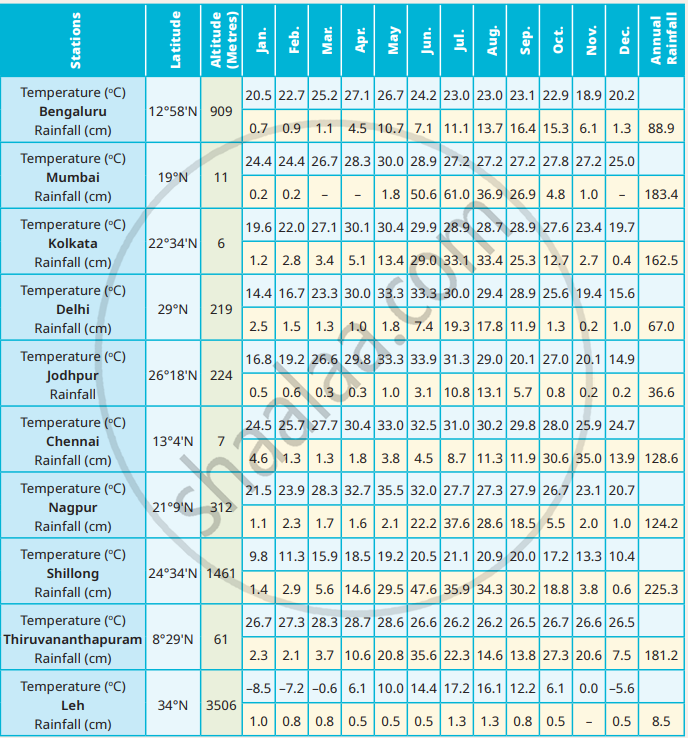
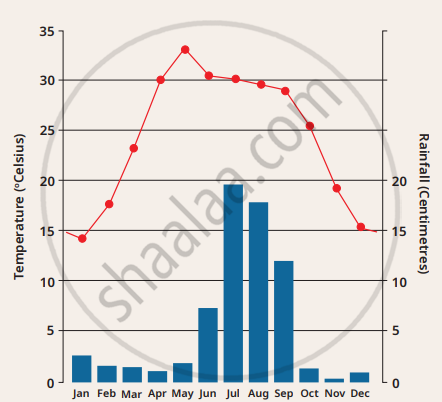
| Do it yourself: Table shows the average monthly temperatures and rainfall amounts for 10 representative stations. Study these figures on your own and convert them into ‘temperature and rainfall’ graphs. The visual representations will help you grasp their similarities and differences at a glance. One such graph, Fig., is already prepared for you. See if you can arrive at some broad generalisations about our diverse climatic conditions. |
1. Now look at the table again. Rearrange the 10 stations according to their distance from the equator.
2. Find out:
- Two stations with the most extreme climate
- Two stations influenced by retreating monsoons.
- The two hottest stations in the months of
- February
- June
3. Now find out:
- Why does Shillong experience more rainfall than Kolkata?
- Why does Delhi receive more rainfall than Jodhpur?
4. Now think about why
- Thiruvananthapuram has an equable climate?
- Chennai has more rainfall only after the fury of the monsoon is over in most parts of the country?
- Leh has moderate precipitation almost throughout the year?
5. Despite these differences across regions, can you observe any substantial evidence to conclude that the monsoons provide a very strong framework, lending overall climatic unity to the whole country?
Collect pictures of houses and clothing of people from different regions of India. Examine whether they reflect any relationship with the climatic conditions or the relief of those regions.
Solutions for 3: Atmosphere and Climate
NCERT solutions for Social Science Understanding Society India and Beyond Part 1 [English] Class 9 chapter 3 - Atmosphere and Climate
Shaalaa.com has the CBSE Mathematics Social Science Understanding Society India and Beyond Part 1 [English] Class 9 CBSE solutions in a manner that help students grasp basic concepts better and faster. The detailed, step-by-step solutions will help you understand the concepts better and clarify any confusion. NCERT solutions for Mathematics Social Science Understanding Society India and Beyond Part 1 [English] Class 9 CBSE 3 (Atmosphere and Climate) include all questions with answers and detailed explanations. This will clear students' doubts about questions and improve their application skills while preparing for board exams.
Further, we at Shaalaa.com provide such solutions so students can prepare for written exams. NCERT textbook solutions can be a core help for self-study and provide excellent self-help guidance for students.
Concepts covered in Social Science Understanding Society India and Beyond Part 1 [English] Class 9 chapter 3 Atmosphere and Climate are .
Using NCERT Social Science Understanding Society India and Beyond Part 1 [English] Class 9 solutions Atmosphere and Climate exercise by students is an easy way to prepare for the exams, as they involve solutions arranged chapter-wise and also page-wise. The questions involved in NCERT Solutions are essential questions that can be asked in the final exam. Maximum CBSE Social Science Understanding Society India and Beyond Part 1 [English] Class 9 students prefer NCERT Textbook Solutions to score more in exams.
Get the free view of Chapter 3, Atmosphere and Climate Social Science Understanding Society India and Beyond Part 1 [English] Class 9 additional questions for Mathematics Social Science Understanding Society India and Beyond Part 1 [English] Class 9 CBSE, and you can use Shaalaa.com to keep it handy for your exam preparation.
