Advertisements
Online Mock Tests
Chapters
2: Polynomials
▶ 3: Pair of Linear Equations in Two Variables
4: Quadratic Equations
5: Arithmetic Progressions
6: Triangles
7: Coordinate Geometry
8: Introduction to Trigonometry
9: Some Applications of Trigonometry
10: Circles
11: Constructions
12: Areas Related to Circles
13: Surface Areas and Volumes
14: Statistics
15: Probability
![NCERT solutions for Mathematics [English] Class 10 chapter 3 - Pair of Linear Equations in Two Variables - Shaalaa.com](/images/mathematics-english-class-10_6:608765d445324ac894a5bdfeb0e3a93a.jpg "NCERT solutions for Mathematics [English] Class 10 chapter 3 - Pair of Linear Equations in Two Variables")
Advertisements
Solutions for Chapter 3: Pair of Linear Equations in Two Variables
Below listed, you can find solutions for Chapter 3 of CBSE, Karnataka Board NCERT for Mathematics [English] Class 10.
NCERT solutions for Mathematics [English] Class 10 3 Pair of Linear Equations in Two Variables Exercise 3.1 [Page 44]
A father tells his daughter, “ Seven years ago, I was seven times as old as you were then. Also, three years from now, I shall be three times as old as you will be.” Represent this situation algebraically and graphically.
The cost of 2 kg of apples and 1 kg of grapes on a day was found to be Rs 160. After a month, the cost of 4 kg of apples and 2 kg of grapes is Rs 300. Represent the situation algebraically and geometrically.
The coach of a cricket team buys 3 bats and 6 balls for Rs 3900. Later, she buys another bat and 3 more balls of the same kind for Rs 1300. Represent this situation algebraically and geometrically.
NCERT solutions for Mathematics [English] Class 10 3 Pair of Linear Equations in Two Variables Exercise 3.2 [Pages 49 - 50]
10 students of class X took part in a Mathematics quiz. If the number of girls is 4 more than the number of boys, find the number of boys and girls who took part in the quiz.
Form the pair of linear equations in the following problems, and find their solutions graphically.
5 pencils and 7 pens together cost Rs 50, whereas 7 pencils and 5 pens together cost Rs 46. Find the cost of one pencil and that of one pen.
On comparing the ratios `bb(a_1/a_2, b_1/b_2)` and `bb(c_1/c_2)` without drawing them, find out whether the lines representing the following pair of linear equations intersect at a point, are parallel or coincide.
5x – 4y + 8 = 0
7x + 6y – 9 = 0
On comparing the ratios `bb(a_1/a_2, b_1/b_2` and `bb(c_1/c_2)` without drawing them, find out whether the lines representing the following pair of linear equations intersect at a point, are parallel or coincide.
9x + 3y + 12 = 0
18x + 6y + 24 = 0
On comparing the ratios `bb(a_1/a_2, b_1/b_2)` and `bb(c_1/c_2)` without drawing them, find out whether the lines representing the following pair of linear equations intersect at a point, are parallel or coincide.
6x – 3y + 10 = 0
2x – y + 9 = 0
On comparing the ratios `bb(a_1/a_2, b_1/b_2)` and `bb(c_1/c_2)`, find out whether the following pair of linear equations are consistent, or inconsistent.
3x + 2y = 5 ; 2x – 3y = 7
On comparing the ratios `bb(a_1/a_2, b_1/b_2)` and `bb(c_1/c_2)`, find out whether the following pair of linear equations are consistent, or inconsistent.
2x – 3y = 8 ; 4x – 6y = 9
On comparing the ratios `bb(a_1/a_2, b_1/b_2)` and `bb(c_1/c_2)`, find out whether the following pair of linear equations are consistent, or inconsistent.
`3/2x + 5/3y = 7` ; 9x - 10y = 14
On comparing the ratios `bb(a_1/a_2, b_1/b_2)` and `bb(c_1/c_2`, find out whether the following pair of linear equations are consistent, or inconsistent.
5x – 3y = 11 ; –10x + 6y = –22
On comparing the ratios `bb(a_1/a_2, b_1/b_2)` and `bb(c_1/c_2)`, find out whether the following pair of linear equations are consistent, or inconsistent.
`4/3x + 2y` = 8; 2x + 3y = 12
Which of the following pairs of linear equations are consistent/inconsistent? If consistent, obtain the solution graphically:
x + y = 5, 2x + 2y = 10
Which of the following pairs of linear equations are consistent/inconsistent? If consistent, obtain the solution graphically:
x – y = 8, 3x – 3y = 16
Which of the following pairs of linear equations are consistent/inconsistent? If consistent, obtain the solution graphically:
2x + y – 6 = 0, 4x – 2y – 4 = 0
Which of the following pairs of linear equations are consistent/inconsistent? If consistent, obtain the solution graphically:
2x – 2y – 2 = 0, 4x – 4y – 5 = 0
Half the perimeter of a rectangular garden, whose length is 4 m more than its width, is 36 m. Find the dimensions of the garden
Given the linear equation 2x + 3y – 8 = 0, write another linear equation in two variables such that the geometrical representation of the pair so formed is:
- Intersecting lines
- Parallel lines
- Coincident lines
Draw the graphs of the equations x – y + 1 = 0 and 3x + 2y – 12 = 0. Determine the coordinates of the vertices of the triangle formed by these lines and the x-axis, and shade the triangular region.
NCERT solutions for Mathematics [English] Class 10 3 Pair of Linear Equations in Two Variables Exercise 3.3 [Pages 53 - 54]
Solve the following pair of linear equations by the substitution method.
x + y = 14
x – y = 4
Solve the following pair of linear equations by the substitution method.
s – t = 3
`s/3 + t/2 = 6`
Solve the following pair of linear equations by the substitution method.
3x – y = 3
9x – 3y = 9
Solve the following pair of linear equations by the substitution method.
0.2x + 0.3y = 1.3
0.4x + 0.5y = 2.3
Solve the following pair of linear equations by the substitution method.
`sqrt2x + sqrt3y = 0`
`sqrt3x - sqrt8y = 0`
Solve the following pair of linear equations by the substitution method.
`(3x)/2 - (5y)/3 = -2`
`x/y+y/2 = 13/6`
Solve 2x + 3y = 11 and 2x – 4y = – 24 and hence find the value of ‘m’ for which y = mx + 3.
Form the pair of linear equations for the following problem and find their solution by substitution method.
The difference between two numbers is 26 and one number is three times the other. Find them.
Form the pair of linear equations for the following problem and find their solution by substitution method.
The larger of two supplementary angles exceeds the smaller by 18 degrees. Find them.
Form the pair of linear equations for the following problem and find their solution by substitution method.
The coach of a cricket team buys 7 bats and 6 balls for ₹ 3800. Later, she buys 3 bats and 5 balls for ₹ 1750. Find the cost of each bat and each ball.
Form the pair of linear equations for the following problems and find their solution by substitution method.
The taxi charges in a city consist of a fixed charge together with the charge for the distance covered. For a distance of 10 km, the charge paid is ₹ 105 and for a journey of 15 km, the charge paid is ₹ 155. What are the fixed charges and the charge per km? How much does a person have to pay for travelling a distance of 25 km?
Form the pair of linear equations for the following problem and find their solution by substitution method.
A fraction becomes `9/11` if 2 is added to both the numerator and the denominator. If 3 is added to both the numerator and the denominator it becomes `5/6`. Find the fraction.
Form the pair of linear equations for the following problem and find their solution by substitution method.
Five years hence, the age of Jacob will be three times that of his son. Five years ago, Jacob’s age was seven times that of his son. What are their present ages?
NCERT solutions for Mathematics [English] Class 10 3 Pair of Linear Equations in Two Variables Exercise 3.4 [Pages 56 - 57]
Solve the following pair of linear equation by the elimination method and the substitution method:
x + y = 5 and 2x – 3y = 4
Solve the following pair of linear equation by the elimination method and the substitution method:
3x + 4y = 10 and 2x – 2y = 2
Solve the following pair of linear equation by the elimination method and the substitution method.
3x – 5y – 4 = 0 and 9x = 2y + 7
Solve the following pair of linear equation by the elimination method and the substitution method.
`x/2 + (2y)/3 = -1 and x - y /3 = 3`
Form the pair of linear equation in the following problem, and find its solution (if they exist) by the elimination method:
If we add 1 to the numerator and subtract 1 from the denominator, a fraction reduces to 1. It becomes `1/2` if we only add 1 to the denominator. What is the fraction?
Form the pair of linear equation in the following problem, and find its solutions (if they exist) by the elimination method:
Five years ago, Nuri was thrice as old as Sonu. Ten years later, Nuri will be twice as old as Sonu. How old are Nuri and Sonu?
Form the pair of linear equation in the following problem, and find its solution (if they exist) by the elimination method:
The sum of the digits of a two-digit number is 9. Also, nine times this number is twice the number obtained by reversing the order of the digits. Find the number.
Form the pair of linear equation in the following problem, and find its solution (if they exist) by the elimination method:
Meena went to a bank to withdraw ₹ 2000. She asked the cashier to give her ₹ 50 and ₹ 100 notes only. Meena got 25 notes in all. Find how many notes of ₹ 50 and ₹ 100 she received.
Form the pair of linear equation in the following problem, and find its solution (if they exist) by the elimination method:
A lending library has a fixed charge for the first three days and an additional charge for each day thereafter. Saritha paid Rs 27 for a book kept for seven days, while Susy paid Rs 21 for the book she kept for five days. Find the fixed charge and the charge for each extra day.
NCERT solutions for Mathematics [English] Class 10 3 Pair of Linear Equations in Two Variables Exercise 3.5 [Pages 62 - 63]
Which of the following pairs of linear equations has unique solution, no solution, or infinitely many solutions. In case there is a unique solution, find it by using cross multiplication method
x – 3y – 3 = 0
3x – 9y – 2 = 0
Which of the following pairs of linear equations has unique solution, no solution or infinitely many solutions? In case there is a unique solution, find it by using cross multiplication method
2x + y = 5
3x + 2y = 8
Which of the following pairs of linear equations has unique solution, no solution, or infinitely many solutions. In case there is a unique solution, find it by using cross multiplication method
3x – 5y = 20
6x – 10y = 40
Which of the following pairs of linear equations has unique solution, no solution, or infinitely many solutions. In case there is a unique solution, find it by using cross multiplication method.
x – 3y – 7 = 0
3x – 3y – 15 = 0
For which values of a and b does the following pair of linear equations have an infinite number of solutions?
2x + 3y = 7
(a – b) x + (a + b) y = 3a + b – 2
For which value of k will the following pair of linear equations have no solution?
3x + y = 1
(2k – 1)x + (k – 1)y = 2k + 1
Solve the following pair of linear equations by the substitution and cross-multiplication methods
8x + 5y = 9
3x + 2y = 4
Form the pair of linear equations in the following problems and find their solutions (if they exist) by any algebraic method :
A part of monthly hostel charges is fixed and the remaining depends on the number of days one has taken food in the mess. When a student A takes food for 20 days she has to pay Rs 1000 as hostel charges whereas a student B, who takes food for 26 days, pays Rs 1180 as hostel charges. Find the fixed charges and the cost of food per day.
Form the pair of linear equations in the following problems and find their solutions (if they exist) by any algebraic method:
A fraction becomes `1/3` when 1 is subtracted from the numerator and it becomes `1/4` when 8 is added to its denominator. Find the fraction.
Form the pair of linear equations in the following problems and find their solutions (if they exist) by any algebraic method:
Yash scored 40 marks in a test, getting 3 marks for each right answer and losing 1 mark for each wrong answer. Had 4 marks been awarded for each correct answer and 2 marks been deducted for each incorrect answer, then Yash would have scored 50 marks. How many questions were there in the test?
Form the pair of linear equations in the following problems and find their solutions (if they exist) by any algebraic method:
Places A and B are 100 km apart on a highway. One car starts from A and another from B at the same time. If the cars travel in the same direction at different speeds, they meet in 5 hours. If they travel towards each other, they meet in 1 hour. What are the speeds of the two cars?
Form the pair of linear equations in the following problems and find their solutions (if they exist) by any algebraic method
The area of a rectangle gets reduced by 9 square units, if its length is reduced by 5 units and breadth is increased by 3 units. If we increase the length by 3 units and the breadth by 2 units, the area increases by 67 square units. Find the dimensions of the rectangle.
NCERT solutions for Mathematics [English] Class 10 3 Pair of Linear Equations in Two Variables Exercise 3.6 [Page 67]
Solve the following pairs of equations by reducing them to a pair of linear equations
`1/(2x) + 1/(3y) = 2`
`1/(3x) + 1/(2y) = 13/6`
Solve the following pairs of equations by reducing them to a pair of linear equations
`2/sqrtx +3/sqrty = 2`
`4/sqrtx - 9/sqrty = -1`
Solve the following pairs of equations by reducing them to a pair of linear equations
`4/x + 3y = 14`
`3/x - 4y = 23`
Solve the following pairs of equations by reducing them to a pair of linear equations
`5/(x-1) + 1/y-2 = 2`
`6/(x-1) - 3/(y-2) = 1`
Solve the following pairs of equations by reducing them to a pair of linear equations
`(7x-2y)/(xy) = 5`
`(8x + 7y)/(xy) = 15`
Solve the following pairs of equations by reducing them to a pair of linear equations
6x + 3y = 6xy
2x + 4y = 5xy
Solve the following pairs of equations by reducing them to a pair of linear equations
`10/(x+y) + 2/(x-y) = 4`
`15/(x+y) - 5/(x-y) = -2`
Solve the following pairs of equations by reducing them to a pair of linear equations
`1/(3x+y) + 1/(3x-y) = 3/4`
`1/(2(3x-y)) - 1/(2(3x-y)) = (-1)/8`
Formulate the following problems as a pair of equations, and hence find their solutions:
Ritu can row downstream 20 km in 2 hours, and upstream 4 km in 2 hours. Find her speed of rowing in still water and the speed of the current
Formulate the following problems as a pair of equations, and hence find their solutions:
2 women and 5 men can together finish an embroidery work in 4 days, while 3 women and 6 men can finish it in 3 days. Find the time taken by 1 woman alone to finish the work, and also that taken by 1 man alone.
Formulate the following problems as a pair of equations, and hence find their solutions:
Roohi travels 300 km to her home partly by train and partly by bus. She takes 4 hours if she travels 60 km by train and remaining by bus. If she travels 100 km by train and the remaining by bus, she takes 10 minutes longer. Find the speed of the train and the bus separately.
NCERT solutions for Mathematics [English] Class 10 3 Pair of Linear Equations in Two Variables Exercise 3.7 [Page 68]
The ages of two friends Ani and Biju differ by 3 years. Ani’s father Dharam is twice as old as Ani and Biju is twice as old as his sister Cathy. The ages of Cathy and Dharam differ by 30 years. Find the ages of Ani and Biju.
One says, "Give me a hundred, friend! I shall then become twice as rich as you". The other replies, “If you give me ten, I shall be six times as rich as you”. Tell me what is the amount of their (respective) capital? [From the Bijaganita of Bhaskara II)
[Hint: x + 100 = 2 (y − 100), y + 10 = 6(x − 10)]
A train covered a certain distance at a uniform speed. If the train could have been 10 km/hr faster, it would have taken 2 hours less than the scheduled time. And if the train were slower by 10 km/hr; it would have taken 3 hours more than the scheduled time. Find the distance covered by the train.
The students of a class are made to stand in rows. If 3 students are extra in a row, there would be 1 row less. If 3 students are less in a row, there would be 2 rows more. Find the number of students in the class.
In a ΔABC, ∠C = 3 ∠B = 2 (∠A + ∠B). Find the three angles.
Draw the graphs of the equations 5x – y = 5 and 3x – y = 3. Determine the co-ordinates of the vertices of the triangle formed by these lines and the y-axis.
Solve the following pair of linear equations: px + qy = p − q, qx − py = p + q
Solve the following pair of linear equations
ax + by = c
bx + ay = 1 + c
Solve the following pair of linear equations.
`x/a-y/b = 0`
ax + by = a2 + b2
Solve the following pair of linear equations.
(a − b) x + (a + b) y = a2− 2ab − b2
(a + b) (x + y) = a2 + b2
Solve the following pair of linear equations.
152x − 378y = − 74
− 378x + 152y = − 604
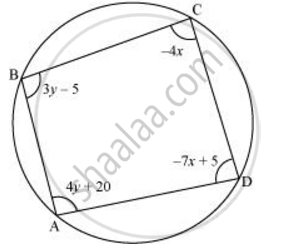
ABCD is a cyclic quadrilateral finds the angles of the cyclic quadrilateral.
Solutions for 3: Pair of Linear Equations in Two Variables
NCERT solutions for Mathematics [English] Class 10 chapter 3 - Pair of Linear Equations in Two Variables
Shaalaa.com has the CBSE, Karnataka Board Mathematics Mathematics [English] Class 10 CBSE, Karnataka Board solutions in a manner that help students grasp basic concepts better and faster. The detailed, step-by-step solutions will help you understand the concepts better and clarify any confusion. NCERT solutions for Mathematics Mathematics [English] Class 10 CBSE, Karnataka Board 3 (Pair of Linear Equations in Two Variables) include all questions with answers and detailed explanations. This will clear students' doubts about questions and improve their application skills while preparing for board exams.
Further, we at Shaalaa.com provide such solutions so students can prepare for written exams. NCERT textbook solutions can be a core help for self-study and provide excellent self-help guidance for students.
Concepts covered in Mathematics [English] Class 10 chapter 3 Pair of Linear Equations in Two Variables are .
Using NCERT Mathematics [English] Class 10 solutions Pair of Linear Equations in Two Variables exercise by students is an easy way to prepare for the exams, as they involve solutions arranged chapter-wise and also page-wise. The questions involved in NCERT Solutions are essential questions that can be asked in the final exam. Maximum CBSE, Karnataka Board Mathematics [English] Class 10 students prefer NCERT Textbook Solutions to score more in exams.
Get the free view of Chapter 3, Pair of Linear Equations in Two Variables Mathematics [English] Class 10 additional questions for Mathematics Mathematics [English] Class 10 CBSE, Karnataka Board, and you can use Shaalaa.com to keep it handy for your exam preparation.
