Advertisements
Online Mock Tests
Chapters
2: Chemical Bonding
3: Acids, Bases and Salts
4: Analytical Chemistry
5: Mole Concept and Stoichiometry
6: Electrolysis
7: Metallurgy
▶ 8: Study of Compounds: Hydrogen Chloride
9: Study of Compounds: Ammonia
10: Study of Compounds: Nitric Acid
11: Study of Compounds: Sulphuric Acid
12: Organic Chemistry
Chapter 13: Practical Work
![Lakhmir Singh solutions for Chemistry [English] Class 10 ICSE chapter 8 - Study of Compounds: Hydrogen Chloride - Shaalaa.com](/images/chemistry-english-class-10-icse_6:b9d33ffc3c864725b49a398fa5334703.jpg "Lakhmir Singh solutions for Chemistry [English] Class 10 ICSE chapter 8 - Study of Compounds: Hydrogen Chloride")
Advertisements
Solutions for Chapter 8: Study of Compounds: Hydrogen Chloride
Below listed, you can find solutions for Chapter 8 of CISCE Lakhmir Singh for Chemistry [English] Class 10 ICSE.
Lakhmir Singh solutions for Chemistry [English] Class 10 ICSE 8 Study of Compounds: Hydrogen Chloride Intext Question [Pages 164 - 171]
TEST YOUR UNDERSTANDING - 1
State whether the following statement is True or False.
The chemical formula of hydrogen chloride is HCl.
State whether the following statement is True or False.
Molecular weight of hydrogen chloride is 34.5 u.
State whether the following statement is True or False.
Lavoisier named HCl as hydrogen chloride.
State whether the following statement is True or False.
Activated carbon enhances the rate of a chemical reaction.
State whether the following statement is True or False.
Hydrogen chloride is covalent due to the difference in the electronegativity between hydrogen and chlorine.
Fill in the following blanks with suitable words.
Hydrogen is ______ than air.
HCl gas can be liquefied at ______ pressure and ______ temperature.
When hydrogen and chlorine gas react in the presence of direct sunlight the reaction becomes very ______.
In the fountain experiment, the blue litmus solution turns into a red fountain. It shows ______ of hydrogen chloride.
Choose the correct option for each ofthe following questions.
The chemical formula of muriatic acid is ______.
H2SO4
HNO3
HF
HCl
In 1648, which of the following scientist prepared hydrogen chloride gas from sodium chloride and concentrated sulphuric acid?
William Prout
Glauber
Davy
Lavoisier
Normally concentrated hydrogen chloride contains ______.
36.7%
37%
38%
38.5%
HNO3 cannot be used in place of concentrated H2SO4 because HNO3 acid ______.
volatilises and may volatilise out along with HCl
is very costly and not easily available
does not react with sodium chloride
It is very harmful
The fountain experiment is used to check which property of HCl gas?
Density
Molecular weight
Solubility
Viscosity
Noble metals react only with ______.
sulphuric acid
hydrochloric acid
aqua regia
nitric acid
The fountain experiment is used ______.
to show solubility of hydrogen chloride gas in water
to show electrical conductivity of hydrogen chloride gas in water
to show acidic nature of hydrogen chloride gas
to show solubility of hydrogen chloride gas in water and to show acidic nature of hydrogen chloride gas
Match the items given in column I with the one given in column II.
| Column I | Column II |
| (p) AgCl | (i) in its aqueous forms hydronium ion |
| (q) NH4Cl | (ii) salt insoluble in nitric acid but soluble in ammonia solution |
| (r) HCl | (iii) salt obtained when a basic gas reacts with HCl gas |
| (s) FeCl2 | (iv) salt obtained by the action of active metal with HCl |
Why is the gastric juice of the mammal acidic?
Why is HCl considered as a polar covalent compound?
State why HCl gas, fumes in moist air.
Write an ionic equation when HCl gas is dissolved in water.
Draw a labelled diagram and explain the laboratory preparation of hydrogen chloride gas. Give the balanced equations.
Explain why HCl gas is collected by using upward displacement of air.
Explain why P2O5 and CaO cannot be used for drying of hydrogen chloride gas.
In the laboratory preparation of HCl gas from sodium chloride, state why the following is preferred.
Conc. H2SO4 as a reactant.
In the laboratory preparation of HCl gas from sodium chloride, state why the following is preferred.
The temperature of reaction mixture kept below 200°C.
In the laboratory preparation of HCl gas from sodium chloride, state why the following is preferred.
Conc. H2SO4 is used as a drying agent.
TEST YOUR UNDERSTANDING - 2
State whether the following statement is True or False.
Dil. HCl does not normally reacts with nitrates except nitrates of lead and mercury.
State whether the following statement is True or False.
A thick curdy white precipitate is formed when a salt of silver reacts with HCl.
State whether the following statement is True or False.
Concentrated hydrochloric acid can readily be oxidised by strong oxidising agents.
State whether the following statement is True or False.
On heating with concentrated HCl, PbO2 gets oxidised.
State whether the following statement is True or False.
CaOCl2 on heating with dil. HCl forms O2 gas.
Fill in the following blanks with suitable words.
______ + HCl (dil.) → metal salt + water + carbon dioxide
______ HCl (dil.) → metal salt sulphide + hydrogen gas
______ + HCl (dil.) → metal salt + hydrogen gas
______ + HCl (dil.) → metal salt + water + sulphur dioxide
______ + HCl (dil.) → metal salt + water
Choose the correct option for each of the following questions.
Which of the following is the product formed when hydrochloric acid reacts with Fe2O3?
FeCl3 + Water
FeCl3 + Cl2 gas
Only FeCl3
FeCl3 + Water + Cl2 gas
Which of the following gas is liberated when hydrochloric acid is added to iron(II) sulphide?
Hydrogen
Chlorine
Carbon dioxide
Hydrogen sulphide
When an active metal reacts with HCl which of the following gas is evolved?
Cl2
H2
N2
H2S
An azeotrope mixture boils at a constant temperature, ______.
without any change in its composition
with change in its composition
with change in its composition initially, but after some time it gets constant
None of the above
Which of the following salts reacts with HCl to precipitate sulphur?
Na2SO3
NaHSO3
Na2S
Na2S2O3
Match the chemicals given in column I with the respective description given in column II.
| Column I | Column II |
| (p) CO2 gas released | (i) salt soluble in hot water but insoluble in cold water |
| (q) AgCl | (ii) salt insoluble in nitric acid but soluble in ammonia solution |
| (r) PbCl2 | (iii) metal carbonates react with HCl |
| (s) HCl | (iv) used for pickling of metals |
State your observation when a rod dipped in ammonium hydroxide solution is taken to the mouth of the jar filled with HCl. Write down the chemical equation for the same reaction.
How will you obtain [PbCl4]2− from (PbNO3)2? Give the chemical equation for the reaction.
State why dilute hydrochloric acid cannot be concentrated beyond a certain concentration on boiling?
Why are conventional drying agents such as calcium oxide and phosphorous pentoxide not used for drying moist HCl gas? Give equations.
Describe a test (other than electrolysis) to prove that hydrochloric acid contains hydrogen.
Describe a test (other than electrolysis) to prove that hydrochloric acid contains chlorine gas.
ART EXPRESS
Make a miniature model of the apparatus setup of the Fountain Experiment using dropper, flask, paper straw etc. Present this model in your classroom and explain the working principle of the setup and significance of the experiment to your fellow classmates and teacher.
Lakhmir Singh solutions for Chemistry [English] Class 10 ICSE 8 Study of Compounds: Hydrogen Chloride EXERCISE [Pages 173 - 175]
Objective Questions
True or False.
Hydrogen chloride is manufactured by the 'salt cake' method.
True or False.
Hydrogen chloride can be obtained from the heavy organic chemical industry.
True or False.
Sodium bisulphate is formed in the second step of the 'salt cake' method.
True or False.
When dilute hydrochloric acid reacts with thiosulphates, then sulphur dioxide gas is liberated and yellow sulphur is precipitated.
True or False.
Dilute hydrochloric acid reacts with metal oxides/hydroxides and forms metal chloride and water.
True or False.
With HCl moist blue litmus paper turns red.
True or False.
Dry HCl gas and liquefied HCl turn blue litmus paper red.
True or False.
Carbon dioxide gas is liberated when hydrochloric acid reacts with carbonates or bicarbonates.
True or False.
Concentrated sulphuric acid is corrosive and causes blisters on the skin.
Fill in the Blanks
Ca + 2HCl → CaCl2 + ______
CuO + 2HCl → ______ + H2O
NaHCO3 + HCl → NaCl + ______ + ______
CaCO3 + 2HCl → CaCl2 + ______ + ______
HCl turns the orange colour of the methyl orange indicator into ______.
Multiple Choice Questions
Which of the following can be used to dry HCl gas?
Sodium hydroxide
Potassium hydroxide
Nitric acid
Sulphuric acid
Which of the following does not react with hydrochloric acid to give chlorine?
KMnO4
MnO2
K2Cr2O7
Mg
Which of the following reacts with hydrochloric acid to give hydrogen as a product?
Zn
Sodium carbonate
Sodium sulphate
Sodium nitrate
For which of the following hydrochloric acid is not used:
Manufacture of metal chloride
Preparation of TNT
Preparation of aqua regia
Extraction of glue from bones
Hydrochloric acid reacts as a reducing agent because ______.
it oxidises strong reducing agents
it oxidises strong oxidising agents
it can be oxidised to chlorine by strong oxidising agent
it can be reduced to chlorine by strong reducing agent.
Hydrogen chloride gives white precipitate with:
Silver nitrate
Lead nitrate
Ammonium nitrate
Both Silver nitrate and Lead nitrate
In a chemical reaction, aqua regia releases nascent ______.
Chlorine
Oxygen
Nitrogen
Hydrogen
Which of the following is not a physical property of hydrogen chloride?
The gas fumes in moist air.
It has a pungent and suffocating smell.
It is insoluble in water.
It is heavier than air.
A substance with which conc. hydrochloric acid reacts to liberate chlorine is ______.
PbO
PbCl2
PbO2
Pb3O4
Hydrochloric acid reacts with carbonates or bicarbonates of metals and product is formed:
Metal chloride + water + carbon dioxide gas
Metal chloride + carbon dioxide gas
Only metal chloride
Metal chloride + water
Match the chemical reaction given in column I with the name of the gas evolved mentioned in column II and choose the correct option.
| Column I | Column II |
| (p) CuCl2 + H2SO4 | (i) H2S gas evolved |
| (q) Mg + HCl | (ii) H2 gas evolved |
| (r) NaHCO3 + HCl | (iii) CO2 gas evolved |
| (s) FeS + HCl | (iv) HCl gas evolved |
(p) - (iv), (q) - (ii), (r) - (iii), (s) - (i)
(p) - (iii), (q) - (i), (r) - (ii), (s) - (iv)
(p) - (iii), (q) - (i), (r) - (iv), (s) - (ii)
(p) - (iv), (q) - (i), (r) - (iii), (s) - (ii)
Match the chemical reaction given in column I with the name of the gas evolved mentioned in column II and choose the correct option.
| Column I | Column II |
| (p) Who prepared HCl by heating sodium chloride with concentrated sulphuric acid | (i) Lavoisier |
| (q) Muriatic acid name was given to hydrogen chloride by | (ii) Glauber |
| (r) Who gave the name hydrochloric acid to HCl | (iii) Davy |
| (s) Who discovered that presence of HCl in gastric juice of mammals | (iv) William Prout |
(p) - (i), (q) - (ii), (r) - (iii), (s) - (iv)
(p) - (ii), (q) - (i), (r) - (iii), (s) - (iv)
(p) - (iii), (q) - (i), (r) - (iv), (s) - (ii)
(p) - (iv), (q) - (i), (r) - (iii), (s) - (ii)
Hydrogen chloride gas is not collected over water, as:
It is highly soluble in water.
It is less soluble in water.
It is lighter than air.
It is heavier than air.
The metallic oxide, which when reacts with HCl forms salt and water.
Carbon monoxide
Nitrous oxide
Ammonium hydroxide
Sodium oxide
Descriptive Questions Short Answer Questions
State the composition of aqua regia. State which component is the oxidizing agent in aqua regia.
Solution A reacts with an acid B (which gives greenish yellow gas on reacting with oxidizing agents like Pb3O4) to give white precipitate C insoluble in nitric acid but soluble in ammonium hydroxide. Name A, B and C.
How will the action of dilute hydrochloric acid enable you to distinguish between sodium carbonate and sodium sulphite?
How will the action of dilute hydrochloric acid enable you to distinguish between sodium thiosulphate and sodium sulphite?
A greenish-yellow gas is liberated when concentrated hydrochloric acid is heated with an oxidising agent MnO2. The liberated gas turns moist starch iodide paper blue-black. Identify the liberated gas.
HCl gas gives a thick white fume when a glass rod dipped into ammonia solution is brought near the vapours of the acid. Identify the name of the thick white fumes.
Write an equation for the reaction of hydrochloric acid on the silver nitrate solution.
Write an equation for the reaction of hydrochloric acid on magnesium foil.
Write an equation for the reaction of hydrochloric acid on caustic soda solution.
Write an equation for the reaction of hydrochloric acid on zinc carbonate.
Write the balanced equation for the reaction of dilute hydrochloric acid with the following:
Iron
Write the balanced equation for the reaction of dilute hydrochloric acid with the following:
Sodium hydrogen carbonate
Write the balanced equation for the reaction of dilute hydrochloric acid with the following:
Iron (II) sulphide
Write a balanced equation for the action of dilute hydrochloric acid on sodium sulphide.
Write a balanced chemical equation.
Sodium thiosulphate is reacted with dilute hydrochloric acid.
Refer to the flowchart diagram below and give balanced equations with conditions, if any, for the following conversions A to D.
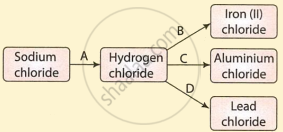
The following question is pertaining to the laboratory preparation of hydrogen chloride gas.
Write the equation for its preparation, mentioning the condition required.
The following question is pertaining to the laboratory preparation of hydrogen chloride gas.
Name the drying agent used and justify your choice.
The following question is pertaining to the laboratory preparation of hydrogen chloride gas.
State a safety precaution you would take during the preparation of hydrochloric acid.
For the preparation of hydrochloric acid in the laboratory:
Why is the direct absorption of hydrogen chloride gas in water not feasible?
For the preparation of hydrochloric acid in the laboratory:
What arrangement is done to dissolve hydrogen chloride gas in water?
Hydrogen chloride gas is prepared in the laboratory by the action of concentrated sulphuric acid on sodium chloride.
Give a balanced chemical equation for the above reaction.
Hydrogen chloride gas is prepared in the laboratory using concentrated sulphuric acid and sodium chloride. Answer the question that follow based on this reaction.
Why is concentrated sulphuric acid used instead of concentrated nitric acid?
Hydrogen chloride gas is prepared in the laboratory using concentrated sulphuric acid and sodium chloride. Answer the question that follow based on this reaction.
How is the gas collected?
Hydrogen chloride gas is prepared in the laboratory using concentrated sulphuric acid and sodium chloride. Answer the question that follow based on this reaction.
Name the drying agent not used for drying the gas.
Long Answer Questions
Explain why anhydrous HCl is a poor conductor while aqueous HCl is an excellent conductor.
Explain why?
Liquefied hydrogen chloride gas does not conduct electricity.
Explain why?
Why the funnel arrangement is used in the preparation of hydrochloric acid.
Explain why a solution of hydrogen chloride in water turns blue litmus red and conducts electricity, while a solution of the same gas in toluene:
- has no effect on litmus, and
- does not conduct electricity.
Explain why?
Hydrogen gas is not collected over water.
Explain why dilute hydrochloric acid cannot be concentrated by boiling beyond 22.2%.
Write the balanced equation for the reaction of dilute hydrochloric acid with the following:
Iron
Write the balanced equation for the reaction of dilute hydrochloric acid with the following:
Sodium hydrogen carbonate
Write the balanced equation for the reaction of dilute hydrochloric acid with the following:
Iron (II) sulphide
Write balanced equation for the reaction between dilute hydrochloric acid and sodium sulphite.
Write a balanced chemical equation.
Sodium thiosulphate is reacted with dilute hydrochloric acid.
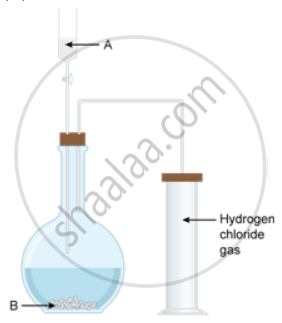
The diagram shows an apparatus for the laboratory preparation of hydrogen chloride.
(i) Identify A and B
(ii) Write the equation for the reaction
(iii) How would you check whether or not the gas jar is filled with hydrogen chloride?
(iv) What does the method of collection tell you about the density of hydrogen chloride.
Solutions for 8: Study of Compounds: Hydrogen Chloride
Lakhmir Singh solutions for Chemistry [English] Class 10 ICSE chapter 8 - Study of Compounds: Hydrogen Chloride
Shaalaa.com has the CISCE Mathematics Chemistry [English] Class 10 ICSE CISCE solutions in a manner that help students grasp basic concepts better and faster. The detailed, step-by-step solutions will help you understand the concepts better and clarify any confusion. Lakhmir Singh solutions for Mathematics Chemistry [English] Class 10 ICSE CISCE 8 (Study of Compounds: Hydrogen Chloride) include all questions with answers and detailed explanations. This will clear students' doubts about questions and improve their application skills while preparing for board exams.
Further, we at Shaalaa.com provide such solutions so students can prepare for written exams. Lakhmir Singh textbook solutions can be a core help for self-study and provide excellent self-help guidance for students.
Concepts covered in Chemistry [English] Class 10 ICSE chapter 8 Study of Compounds: Hydrogen Chloride are .
Using Lakhmir Singh Chemistry [English] Class 10 ICSE solutions Study of Compounds: Hydrogen Chloride exercise by students is an easy way to prepare for the exams, as they involve solutions arranged chapter-wise and also page-wise. The questions involved in Lakhmir Singh Solutions are essential questions that can be asked in the final exam. Maximum CISCE Chemistry [English] Class 10 ICSE students prefer Lakhmir Singh Textbook Solutions to score more in exams.
Get the free view of Chapter 8, Study of Compounds: Hydrogen Chloride Chemistry [English] Class 10 ICSE additional questions for Mathematics Chemistry [English] Class 10 ICSE CISCE, and you can use Shaalaa.com to keep it handy for your exam preparation.
