Advertisements
Online Mock Tests
Chapters
2: Physics and Mathematics
3: Rest and Motion: Kinematics
4: The Forces
5: Newton's Laws of Motion
6: Friction
7: Circular Motion
8: Work and Energy
9: Centre of Mass, Linear Momentum, Collision
10: Rotational Mechanics
11: Gravitation
12: Simple Harmonics Motion
13: Fluid Mechanics
14: Some Mechanical Properties of Matter
15: Wave Motion and Waves on a String
16: Sound Waves
17: Light Waves
18: Geometrical Optics
19: Optical Instruments
▶ 20: Dispersion and Spectra
21: Speed of Light
22: Photometry
23: Heat and Temperature
24: Kinetic Theory of Gases
25: Calorimetry
26: Laws of Thermodynamics
27: Specific Heat Capacities of Gases
28: Heat Transfer
29: Electric Field and Potential
30: Gauss’s Law
31: Capacitors
32: Electric Current in Conductors
33: Thermal and Chemical Effects of Current
34: Magnetic Field
35: Magnetic Field due to a Current
36: Permanent Magnets
37: Magnetic Properties of Matter
38: Electromagnetic Induction
39: Alternating Current
40: Electromagnetic Waves
41: Electric Current through Gases
42: Photoelectric Effect and Wave-Particle Duality
43: Bohr’s Model and Physics of Atom
44: X-rays
45: Semiconductors and Semiconductor Devices
46: The Nucleus
47: The Special Theory of Relativity
![HC Verma solutions for Concepts of Physics Volume 1 and 2 [English] chapter 20 - Dispersion and Spectra - Shaalaa.com](/images/concepts-of-physics-volume-1-and-2-english_6:9bad16cab2dd4ae1a1a6bac3add1eb27.jpg "HC Verma solutions for Concepts of Physics Volume 1 and 2 [English] chapter 20 - Dispersion and Spectra")
Advertisements
Solutions for Chapter 20: Dispersion and Spectra
Below listed, you can find solutions for Chapter 20 of CBSE, Karnataka Board PUC HC Verma for Concepts of Physics Volume 1 and 2 [English].
HC Verma solutions for Concepts of Physics Volume 1 and 2 [English] 20 Dispersion and Spectra Short Answers [Page 441]
The equation \[\omega = \frac{\mu_u - \mu_r}{\mu - 1}\] was derived for a prism having small refracting angle. Is it also valid for a prism of large refracting angle? Is it also valid for a glass slab or a glass sphere?
Can the dispersive power \[\omega = \frac{\mu_u - \mu_r}{\mu - 1}\] be negative? What is the sign of ω if a hollow prism is immersed into water?
If three identical prisms are combined, is it possible to pass a beam that emerges undeviated? Undispersed?
"Monochromatic light should be used to produce pure spectrum". Comment on this statement.
Does focal length of a lens depend on the colour of the light used? Does focal length of a mirror depend on the colour?
Suggest a method to produce a rainbow in your house.
HC Verma solutions for Concepts of Physics Volume 1 and 2 [English] 20 Dispersion and Spectra MCQ [Pages 441 - 442]
The angular dispersion produced by a prism ___________ .
increases if the average refractive index increases
increases if the average refractive index decreases
remains constant whether the average refractive index increases or decreases
has no relation with average refractive index
If a glass prism is dipped in water, its dispersive power ___________ .
increases
decreases
does not change
may increase or decrease depending on whether the angle of the prism is less than or greater than 60°
A prism can produce a minimum deviation δ in a light beam. If three such prisms are combined, the minimum deviation that can be produced in this beam is _______________.
0
δ
2δ
3δ
Consider the following two statements :-
(A) Line spectra contain information about atoms.
(B) Band spectra contain information about molecules.
Both A and B are wrong
A is correct but B is wrong
B is correct but A is wrong
Both A and B are correct
The focal length of a converging lens are fv and fr for violet and red light respectively.
fv > fr
fv = fr
fv < fr
Any of the three is possible depending on the value of the average refractive index μ.
HC Verma solutions for Concepts of Physics Volume 1 and 2 [English] 20 Dispersion and Spectra MCQ [Page 442]
A narrow beam of white light goes through a slab having parallel faces.
(a) The light never splits in different colours
(b) The emergent beam is white
(c) The light inside the slab is split into different colours
(d) The light inside the slab is white
By properly combining two prisms made of different materials, it is possible to
(a) have dispersion without average deviation
(b) have deviation without dispersion
(c) have both dispersion and average deviation
(d) have neither dispersion nor average deviation
In producing a pure spectrum, the incident light is passed through a narrow slit placed in the focal plane of an achromatic lens because a narrow slit ___________ .
produces less diffraction
increases intensity
allows only one colour at a time
allows a more parallel beam when it passes through the lens
Which of the following quantities related to a lens depend on the wavelength or wavelengths of the incident light?
(a) Power
(b) Focal length
(c) Chromatic aberration
(d) Radii of curvature
Which of the following quantities increase when wavelength is increased? Consider only the magnitudes.
(a) The power of a converging lens
(b) The focal length of a converging lens
(c) The power of a diverging lens
(d) The focal length of a diverging lens
HC Verma solutions for Concepts of Physics Volume 1 and 2 [English] 20 Dispersion and Spectra Exercise [Pages 442 - 443]
A flint glass prism and a crown glass prism are to be combined in such a way that the deviation of the mean ray is zero. The refractive index of flint and crown glasses for the mean ray are 1.620 and 1.518 respectively. If the refracting angle of the flint prism is 6.0°, what would be the refracting angle of the crown prism?
A certain material has refractive indices 1.56, 1.60 and 1.68 rfor red, yellow and violet lightespectively. (a) Calculate the dispersive power. (b) Find the angular dispersion produced by a thin prism of angle 6° made of this material.
The focal lengths of a convex lens for red, yellow and violet rays are 100 cm, 98 cm and 96 cm respectively. Find the dispersive power of the material of the lens.
The refractive index of a material changes by 0.014 as the colour of the light changes from red to violet. A rectangular slab of height 2.00 cm made of this material is placed on a newspaper. When viewed normally in yellow light, the letters appear 1.32 cm below the top surface of the slab. Calculate the dispersive power of the material.
A thin prism is made of a material having refractive indices 1.61 and 1.65 for red and violet light. The dispersive power of the material is 0.07. It is found that a beam of yellow light passing through the prism suffers a minimum deviation of 4.0° in favourable conditions. Calculate the angle of the prism.
The minimum deviations suffered by, yellow and violet beams passing through an equilateral transparent prism are 38.4°, 38.7° and 39.2° respectively. Calculate the dispersive power of the medium.
Two prisms of identical geometrical shape are combined with their refracting angles oppositely directed. The materials of the prisms have refractive indices 1.52 and 1.62 for violet light. A violet ray is deviated by 1.0° when passes symmetrically through this combination. What is the angle of the prisms?
Three thin prisms are combined as shown in figure. The refractive indices of the crown glass for red, yellow and violet rays are μr, μy and μv respectively and those for the flint glass are μ'r, μ'y and μ'v respectively. Find the ratio A'/A for which (a) there is no net angular dispersion, and (b) there is no net deviation in the yellow ray.
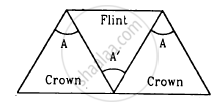
A thin prism of crown glass (μr = 1.515, μv = 1.525) and a thin prism of flint glass (μr = 1.612, μv = 1.632) are placed in contact with each other. Their refracting angles are 5.0° each and are similarly directed. Calculate the angular dispersion produced by the combination.
A thin prism of angle 6.0°, ω = 0.07 and μy = 1.50 is combined with another thin prism having ω = 0.08 and μy = 1.60. The combination produces no deviation in the mean ray. (a) Find the angle of the second prism. (b) Find the net angular dispersion produced by the combination when a beam of white light passes through it. (c) If the prisms are similarly directed, what will be the deviation in the mean ray? (d) Find the angular dispersion in the situation described in (c).
The refractive index of a material M1 changes by 0.014 and that of another material M2 changes by 0.024 as the colour of the light is changed from red to violet. Two thin prisms, one made of M1(A = 5.3°) and the other made of M2(A = 3.7°) are combined with their refracting angles oppositely directed. (a) Find the angular dispersion produced by the combination. (b) The prisms are now combined with their refracting angles similarly directed. Find the angular dispersion produced by the combination.
Solutions for 20: Dispersion and Spectra
HC Verma solutions for Concepts of Physics Volume 1 and 2 [English] chapter 20 - Dispersion and Spectra
Shaalaa.com has the CBSE, Karnataka Board PUC Mathematics Concepts of Physics Volume 1 and 2 [English] CBSE, Karnataka Board PUC solutions in a manner that help students grasp basic concepts better and faster. The detailed, step-by-step solutions will help you understand the concepts better and clarify any confusion. HC Verma solutions for Mathematics Concepts of Physics Volume 1 and 2 [English] CBSE, Karnataka Board PUC 20 (Dispersion and Spectra) include all questions with answers and detailed explanations. This will clear students' doubts about questions and improve their application skills while preparing for board exams.
Further, we at Shaalaa.com provide such solutions so students can prepare for written exams. HC Verma textbook solutions can be a core help for self-study and provide excellent self-help guidance for students.
Concepts covered in Concepts of Physics Volume 1 and 2 [English] chapter 20 Dispersion and Spectra are Reflection of Light by Spherical Mirrors, Ray Optics Or Geometrical Optics, Sign Convention for Reflection by Spherical Mirrors, Overview of Ray Optics and Optical Instruments, Focal Length of Spherical Mirrors, Mirror Equation of Spherical Mirrors, Refraction of Light, Total Internal Reflection, Applications of Total Internal Reflection, Refraction at a Spherical Surfaces, Refraction by a Lens, Power of a Lens, Combined Focal Length of Two Thin Lenses in Contact, Refraction of Light Through a Prism, Optical Instruments, Microscope and it’s types, Telescope.
Using HC Verma Concepts of Physics Volume 1 and 2 [English] solutions Dispersion and Spectra exercise by students is an easy way to prepare for the exams, as they involve solutions arranged chapter-wise and also page-wise. The questions involved in HC Verma Solutions are essential questions that can be asked in the final exam. Maximum CBSE, Karnataka Board PUC Concepts of Physics Volume 1 and 2 [English] students prefer HC Verma Textbook Solutions to score more in exams.
Get the free view of Chapter 20, Dispersion and Spectra Concepts of Physics Volume 1 and 2 [English] additional questions for Mathematics Concepts of Physics Volume 1 and 2 [English] CBSE, Karnataka Board PUC, and you can use Shaalaa.com to keep it handy for your exam preparation.
