English
Karnataka Board PUCPUC Science Class 11

The Refractive Indices of the Crown Glass for Red, Yellow and Violet Rays Are μR, μY and μV Respectively and Those for the Flint Glass Are μ'R, μ'Y and μ'V Respectively. - Physics

Advertisements
Advertisements

Question

Three thin prisms are combined as shown in figure. The refractive indices of the crown glass for red, yellow and violet rays are μr, μy and μv respectively and those for the flint glass are μ'r, μ'y and μ'v respectively. Find the ratio A'/A for which (a) there is no net angular dispersion, and (b) there is no net deviation in the yellow ray.
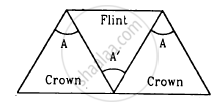
Sum
Advertisements

Solution

For the crown glass, we have:-

Refractive index for red rays = μr

Refractive index for yellow rays = μy

Refractive index for violet rays = μv

For the flint glass, we have:-

Refractive index for red rays = μ'r

Refractive index for yellow rays = μ'y

Refractive index for violet rays = μ'v

Let δcy and δfy be the angles of deviation produced by the crown and flint prisms for the yellow light.

Total deviation produced by the prism combination for yellow rays:-

δy = δcy − δfy
    = 2δcy − δfy
    =2(μcy + 1)A − (μfy − 1)A'

Angular dispersion produced by the combination is given by

δv − δr = [(μvc − 1)A − (μvf − 1)A' + (μvc − 1)A] − \[\left[ \left( \mu_{rc} - 1 \right)A - \left( \mu_{rf} - 1 \right)A' + \left( \mu_{rc} - 1 \right)A \right]\]

Here,

μvc = Refractive index for the violet colour of the crown glass

μvf = Refractive index for the violet colour of the flint glass

\[\mu_{rc}\] = Refractive index for the red colour of the crown glass

\[\mu_{rf}\] = Refractive index for the red colour of the flint glass

On solving, we get

δv − δr = 2(μvc −1)A − (μvf − 1)A'

(a) For zero angular dispersion, we have:

δt − δt = 0 = 2(μvc −1)A − (μvf − 1)A'

\[\Rightarrow   \frac{A'}{A} = \frac{2( \mu_{vf} - 1)}{( \mu_{vc} - 1)}\]

\[ = \frac{2( \mu_r - \mu_r )}{( \mu_r - \mu)}\]

(b) For zero deviation in the yellow ray, δy = 0.

⇒ 2(μcy − 1)A = (μfy − 1)A

\[\Rightarrow   \frac{A'}{A} = \frac{2( \mu_{cy} - 1)}{( \mu_{fy} - 1)}\]

\[ = \frac{2( \mu_y - 1)}{(\mu '_y - 1)}\]

shaalaa.com
  Is there an error in this question or solution?
Chapter 20: Dispersion and Spectra - Exercise [Page 442]

APPEARS IN

HC Verma Concepts of Physics Vol. 1 [English] Class 11 and 12
Chapter 20 Dispersion and Spectra
Exercise | Q 8 | Page 442

RELATED QUESTIONS

A ray of light incident normally on one face of a right isosceles prism is totally reflected, as shown in fig. What must be the minimum value of refractive index of glass? Give relevant calculations.


For any prism, prove that :

'n' or `mu = sin((A + delta_m)/2)/sin(A/2)`

where the terms have their usual meaning


Describe an activity to show that the colours of white light splitted by a glass prism can be recombined to get white light by another identical glass prism. Also, draw a ray diagram to show the recombination of the spectrum of white light.


 Out of blue and red light which is deviated more by a prism? Give reason.


The equation \[\omega = \frac{\mu_u - \mu_r}{\mu - 1}\] was derived for a prism having small refracting angle. Is it also valid for a prism of large refracting angle? Is it also valid for a glass slab or a glass sphere?


Can the dispersive power \[\omega = \frac{\mu_u - \mu_r}{\mu - 1}\] be negative? What is the sign of ω if a hollow prism is immersed into water?


If three identical prisms are combined, is it possible to pass a beam that emerges undeviated? Undispersed?


A certain material has refractive indices 1.56, 1.60 and 1.68  rfor red, yellow and violet lightespectively. (a) Calculate the dispersive power. (b) Find the angular dispersion produced by a thin prism of angle 6° made of this material.


The minimum deviations suffered by, yellow and violet beams passing through an equilateral transparent prism are 38.4°, 38.7° and 39.2° respectively. Calculate the dispersive power of the medium.


Two prisms of identical geometrical shape are combined with their refracting angles oppositely directed. The materials of the prisms have refractive indices 1.52 and 1.62 for violet light. A violet ray is deviated by 1.0° when passes symmetrically through this combination. What is the angle of the prisms?


A thin prism of crown glass (μr = 1.515, μv = 1.525) and a thin prism of flint glass (μr = 1.612, μv = 1.632) are placed in contact with each other. Their refracting angles are 5.0° each and are similarly directed. Calculate the angular dispersion produced by the combination.


The deviation produced for violet, yellow and red lights for crown glass are 3.75°, 3.25° and 2.86° respectively. Calculate the dispersive power of the crown glass.


A ray of light is incident on a prism whose refractive index is 1.52 at an angle of 40°. If the angle of emergence is 60°, calculate the angle of the prism. 


In a regular prism, what is the relation between angle of incidence and angle of emergence when it is in the minimum deviation position?


Define angular dispersion.


Prove that in case of a prism, i + e = A + δ, where the symbols have their usual meanings.


For any prism, obtain a relation between the angle of the prism (A), the angle of minimum deviation (δm) and the refractive index of its material (μ or n).


Share
Notifications

Englishहिंदीमराठी


      Forgot password?
Use app×