हिंदी
कर्नाटक बोर्ड पी.यू.सी.पीयूसी विज्ञान कक्षा ११

The Refractive Indices of the Crown Glass for Red, Yellow and Violet Rays Are μR, μY and μV Respectively and Those for the Flint Glass Are μ'R, μ'Y and μ'V Respectively. - Physics

Advertisements
Advertisements

प्रश्न

Three thin prisms are combined as shown in figure. The refractive indices of the crown glass for red, yellow and violet rays are μr, μy and μv respectively and those for the flint glass are μ'r, μ'y and μ'v respectively. Find the ratio A'/A for which (a) there is no net angular dispersion, and (b) there is no net deviation in the yellow ray.
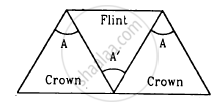
योग
Advertisements

उत्तर

For the crown glass, we have:-

Refractive index for red rays = μr

Refractive index for yellow rays = μy

Refractive index for violet rays = μv

For the flint glass, we have:-

Refractive index for red rays = μ'r

Refractive index for yellow rays = μ'y

Refractive index for violet rays = μ'v

Let δcy and δfy be the angles of deviation produced by the crown and flint prisms for the yellow light.

Total deviation produced by the prism combination for yellow rays:-

δy = δcy − δfy
    = 2δcy − δfy
    =2(μcy + 1)A − (μfy − 1)A'

Angular dispersion produced by the combination is given by

δv − δr = [(μvc − 1)A − (μvf − 1)A' + (μvc − 1)A] − \[\left[ \left( \mu_{rc} - 1 \right)A - \left( \mu_{rf} - 1 \right)A' + \left( \mu_{rc} - 1 \right)A \right]\]

Here,

μvc = Refractive index for the violet colour of the crown glass

μvf = Refractive index for the violet colour of the flint glass

\[\mu_{rc}\] = Refractive index for the red colour of the crown glass

\[\mu_{rf}\] = Refractive index for the red colour of the flint glass

On solving, we get

δv − δr = 2(μvc −1)A − (μvf − 1)A'

(a) For zero angular dispersion, we have:

δt − δt = 0 = 2(μvc −1)A − (μvf − 1)A'

\[\Rightarrow   \frac{A'}{A} = \frac{2( \mu_{vf} - 1)}{( \mu_{vc} - 1)}\]

\[ = \frac{2( \mu_r - \mu_r )}{( \mu_r - \mu)}\]

(b) For zero deviation in the yellow ray, δy = 0.

⇒ 2(μcy − 1)A = (μfy − 1)A

\[\Rightarrow   \frac{A'}{A} = \frac{2( \mu_{cy} - 1)}{( \mu_{fy} - 1)}\]

\[ = \frac{2( \mu_y - 1)}{(\mu '_y - 1)}\]

shaalaa.com
  क्या इस प्रश्न या उत्तर में कोई त्रुटि है?
अध्याय 20: Dispersion and Spectra - Exercise [पृष्ठ ४४२]

APPEARS IN

एचसी वर्मा Concepts of Physics Vol. 1 [English] Class 11 and 12
अध्याय 20 Dispersion and Spectra
Exercise | Q 8 | पृष्ठ ४४२

संबंधित प्रश्न

Plot a graph to show the variation of the angle of deviation as a function of the angle of incidence for light passing through a prism. Derive an expression for the refractive index of the prism in terms of angle of minimum deviation and angle of the prism.


A ray PQ incident normally on the refracting face BA is refracted in the prism BAC made of material of refractive index 1.5. Complete the path of ray through the prism. From which face will the ray emerge? Justify your answer.


A ray PQ incident on the refracting face BA is refracted in the prism BAC as shown in the figure and emerges from the other refracting face AC as RS such that AQ = AR. If the angle of prism A = 60° and refractive index of material of prism is `sqrt3 `. Calculate angle θ.


A ray PQ incident on the face AB of a prism ABC, as shown in the figure, emerges from the face AC such that AQ = AR.

Draw the ray diagram showing the passage of the ray through the prism. If the angle of the prism is 60° and refractive index of the material of prism is `sqrt3` , determine the values of angle of incidence and angle of deviation


Two monochromatic rays of light are incident normally on the face AB of an isosceles right-angled prism ABC. The refractive indices of the glass prism for the two rays '1' and '2' are respectively 1.38 and 1.52. Trace the path of these rays after entering through the prism.


What is a dispersion of light


State any two difference between the primary rainbow and secondary rainbow


The equation \[\omega = \frac{\mu_u - \mu_r}{\mu - 1}\] was derived for a prism having small refracting angle. Is it also valid for a prism of large refracting angle? Is it also valid for a glass slab or a glass sphere?


A prism can produce a minimum deviation δ in a light beam. If three such prisms are combined, the minimum deviation that can be produced in this beam is _______________.


By properly combining two prisms made of different materials, it is possible to

(a) have dispersion without average deviation

(b) have deviation without dispersion

(c) have both dispersion and average deviation

(d) have neither dispersion nor average deviation


Two prisms of identical geometrical shape are combined with their refracting angles oppositely directed. The materials of the prisms have refractive indices 1.52 and 1.62 for violet light. A violet ray is deviated by 1.0° when passes symmetrically through this combination. What is the angle of the prisms?


A thin prism of angle 6.0°, ω = 0.07 and μy = 1.50 is combined with another thin prism having ω = 0.08 and μy = 1.60. The combination produces no deviation in the mean ray. (a) Find the angle of the second prism. (b) Find the net angular dispersion produced by the combination when a beam of white light passes through it. (c) If the prisms are similarly directed, what will be the deviation in the mean ray? (d) Find the angular dispersion in the situation described in (c).


Calculate dispersive power of a transparent material given : nv = 1.56, nr = 1.54, ny = 1.55. 


An equilateral glass prism has a refractive index 1.6 in the air. Calculate the angle of minimum deviation of the prism, when kept in a medium of refractive index `4sqrt(2)"/"5.`


Define angular dispersion.


When a ray of white light is incident obliquely on the first surface of a prism, then ______.


Share
Notifications

Englishहिंदीमराठी


      Forgot password?
Use app×