Advertisements
Chapters
1: Elementary Theory of Demand
2: Elasticity of Demand
3: Theory of Supply
Unit II - Factors of Production : Basic Concepts
4: Factors of Production
Unit III - Alternative Market Structures : Basic Concepts
5: Nature and Structure of Markets
Unit IV - The State and Economic Development
6: The State and Economic Development
Unit V - Money and Banking : Basic Concepts
▶ 7: Meaning and Functions of Money
8: Commercial Banks
9: Central Banks
10: Inflation
![Goyal Brothers Prakashan solutions for Economic Applications [English] Class 10 ICSE chapter 7 - Meaning and Functions of Money - Shaalaa.com](/images/economic-applications-english-class-10-icse_6:4e056063b64247cab65a92e42cef2973.jpg "Goyal Brothers Prakashan solutions for Economic Applications [English] Class 10 ICSE chapter 7 - Meaning and Functions of Money")
Advertisements
Solutions for Chapter 7: Meaning and Functions of Money
Below listed, you can find solutions for Chapter 7 of CISCE Goyal Brothers Prakashan for Economic Applications [English] Class 10 ICSE.
Goyal Brothers Prakashan solutions for Economic Applications [English] Class 10 ICSE 7 Meaning and Functions of Money QUESTIONS [Pages 200 - 203]
Multiple Choice Questions
Read the following dialogue between two people:
| Sita: | I want 1 kg of potatoes. |
| Rani: | What will you give in exchange? |
| Sita: | I can give you 2 litres of milk in return for the potatoes. |
| Rani: | I don't need milk, I want a pair of shoe. |
Which of the following problem is being faced by Sita and Rani in their exchange process?
Lack of double coincidence of wants
Absence of common unit of value
Lack of store of value
Lack of standard of deferred payment
Which of the following is not a problem of barter system of exchange?
Store of value
Double Coincidence of Wants
Unit of Account
Unemployment
Currency and ______ are two modern forms of money.
demand deposits
time deposits
coins
government securities
Who regulates money supply in India?
Government of India
Reserve Bank of India
Commercial Banks
NITI Aayog
______ implies demand deposits with banks.
Paper money
Bank money
Near money
None of these
Money whose value as a commodity is equal to its face value is called:
Credit money
Full bodied money
High powered money
Legal tender money
Which of the following agency is responsible for issuing ₹ 1 currency note in India?
Reserve Bank of India
Ministry of Commerce
Ministry of Finance
NITI Aayog
Name the system in which the double coincidence of wants is an essential feature.
Barter system
Money economy
Global economy
None of these
Which of the following institutions is authorised to issue currency in India?
Reserve Bank of India
Bank of India
Parliament of India
State Bank of India
Which one of the following is not a modern form of money?
Demand deposits
Paper currency
Coins
Precious metals
Indian rupee is legal tender.
True
False
Observe the relationship of the first pair of words and complete the second pair.
The primary function of money : Medium of exchange. The secondary function of money : ______.
Measure of value
Distribution of national income
Maximisation of utility
Store of value
______ are termed as Legal Tender Money.
Demand deposits
Time Deposits
Inter-bank deposits
Currency Notes
Transfer of value is the primary function of money.
True
False
Match the following and select the correct option:
| Column A | Column B | ||
| (i) | Currency Notes | A. | General acceptability |
| (ii) | Demand deposits | B. | Lack of double coincidence of wants |
| (iii) | Feature of money | C. | Legal tender |
| (iv) | Problem of barter exchange | D. | Bank money |
(i) C, (ii) D, (iii) A, (iv) B
(i) A, (ii) B, (iii) D, (iv) C
(i) B, (ii) C, (iii) A, (iv) D
(i) C, (ii) D, (iii) B, (iv) A
Which of these is the primary function of money?
Store of value
Standard of deferred payment
Measure of value
Transfer of value
Which money is used to settle debts or make payment in future, it is said to perform the function of:
Standard of deferred payment
Medium of exchange
Transfer of value
Store of value
The function of money which allows a person to pay for a commodity at a future date is called as ______.
Unit of account
Measure of value
Standard of deferred payment
Medium of exchange
‘Which function of money is most closely linked to saving?
Medium of exchange
Standard of deferred payment
Store of value
Unit of account
From the above visual depiction, identify the problem faced by two people shown in this image.
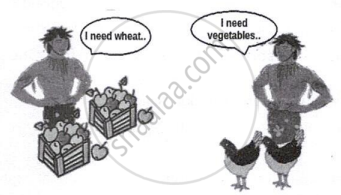
Lack of double coincidence of wants
Lack of store of value
Lack of standard of deferred payment
Disagreement between rate of exchange
Which of the following is a contingent function of money?
Measure of value
Store of value
Medium of exchange
Distribution of National Income
Any medium of exchange, enforced by law is known as ______.
Legal Tender Money
Credit Money
Fiduciary Money
Full bodied Money
Assertion-Reasoning & Matching Based Questions
Read the following statements - Assertion (A) and Reason (R). Choose one of the correct alternatives given below:
Assertion (A): Bank money is legal tender money.
Reason (R): Cheques drawn on demand deposits can be refused by anyone as a mode of payment. Hence, demand deposits (i.e. bank money) are not legal tenders they are optional.
Both Assertion (A) and Reason (R) are true and Reason (R) is the correct explanation of Assertion (A).
Both Assertion (A) and Reason (R) are true and Reason (R) is not the correct explanation of Assertion (A).
Assertion (A) is true but Reason (R) is false.
Assertion (A) is false but Reason (R) is true.
Read the-following statements - Assertion (A) and Reason (R). Choose one of the correct alternatives given below:
Assertion (A): Currency and bank money are the two modern forms of money.
Reason (R): Currency is high powered money.
Both Assertion (A) and Reason (R) are true and Reason (R) is the correct explanation of Assertion (A).
Both Assertion (A) and Reason (R) are true and Reason (R) is not the correct explanation of Assertion (A).
Assertion (A) is true but Reason (R) is false.
Assertion (A) is false but Reason (R) is true.
Match the following:
| Column I | Column II | ||
| A. | Currency | (i) | Something which is commonly used as medium of exchange |
| B. | Bank money | (ii) | Currency and demand deposits |
| C. | Money | (iii) | Bank demand deposits |
| D. | Modern form of money | (iv) | Paper notes + coins |
Read the following statements - Assertion (A) and Reason (R). Choose one of the correct alternatives given below:
Assertion (A): Demand deposits with Commercial banks cannot act as money.
Reason (R): Bank money refers to bank demand deposits.
Both Assertion (A) and Reason (R) are true and Reason (R) is the correct explanation of Assertion (A).
Both Assertion (A) and Reason (R) are true and Reason (R) is not the correct explanation of Assertion (A).
Assertion (A) is true but Reason (R) is false.
Assertion (A) is false but Reason (R) is true.
Short Answer Type Questions
Explain the meaning of barter exchange by giving an example.
State two difficulties of barter system.
How does money resolve the problem of double coincidence of wants?
Why is money referred to as legal tender?
State the two primary functions of money.
Give two characteristics of money.
Define Money.
How does money act as a measure of value?
How does money help in the distribution of national income?
How does money act as a standard of deferred payment?
Why is money referred to as legal tender?
Explain the transfer of value function of money.
Long Answer Type Questions
Enumerate any two difficulties faced under the barter system of exchange.
Define Money.
What are the main features of money?
Define Money.
How does money perform its role as medium of Exchange.
How does money perform its role as store of value.
Explain the contingent functions of money.
Define Money.
Explain the secondary functions of money.
Define Money.
Describe how money has removed the defects of the barter system.
Distinguish between fiat money and bank money.
State the two primary functions of money.
Define Money.
State the two primary functions of money.
Explain the secondary functions of money.
Explain the secondary functions of money.
Define Money.
Explain how money can overcome the difficulties of double coincidence of wants.
Explain the secondary functions of money.
Explain the contingent functions of money.
Define Money.
State the two primary functions of money.
Explain the secondary functions of money.
Explain the contingent functions of money.
State how money acts as a medium of exchange.
State how money acts as a transfer of value.
State how money acts as maximisation of utility.
What is meant by Money?
How does money act as a measure of value?
How does money act as a standard of deferred payment?
How does money help in the distribution of national income?
Goyal Brothers Prakashan solutions for Economic Applications [English] Class 10 ICSE 7 Meaning and Functions of Money QUESTION BANK [Pages 203 - 205]
Explain the meaning of barter exchange by giving an example.
State two difficulties of barter system.
What is meant by double coincidence of wants?
Define Money.
State the two primary functions of money.
Explain the secondary functions of money.
Explain the contingent functions of money.
Distinguish between limited legal tender and unlimited legal tender.
Distinguish between standard money and bank money.
What is fiat money?
Why is money referred to as legal tender?
Give two characteristics of money.
Describe how money has removed the defects of the barter system.
How does money resolve the problem of double coincidence of wants?
Explain the secondary functions of money.
How does money perform its role as store of value.
Explain the contingent functions of money.
Define Money.
Explain various stages in the evolution of money.
State the two primary functions of money.
Explain the secondary functions of money.
How does money help the consumers?
How does money help the producers?
Enumerate any two difficulties faced under the barter system of exchange.
Explain the transfer of value function of money.
Solutions for 7: Meaning and Functions of Money
Goyal Brothers Prakashan solutions for Economic Applications [English] Class 10 ICSE chapter 7 - Meaning and Functions of Money
Shaalaa.com has the CISCE Mathematics Economic Applications [English] Class 10 ICSE CISCE solutions in a manner that help students grasp basic concepts better and faster. The detailed, step-by-step solutions will help you understand the concepts better and clarify any confusion. Goyal Brothers Prakashan solutions for Mathematics Economic Applications [English] Class 10 ICSE CISCE 7 (Meaning and Functions of Money) include all questions with answers and detailed explanations. This will clear students' doubts about questions and improve their application skills while preparing for board exams.
Further, we at Shaalaa.com provide such solutions so students can prepare for written exams. Goyal Brothers Prakashan textbook solutions can be a core help for self-study and provide excellent self-help guidance for students.
Concepts covered in Economic Applications [English] Class 10 ICSE chapter 7 Meaning and Functions of Money are Importance of Money, Characteristics of Inflation, Types of Inflation, Inflation, Forms of Money, Anti-inflationary Measures, Barter system, Causes of Inflation, Effects of Inflation, Qualities of Money.
Using Goyal Brothers Prakashan Economic Applications [English] Class 10 ICSE solutions Meaning and Functions of Money exercise by students is an easy way to prepare for the exams, as they involve solutions arranged chapter-wise and also page-wise. The questions involved in Goyal Brothers Prakashan Solutions are essential questions that can be asked in the final exam. Maximum CISCE Economic Applications [English] Class 10 ICSE students prefer Goyal Brothers Prakashan Textbook Solutions to score more in exams.
Get the free view of Chapter 7, Meaning and Functions of Money Economic Applications [English] Class 10 ICSE additional questions for Mathematics Economic Applications [English] Class 10 ICSE CISCE, and you can use Shaalaa.com to keep it handy for your exam preparation.
