Advertisements
Chapters
1: Elementary Theory of Demand
2: Elasticity of Demand
3: Theory of Supply
Unit II - Factors of Production : Basic Concepts
4: Factors of Production
Unit III - Alternative Market Structures : Basic Concepts
5: Nature and Structure of Markets
Unit IV - The State and Economic Development
▶ 6: The State and Economic Development
Unit V - Money and Banking : Basic Concepts
7: Meaning and Functions of Money
8: Commercial Banks
9: Central Banks
10: Inflation
![Goyal Brothers Prakashan solutions for Economic Applications [English] Class 10 ICSE chapter 6 - The State and Economic Development - Shaalaa.com](/images/economic-applications-english-class-10-icse_6:4e056063b64247cab65a92e42cef2973.jpg "Goyal Brothers Prakashan solutions for Economic Applications [English] Class 10 ICSE chapter 6 - The State and Economic Development")
Advertisements
Solutions for Chapter 6: The State and Economic Development
Below listed, you can find solutions for Chapter 6 of CISCE Goyal Brothers Prakashan for Economic Applications [English] Class 10 ICSE.
Goyal Brothers Prakashan solutions for Economic Applications [English] Class 10 ICSE 6 The State and Economic Development QUESTIONS [Pages 179 - 186]
Multiple Choice Questions
The essential feature of a tax.
A compulsory payment
A legal payment
Both Compulsory payment and legal payment.
Neither Compulsory payment nor Legal payment
______ is an example of commercial revenues.
Fees
Special assessment
Railways fares/freights
Gifts and grants
______ are those taxes which are paid by the same person on whom they have been imposed.
Proportional tax
Progressive taxes
Direct taxes
Indirect taxes
The government imposes tax ______.
To raise revenue
To reduce inequalities of income and wealth
Both to raise revenue and to reduce inequalities of income and wealth
Neither to raise revenue nor to reduce inequalities of income and wealth
Which of the following is an advantage of direct taxes?
Convenient to pay
Wide coverage
Levied according to the taxable capacity
No Evasion
Under ______ the rate of tax increases with rise in tax payer's income.
Progressive taxation
Proportional taxation
Regressive taxation
Digressive taxation
Taxes in which the rate of tax remains the same, though the tax bases changes are called ______.
Direct taxes
Indirect taxes
Progressive taxes
Proportional taxes
Fiscal policy means public expenditure and tax policy of the government.
True
False
Instruments of fiscal policy is:
taxation
public expenditure
public debt
All of the above
Instrument of monetary policy is:
Bank rate
Cash reserve ratio
Both Bank rate and Cash reserve ratio
Neither Bank rate nor Cash reserve ratio
Match the following and select the correct option:
| Column A | Column B | ||
| (i) | Taxes imposed on income and wealth | A. | Regressive |
| (ii) | Taxes imposed on goods and services | B. | Progressive |
| (iii) | A tax system where the rate of tax decreases with increase income | C. | Direct taxes |
| (iv) | A tax system where the rate of tax increases as income increase | D. | Indirect taxes |
(i) D, (ii) A, (iii) B, (iv) C
(i) C, (ii) D, (iii) B, (iv) A
(i) B, (ii) A, (iii) D, (iv) C
(i) C, (ii) D, (iii) A, (iv) B
Monetary policy means regulation of money supply by the monetary authority.
True
False
Observe the relationship of the first pair of words and complete the second pair:
Tax paid by person on whose it is imposed : Direct tax.
A tax is paid by some person and the final burden is born by some other person : ______.
Proportional tax
Indirect tax
Progressive tax
Regressive tax
Which of the following statements are true?
- Public sector enterprise is an enterprise which is owned and managed by the government.
- Privatisation means the sale of all or parts of a government equity in state owned enterprises to the private sector.
- Disinvestment programme of India started in 1991-92.
Only (i)
Only (ii) and (iii)
Only (i) and (iii)
All of these
The state can promote economic development by ______.
Establishing basic heavy capital goods industries
Establishing socialistic pattern of society
Creating infrastructural facilities
All of the above
A policy under which the government uses its expenditure and revenue to produce desirable effect and avoid undesirable effects on the national income, production and employment. This defines ______.
Monetary Policy
Wage Policy
Price Policy
Fiscal Policy
Identify the tax which is most likely to faster civic conciousness.
Property tax
Entertainment tax
Goods and Services tax
Customs duty
The following table indicates:
| Tax Base in ₹ | Rate of tax in % |
| 10,000 | 8 |
| 20,000 | 8 |
| 30,000 | 8 |
| 40,000 | 8 |
Progressive taxation
Regressive taxation
Proportional taxation
Degressive taxation
The major objective of monetary policy is ______.
Employment generation
Maintaining foreign relations
Price stability
Greater tax collection
Which of these taxes is most likely to be progressive?
Entertainment tax
Goods and services tax
Property tax
Custom duty
The tax whose rate remains unchanged irrespective of the income of the taxpayer is called as ______.
Progressive tax
Regressive tax
Direct tax
Proportional tax
______ implies an introduction of private ownership in public sector enterprises.
Disinvestment
Globalisation
Privatisation
Liberalisation
Wealth tax is an example of:
Direct tax
Indirect tax
Proportional tax
Degressive tax
Which of the statement is true for income tax?
It is regressive by nature.
It is an example of indirect tax.
Impact and incidence of the tax lies on the same person.
Impact and incidence of the tax lies on the different persons.
Identify the reason for privatisation:
Reduction in unproductive expenditure of the government.
Growth of private monopolies.
Social welfare aspect is not emphasised.
Possibility of employment loss.
Which of the following taxes generate civic consciousness among people?
GST
Custom duty
Income tax
Entertainment tax
Identify the merit of direct tax from the following:
Tax evasion
Greater cost of collection
Ensuring equity
Inconvenient
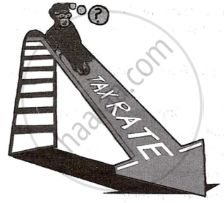
Identify the type of taxation.
Progressive
Regressive
Proportional
Degressive
Which of the following is not associated with fiscal policy?
Public revenue
Public expenditure
Public debt
Open market operations
Which of the following is not a private sector enterprise?
Tata Industrial Group
Steel Authority of India
Hindustan Unilever
Bharti Airtel
Which of the following is not an example of public sector enterprises?
BHEL
Reliance Industries
Hindustan Steel Limited
ONGC
Assertion-Reasoning & Matching Based Questions
Match the following:
| Column I | Column II | ||
| A. | Direct tax | (i) | Tax rate increases with tax base |
| B. | Indirect tax | (ii) | Tax rate remains constant |
| C. | Proportional tax | (iii) | Imposed on goods and services |
| D. | Progressive tax | (iv) | Impact and incidence lie on the same person |
A. (iii), B. (ii), C. (i), D. (iv)
A. (ii), B. (iii), C. (i), D. (iv)
A. (iv), B. (iii), C. (i), D. (ii)
A. (iv), B. (iii), C. (ii), D. (i)
Match the following:
| Column I | Column II | ||
| A. | Impact of tax | (i) | Price stability |
| B. | Incidence of tax | (ii) | Simple to calculate |
| C. | Objective of Monetary Policy | (iii) | Ultimate burden of tax |
| D. | Proportional tax | (iv) | Original imposition of tax |
A. (iv), B. (iii), C. (i), D. (ii)
A. (iii), B. (iv), C. (ii), D. (i)
A. (iv), B. (ii), C. (i), D. (iii)
A. (ii), B. (i), C. (iii), D. (iv)
Read the following statements carefully and choose the correct alternative:
Read the following statements carefully and choose the correct alternative:
Assertion (A): Income tax is a direct tax.
Reason (R): GST is an indirect tax.
Both Assertion (A) and Reason (R) are true and Reason (R) is the correct explanation of Assertion (A).
Both Assertion (A) and Reason (R) are true and Reason (R) is not the correct explanation of Assertion (A).
Assertion (A) is true but Reason (R) is false.
Assertion (A) is false but Reason (R) is true.
Assertion (A): Goods and Services Tax (GST) is an indirect tax.
Reason (R): The impact and the incidence of tax are on two different person.
A is true but R is false.
A is false but R is true.
Both A & R are true R explains A.
Both A & R are true but R does not explain A.
Assertion (A): The rate of tax increases to a certain limit and then becomes constant.
Reason (R): This system is a combination of progressive tax and regressive tax.
A is true but R is false.
A is false but R is true.
Both A & R are true R explains A.
Both A & R are true but R does not explain A.
Assertion (A): The policy of converting public ownership of an asset to private ownership is Privatisation.
Reason (R): There is no sale of shares of Public Sector Undertaking.
(A) is true and (R) is false.
(A) is false and (R) is true.
Both (A) and (R) are true and (R) is the correct explanation of (A).
Both (A) and (R) are true and (R) is not the correct explanation of (A).
Assertion (A): Indirect taxes can be made progressive.
Reason (R): More excise duty imposed on producing luxury items and exempting taxes on necessary items.
(A) is true and (R) is false.
(A) is false and (R) is true.
Both (A) and (R) are true and (R) is the correct explanation of (A).
Both (A) and (R) are true and (R) is not the correct explanation of (A).
Read the following statements carefully and choose the correct alternative:
Assertion (A): Income tax is a direct tax.
Reason (R): GST is an indirect tax.
Both Assertion (A) and Reason (R) are true and Reason (R) is the correct explanation of Assertion (A).
Both Assertion (A) and Reason (R) are true and Reason (R) is not the correct explanation of Assertion (A).
Assertion (A) is true but Reason (R) is false.
Assertion (A) is false but Reason (R) is true.
Assertion (A): Transfer of ownership and management of Public Sector Undertakings to the private sector is privatisation.
Reason (R): There is no sale of share of Public Sector Undertaking.
(A) is true and (R) is false.
(A) is false and (R) is true.
Both (A) and (R) are true and (R) is the correct explanation of (A).
Both (A) and (R) are true but (R) is not the correct explanation of (A).
Short Answer Type Questions
State two ways in which the public sector is important even at the present time.
Mention two problems faced by public sector enterprises in India.
Define fiscal policy.
Name any two instruments of Fiscal Policy.
How can tax be used as an instrument to bring about equitable distribution of wealth and income?
State two objectives of fiscal policy.
Distinguish between fiscal policy and monetary policy.
Define direct tax
Define Indirect tax
Differentiate between direct and indirect taxes.
Define Indirect tax
Give an example of Indirect tax.
State two ways by which increase in public expenditure can promote growth in backward areas.
'The role of the State is important in developing the economic infrastructure of a developing economy'. Give two reasons to support your answer.
How can tax be used as an instrument to bring about equitable distribution of wealth and income?
How can tax be used as an instrument to bring about equitable distribution of wealth and income?
'The role of the State is important in developing the economic infrastructure of a developing economy'. Give two reasons to support your answer.
Give two reasons for privatisation of public sector units in India.
State the difference between income tax and expenditure tax.
Define a degressive tax.
Citing reason state the advantage of a progressive tax over proportional tax.
Citing reason state the advantage of private sector over public sector.
Citing reason state the advantage of a direct tax over an indirect tax.
An indirect tax is not always equitable. Give two reasons to support your answer.
What are public sector units?
Mention one problem faced by public sector units in India.
Explain how an improper price policy results in the poor performance of the public sector enterprises.
What is meant by shifting of tax burden?
To which tax is this shifting of tax burden relevant?
Classify the following types of tax into direct and indirect taxes:
- Entertainment tax
- Income tax
- House tax
- Sales tax
Briefly explain why direct taxes foster civic consciousness among people.
What is meant by regressive taxation?
What are progressive taxes.
Give one example of progressive tax.
Explain the term proportional taxation.
What are public sector units?
Give two examples of Public Sector Enterprises in India.
Give two reasons why the government imposes tax?
Define privatisation.
Distinguish between fiscal policy and monetary policy.
Explain how indirect taxes can be inflationary.
Explain how Public Sector Enterprises can remove regional imbalance.
What are progressive taxes.
What is meant by regressive taxation?
Which one is better progressive or regressive taxation and why?
Mention three arguments against privatisation.
State two drawbacks of direct taxes.
An indirect tax can be made progressive by imposing higher tax rates on luxuries. Justify the above statement.
What are progressive taxes.
Draw a neat labelled diagram for progressive taxation.
Explain briefly the role of public sector enterprises in developing the industries with strategic importance.
State the four merits of a direct tax.
Long Answer Type Questions
Explain clearly tour ways by which the state can promote economic growth and development.
How does the state fulfil the following socio-economic objective?
Reducing income inequality.
How does the state fulfil the following socio-economic objective?
Promoting industrial growth.
How does the state fulfil the following socio-economic objective?
Environmental protection.
Define a tax.
State two differences between income tax and commodity tax.
Explain how tax can be used as an instrument to regulate consumption and production in an economy.
Define fiscal policy.
Discuss four fiscal policy objectives with reference to India.
Public sector units made a commendable contribution to the Indian economy in the early phase of planned development. What are public sector units? Explain any four contributions of PSU’s to the Indian economy.
Public sector units made a commendable contribution to the Indian economy in the early phase of planned development. Explain any four contributions of PSU’s to the Indian economy.
State the four merits of a direct tax.
State three demerits of an Indirect tax.
What are public sector units?
Give two examples of Public Sector Enterprises in India.
Mention one problem faced by public sector units in India.
Define privatisation.
Explain four benefits of privatisation.
What is meant by ‘Privatisation’?
Explain in brief three arguments against privatization of public sector units in India.
Define privatisation.
Explain four benefits of privatisation.
Mention three arguments against privatisation.
Mention one problem faced by public sector units in India.
Suggest the remedies to overcome problems faced by public sector enterprises.
Explain the term Impact of a tax.
What is meant by shifting of tax burden?
Explain the term Incidence of a tax.
State the four merits of a direct tax.
What are public sector units?
Explain any three problems of public sector undertakings in India.
Define a tax.
What is meant by regressive taxation?
Explain the following with examples:
Progressive tax
Define a degressive tax.
What are public sector units?
Give two reasons for privatisation of public sector units in India.
What is a public sector enterprise?
Explain any three problems of public sector for it to be privatised.
Differentiate between direct and indirect taxes.
With reference to the taxation policy.
Differentiate between progressive and regressive taxes giving an example for each.
State the four merits of a direct tax.
State two drawbacks of direct taxes.
Name the three types of Public Sector in India.
List three ways in which the government can undertake privatisation.
Distinguish between fiscal policy and monetary policy.
Mention two important differences between the Public Sector and the Private Sector.
Explain any two reasons for privatisation.
What is direct tax?
Explain the term Impact of a tax.
Explain the term Incidence of a tax.
Differentiate between direct and indirect taxes.
Citing reasons, evaluate the performance of private sector over public sector enterprises in the following case:
Timely completion of projects undertaken.
Citing reasons, evaluate the performance of private sector over public sector enterprises in the following case:
Decision taking.
Citing reasons, evaluate the performance of private sector over public sector enterprises in the following case:
Managerial efficiency.
Citing reasons, evaluate the performance of private sector over public sector enterprises in the following case:
Attention towards consumer satisfaction.
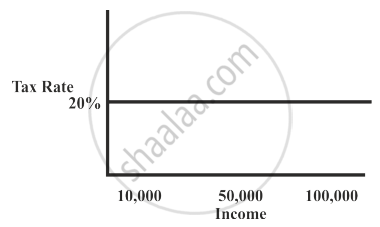
Which type of tax is indicated in the above graph?
State any three points of distinction between progressive taxation and degressive taxation.
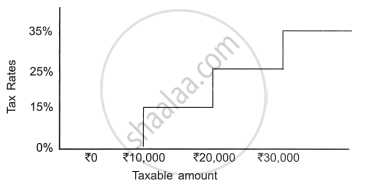
- Which type of tax is indicated in the above graph?
- With the help of any three points distinguish between Proportional tax and the above type of tax.
- State any three points of distinction between progressive taxation and regressive taxation.
Goyal Brothers Prakashan solutions for Economic Applications [English] Class 10 ICSE 6 The State and Economic Development QUESTION BANK [Pages 186 - 190]
What are public sector units?
Give two examples of Public Sector Enterprises in India.
Mention one problem faced by public sector units in India.
Explain clearly tour ways by which the state can promote economic growth and development.
'The role of the State is important in developing the economic infrastructure of a developing economy'. Give two reasons to support your answer.
How can tax be used as an instrument to bring about equitable distribution of wealth and income?
Define fiscal policy.
Name any two instruments of Fiscal Policy.
Define a tax.
Give two reasons why the government imposes tax?
Give two reasons why the government imposes tax?
Explain the significance of taxes.
What are direct taxes?
Give two examples of direct taxes.
Define Indirect tax
Give an example of Indirect tax.
Explain briefly two merits of indirect tax.
State three demerits of an Indirect tax.
State two drawbacks of direct taxes.
Citing reason state the advantage of a direct tax over an indirect tax.
How can tax be used as an instrument to bring about equitable distribution of wealth and income?
Explain how indirect taxes can be inflationary.
Distinguish between fiscal policy and monetary policy.
State two ways by which increase in public expenditure can promote growth in backward areas.
Define a degressive tax.
Mention four causes for increasing public expenditure in modern times.
Explain the state's role in achieving the objective of social justice in less developed countries.
Define privatisation.
Define the Disinvestment.
Define the following term:
Fiscal deficit
What are the two methods of privatisation?
Define privatisation.
Give two reasons for privatisation of public sector units in India.
Mention three arguments against privatisation.
Mention three measures undertaken towards privatisation in India.
Define a tax.
State two differences between income tax and commodity tax.
Explain how indirect taxes can be made progressive.
Citing reason state the advantage of a direct tax over an indirect tax.
Citing reasons state the superiority of Progressive tax over regressive tax.
Citing reasons state the superiority of Public sector over privatization.
Citing reasons state the superiority of Fostering civic consciousness by direct tax over the same by indirect tax.
When do we pay the GST?
Is privatization good or bad for India?
Why is the private sector more efficient than the public sector?
Solutions for 6: The State and Economic Development
Goyal Brothers Prakashan solutions for Economic Applications [English] Class 10 ICSE chapter 6 - The State and Economic Development
Shaalaa.com has the CISCE Mathematics Economic Applications [English] Class 10 ICSE CISCE solutions in a manner that help students grasp basic concepts better and faster. The detailed, step-by-step solutions will help you understand the concepts better and clarify any confusion. Goyal Brothers Prakashan solutions for Mathematics Economic Applications [English] Class 10 ICSE CISCE 6 (The State and Economic Development) include all questions with answers and detailed explanations. This will clear students' doubts about questions and improve their application skills while preparing for board exams.
Further, we at Shaalaa.com provide such solutions so students can prepare for written exams. Goyal Brothers Prakashan textbook solutions can be a core help for self-study and provide excellent self-help guidance for students.
Concepts covered in Economic Applications [English] Class 10 ICSE chapter 6 The State and Economic Development are The State and Economic Development, Functions of the State in Promoting Economic Development, Introduction of Public and Private Sector, Role of State in Economic Development, Role of Public Sector Enterprises, Problems of Public Sector Enterprises/Reasons for Declining Popularity of Public Sector, Suggestions to Improve the Efficiency of Public Sector Enterprises, Public Sector Organisations, Privatization of Public Enterprises, Arguments for Privatisation Or Disinvestment, Arguments Against Privatisation (Or Disinvestment), Rationale of Privatisation in India, Reasons in Favour of Privatisation, Pre-requisites for Privatisation, Limitations of the Privatisation, Suggestive Framework for Privatisation.
Using Goyal Brothers Prakashan Economic Applications [English] Class 10 ICSE solutions The State and Economic Development exercise by students is an easy way to prepare for the exams, as they involve solutions arranged chapter-wise and also page-wise. The questions involved in Goyal Brothers Prakashan Solutions are essential questions that can be asked in the final exam. Maximum CISCE Economic Applications [English] Class 10 ICSE students prefer Goyal Brothers Prakashan Textbook Solutions to score more in exams.
Get the free view of Chapter 6, The State and Economic Development Economic Applications [English] Class 10 ICSE additional questions for Mathematics Economic Applications [English] Class 10 ICSE CISCE, and you can use Shaalaa.com to keep it handy for your exam preparation.
