Advertisements
Chapters
2: Job Analysis and Manpower Planning
3: Staff Recruitment
4: Staff Selection
5: Staff Training
6: Staff Morale
7: Staff Motivation
8: Staff Remuneration
▶ 9: Staff Leadership
10: Staff Appraisal
11: Staff Promotion and Transfer
12: Staff Separation
13: Emerging Trends in Human Resources
14: Business Communication
15: Business Correspondence
16: Reports and Report Writing
17: Various Business Entities
18: Sources of Business Finance
19: Globalisation
20: E-Business
21: Outsourcing
22: Business Regulators and Intermediaries
![C. B. Gupta solutions for Business Studies [English] Class 12 ISC chapter 9 - Staff Leadership - Shaalaa.com](/images/business-studies-english-class-12-isc_6:97d2016e3d3f47998118bcfe2d4e3d43.jpg "C. B. Gupta solutions for Business Studies [English] Class 12 ISC chapter 9 - Staff Leadership")
Advertisements
Solutions for Chapter 9: Staff Leadership
Below listed, you can find solutions for Chapter 9 of CISCE C. B. Gupta for Business Studies [English] Class 12 ISC.
C. B. Gupta solutions for Business Studies [English] Class 12 ISC 9 Staff Leadership EXERCISES [Pages 129 - 131]
Objective Type Questions MCQ's (Select the best Alternative)
The leader possess ______.
intelligence
foresightedness
self-confidence
all of these
The leader takes work from his subordinates ______.
by tact
by rod
by threatening
none of these
The leadership is ______.
wastage of time
necessary
wastage of money
unnecessary
The leadership is ______.
by birth
made
by birth and made both
none of these
The manager is ______.
boss
owner
leader
none of these
The leader has ______ authority.
informal
formal
personal
government
Fill in the blanks with suitable words given in brackets
______ is a good quality of a leader.
open mind
aggressiveness
helpful
In ______ leadership style, the leader has all to power.
Autocratic
Democratic
Laissez Fair
A democratic leader makes decisions ______.
without consulting his followers
jointly with his followers
on its own
A leader may use ______ style/styles over a period of time.
one
two
all
______ style, gives the subordinate maximum scope of self development.
Autocratic
Democratic
Laissez Fair
The ______ style of leadership reduces resistance to change and increases acceptance of new ideas.
Very Short Answer Type Questions
Who is the leader?
Bill Gates is a leader of which company?
‘Leadership is a part of management but not all of it.’ Clarify.
What is meant by leadership?
‘Leadership transforms potential into reality.’ How?
‘A leader does not wait for opportunities but creates them.’ This statement is related to which quality of a good leader?
Why should a leader has the quality of ‘knowledge’?
Briefly explain any two qualities of a good leader.
“A healthy body possess a healthy mind.” This statement is related to which quality of a good leader?
State one point of the importance of leadership.
What are the steps involved in the process of communication? State any two.
All managers are leaders, but all leaders are not managers. Do you agree?
Give the meaning of the ‘Democratic style of Leadership’.
Briefly explain any three leadership styles.
What type of change is brought in by leadership?
What type of relations does a leader maintain with his follower?
How can a leader act as a role model?
Which style of leadership does not like interference by others?
Short Answer Type Questions
Define leadership.
Briefly explain any two qualities of a good leader.
What is autocratic leadership?
There is a world of difference between consultative and participating styles of leadership. Bring out the implications of this statement.
“Participative style is in tune with the norms of democracy.” Examine this statement.
“A trade union leader is born, not made.” Give arguments for or against this proposition.
What is meant by Laissez-Faire leadership?
“Leadership is situational.” Comment.
Autocratic leadership is ideal for blue-collar workers. Justify.
How is a leader different from a manager?
Briefly explain any three leadership styles.
Explain bureaucratic style.
What is ‘paternalistic’ leadership?
Give any two advantages of the Laissez-Faire style of leadership.
Explain the concept of situational leadership.
Give any two differences between leadership and management.
Under the democratic leadership style, the leader gives complete freedom to his followers. State true or false with reason.
True
False
Long Answer Type Questions
What is meant by leadership?
Give any two differences between leadership and management.
State one point of the importance of leadership.
Briefly explain any two qualities of a good leader.
Briefly explain any two qualities of a good leader.
Explain different leadership styles, bringing out clearly the merits and demerits of each style.
Give any four differences between the Autocratic style of leadership and the Democratic style of leadership.
“Leadership style is the varying degree of use of authority by the leader and the ‘area of freedom given’ to the subordinates.” Discuss.
Explain different leadership styles, bringing out clearly the merits and demerits of each style.
Explain different leadership styles, bringing out clearly the merits and demerits of each style.
Define leadership.
Briefly explain any three leadership styles.
Describe the Managerial Grid.
Write a short note on authoritative leadership.
Briefly explain any three leadership styles.
Write a short note on situational leadership.
Give the meaning of the ‘Democratic style of Leadership’.
Explain different leadership styles, bringing out clearly the merits and demerits of each style.
Explain different leadership styles, bringing out clearly the merits and demerits of each style.
Specify any two conditions where the democratic leadership style is most effective.
Mr. Khatri is the Head of the Sales Department in Global Max Ltd. He used different leadership styles in different situations.
- He took all decisions by himself when they have to meet the target in limited time.
- When the Sales Department had to predict future sales of the coming year, Mr. Khatri considered the opinions and suggestions given by his subordinates.
- For the routine activity/work, he gives full freedom to take decisions to his subordinates.
Identify and explain the leadership styles used in the above situations.
Blake and Mouton have identified five combinations in their graphic model of alternative combinations of leadership styles or behaviours. With reference to the above statement, explain any four such combinations.
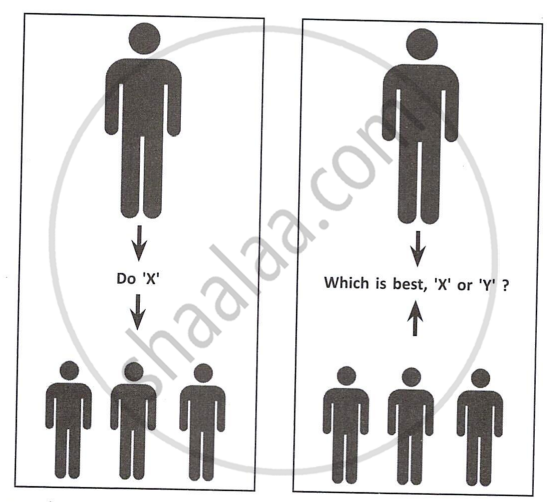
- Identify the two styles of leadership depicted in the above images.
- State any one feature of each of the above styles of leadership.
C. B. Gupta solutions for Business Studies [English] Class 12 ISC 9 Staff Leadership QUESTION BANK [Pages 131 - 132]
“Leadership is required only for less efficient subordinates.” Do you agree?
Why leadership considered as the most important element of directing function of management?
All managers are leaders, but all leaders are not managers. Do you agree?
“A trade union leader is born, not made.” Give arguments for or against this proposition.
Autocratic leadership is ideal for blue-collar workers. Justify.
“Participative style is in tune with the norms of democracy.” Examine this statement.
“Leadership is situational.” Comment.
Give any four differences between the Autocratic style of leadership and the Democratic style of leadership.
Describe the Managerial Grid.
How can the leadership ability of managers be developed?
Solutions for 9: Staff Leadership
C. B. Gupta solutions for Business Studies [English] Class 12 ISC chapter 9 - Staff Leadership
Shaalaa.com has the CISCE Mathematics Business Studies [English] Class 12 ISC CISCE solutions in a manner that help students grasp basic concepts better and faster. The detailed, step-by-step solutions will help you understand the concepts better and clarify any confusion. C. B. Gupta solutions for Mathematics Business Studies [English] Class 12 ISC CISCE 9 (Staff Leadership) include all questions with answers and detailed explanations. This will clear students' doubts about questions and improve their application skills while preparing for board exams.
Further, we at Shaalaa.com provide such solutions so students can prepare for written exams. C. B. Gupta textbook solutions can be a core help for self-study and provide excellent self-help guidance for students.
Concepts covered in Business Studies [English] Class 12 ISC chapter 9 Staff Leadership are Overview of Staff Leadership, Meaning and Definition of Leadership, Distinction Between Leadership and Management, Importance of Leadership, Leadership - Qualities of a Good Leader, Leadership Styles, Difference between Different Styles of Leadership, Leaders: Born or Made?, Situational Leadership, The Managerial Grid, Leadership Continuum.
Using C. B. Gupta Business Studies [English] Class 12 ISC solutions Staff Leadership exercise by students is an easy way to prepare for the exams, as they involve solutions arranged chapter-wise and also page-wise. The questions involved in C. B. Gupta Solutions are essential questions that can be asked in the final exam. Maximum CISCE Business Studies [English] Class 12 ISC students prefer C. B. Gupta Textbook Solutions to score more in exams.
Get the free view of Chapter 9, Staff Leadership Business Studies [English] Class 12 ISC additional questions for Mathematics Business Studies [English] Class 12 ISC CISCE, and you can use Shaalaa.com to keep it handy for your exam preparation.
