Advertisements
Online Mock Tests
Chapters
2: Mechanical Properties of Fluids
3: Kinetic Theory of Gases and Radiation
4: Thermodynamics
5: Oscillations
▶ 6: Superposition of Waves
7: Wave Optics
8: Electrostatics
9: Current Electricity
10: Magnetic Fields due to Electric Current
11: Magnetic Materials
12: Electromagnetic induction
13: AC Circuits
14: Dual Nature of Radiation and Matter
15: Structure of Atoms and Nuclei
16: Semiconductor Devices
![Balbharati solutions for Physics [English] Standard 12 Maharashtra State Board chapter 6 - Superposition of Waves - Shaalaa.com](/images/physics-english-standard-12-maharashtra-state-board_6:60ec3c6386c44147a5060ebeda74b4c4.JPG "Balbharati solutions for Physics [English] Standard 12 Maharashtra State Board chapter 6 - Superposition of Waves")
Advertisements
Solutions for Chapter 6: Superposition of Waves
Below listed, you can find solutions for Chapter 6 of Maharashtra State Board Balbharati for Physics [English] Standard 12 Maharashtra State Board.
Balbharati solutions for Physics [English] Standard 12 Maharashtra State Board 6 Superposition of Waves Intext Questions [Pages 131 - 152]
Con you recall?
What is meant by the term wave motion?
What is a wave pulse?
What are common properties of waves?
What happens when a wave propagates?
What are mechanical waves?
What are electromagnetic waves?
What are sound waves?
Can you tell?
Activity
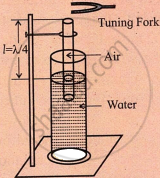
Take a glass tube open at both ends and clamp it so that its one end dips into a glass cylinder containing water as shown in the accompanying figure. By changing the position of the tube at the clamp, you can adjust the length of the air column in the tube. Hold a vibrating tuning fork of frequency 488 Hz or 512 Hz just above the open end of the tube and make the air column vibrate. What is the difference between the sounds that you hear? The sound will be louder. This is an example of resonance. This set-up is a resonance tube. Note the heights of the air column when you hear louder sound. Interpret your observations.
Take another tuning fork of the same frequency as the first one. Vibrate them together above the open end of the tube. Do you hear beats? If the two tuning forks are of same frequency, you should not hear beats. In practice, due to usage, frequencies change and in most of the cases, you will hear beats. If you do not hear beats, there can be two reasons: (i) frequencies of the two forks are exactly same or (ii) the frequencies are very much different (difference greater than 6-7 Hz) and we cannot recognize the beats. Then wind a piece of thread around the tong of one of the tuning fork so that its frequency changes slightly. Try to hear the beats. By changing the position of the thread, vary the frequency and note down your observations systematically. What information you get from this activity?
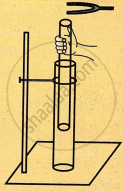
Take two pipes of slightly different diameters, open at both the ends, so that one pipe can be moved freely inside the other. Keep the wider pipe fixed by clamping on a stand and move the other pipe up and down by hand as shown in the accompanying figure. Use a tuning fork of frequency 320 Hz or 288 Hz and keep it above the open end of the fixed pipe. Move the inner tube and try to hear the various sound patterns and write down your observations. Try to analyze the results based on the knowledge you have from the sound pattern formed with a pipe open at both ends.
- Take two tuning forks of the same frequency.
- Put some wax on the prongs of one of the forks.
- Vibrate both the tuning forks and keep them side by side.
- Listen to the periodic vibrations of loudness of resulting sound.
- How many beats have you heard in one minute?
- Can you guess whether frequency of tuning fork is increased or decreased by applying wax on the prong?
- How you can find the new frequency of the fork after applying wax on it.
Balbharati solutions for Physics [English] Standard 12 Maharashtra State Board 6 Superposition of Waves Exercises [Pages 156 - 157]
Choose the correct option:
When an air column in a pipe closed at one end vibrates such that three nodes are formed in it, the frequency of its vibrations is _____ times the fundamental frequency.
2
3
4
5
Choose the correct option.
If two open organ pipes of length 50 cm and 51 cm sounded together produce 7 beats per second, the speed of sound is ______.
307 m/s
327 m/s
350 m/s
357 m/s
Choose the correct option.
The tension in a piano wire is increased by 25%. Its frequency becomes ______ times the original frequency.
0.8
1.12
1.25
1.56
Choose the correct option:
Which of the following equations represents a wave travelling along Y-axis?
x = A sin(ky – ωt)
y = A sin(kx – ωt)
y = A sin(ky) cos(ωt)
y = A cos(ky) sin(ωt)
Choose the correct option:
A standing wave is produced on a string clamped at one end and free at the other. The length of the string ______.
Must be an odd integral multiple of `lambda/4`
Must be an odd integral multiple of `lambda/2`
Must be an odd integral multiple of `lambda`
Must be an even integral multiple of `lambda`
Answer in brief:
A wave is represented by an equation y = A sin (Bx + Ct). Given that the constants A, B and C are positive, can you tell in which direction the wave is moving?
Answer in brief:
A string is fixed at the two ends and is vibrating in its fundamental mode. It is known that the two ends will be at rest. Apart from these, is there any position on the string which can be touched so as not to disturb the motion of the string? What will be the answer to this question if the string is vibrating in its first and second overtones?
Answer in brief:
What are harmonics and overtones?
Answer in brief.
For a stationary wave set up in a string having both ends fixed, what is the ratio of the fundamental frequency to the second harmonic?
Answer in brief.
The amplitude of a wave is represented by y = 0.2 sin 4π `["t"/0.08-"x"/0.8]` in SI units. Find (a) wavelength, (b) frequency, and (c) amplitude of the wave.
State the characteristics of progressive waves.
Answer in brief:
State the characteristics of stationary waves.
Derive an expression for the equation of stationary wave on a stretched string.
Find the amplitude of the resultant wave produced due to interference of two waves given as y1 = A1 sinωt, y2 = A2 sin(ωt + φ)
State the laws of vibrating strings
Explain how vibrating strings can be verified using a sonometer.
Show that only odd harmonics are present in an air column vibrating in a pipe closed at one end.
Prove that all harmonics are present in the vibrations of the air column in a pipe open at both ends.
A wave of frequency 500 Hz is traveling with a speed of 350 m/s. (a) What is the phase difference between two displacements at a certain point at times 1.0 ms apart? (b) what will be the smallest distance between two points which are 45° out of phase at an instant of time?
A sound wave in a certain fluid medium is reflected at an obstacle to form a standing wave. The distance between two successive nodes is 3.75 cm. If the velocity of sound is 1500 m/s, find the frequency.
Two sources of sound are separated by a distance of 4 m. They both emit sound with the same amplitude and frequency (330 Hz), but they are 180° out of phase. At what points between the two sources, will the sound intensity be maximum?
Two sound waves travel at a speed of 330 m/s. If their frequencies are also identical and are equal to 540 Hz, what will be the phase difference between the waves at points 3.5 m from one source and 3 m from the other if the sources are in phase?
Two wires of the same material and the same cross-section are stretched on a sonometer. One wire is loaded with 1.5 kg and another is loaded with 6 kg. The vibrating length of the first wire is 60 cm and its fundamental frequency of vibration is the same as that of the second wire. Calculate the vibrating length of the other wire.
A pipe closed at one end can produce overtones at frequencies 640 Hz, 896 Hz, and 1152 Hz. Calculate the fundamental frequency.
A standing wave is produced in a tube open at both ends. The fundamental frequency is 300 Hz. What is the length of the tube? (speed of the sound = 340 m s-1).
Find the fundamental, first overtone, and second overtone frequencies of a pipe, open at both the ends, of length 25 cm if the speed of sound in air is 330 m/s.
A pipe open at both the ends has a fundamental frequency of 600 Hz. The first overtone of a pipe closed at one end has the same frequency as the first overtone of the open pipe. How long are the two pipes?
(Given: v = 330 m/s)
A string 1m long is fixed at one end. The other end is moved up and down with frequency of 15 Hz. Due to this, a stationary wave with four complete loops gets produced on the string. Find the speed of the progressive wave which produces the stationary wave.
[Hint: Remember that the moving end is an antinode.]
A violin string vibrates with fundamental frequency of 440Hz. What are the frequencies of the first and second overtones?
A set of 8 tuning forks is arranged in a series of increasing order of frequencies. Each fork gives 4 beats per second with the next one and the frequency of last fork is twice that of the first. Calculate the frequencies of the first and the last fork.
A sonometer wire is stretched by the tension of 40 N. It vibrates in unison with a tuning fork of frequency 384 Hz. How many numbers of beats get produced in two seconds if the tension in the wire is decreased by 1.24 N?
A sonometer wire of length 0.5 m is stretched by a weight of 5 kg. The fundamental frequency of vibration is 100 Hz. Calculate the linear density of wire.
The string of a guitar is 80 cm long and has a fundamental frequency of 112 Hz. If a guitarist wishes to produce a frequency of 160 Hz, where should the person press the string?
Solutions for 6: Superposition of Waves
Balbharati solutions for Physics [English] Standard 12 Maharashtra State Board chapter 6 - Superposition of Waves
Shaalaa.com has the Maharashtra State Board Mathematics Physics [English] Standard 12 Maharashtra State Board Maharashtra State Board solutions in a manner that help students grasp basic concepts better and faster. The detailed, step-by-step solutions will help you understand the concepts better and clarify any confusion. Balbharati solutions for Mathematics Physics [English] Standard 12 Maharashtra State Board Maharashtra State Board 6 (Superposition of Waves) include all questions with answers and detailed explanations. This will clear students' doubts about questions and improve their application skills while preparing for board exams.
Further, we at Shaalaa.com provide such solutions so students can prepare for written exams. Balbharati textbook solutions can be a core help for self-study and provide excellent self-help guidance for students.
Concepts covered in Physics [English] Standard 12 Maharashtra State Board chapter 6 Superposition of Waves are Superposition of Waves, Progressive Waves, Reflection of Waves, Stationary Waves, Free and Forced Vibrations, Harmonics and Overtones, Sonometer, Beats, Musical Instruments, Characteristics of Sound, The Speed of a Travelling Wave, Speed of Wave Motion, Study of Vibrations of Air Columns, Overview: Superposition of Waves.
Using Balbharati Physics [English] Standard 12 Maharashtra State Board solutions Superposition of Waves exercise by students is an easy way to prepare for the exams, as they involve solutions arranged chapter-wise and also page-wise. The questions involved in Balbharati Solutions are essential questions that can be asked in the final exam. Maximum Maharashtra State Board Physics [English] Standard 12 Maharashtra State Board students prefer Balbharati Textbook Solutions to score more in exams.
Get the free view of Chapter 6, Superposition of Waves Physics [English] Standard 12 Maharashtra State Board additional questions for Mathematics Physics [English] Standard 12 Maharashtra State Board Maharashtra State Board, and you can use Shaalaa.com to keep it handy for your exam preparation.
