Advertisements
Chapters
1: The Earth and the Graticule
2: Let us Use the Graticule
3: Comparing a Globe and a Map; Field Visits
Part 2
4: Weather and Climate
5: Temperature
6: Importance of Oceans
Part 3
7: Rocks and Rock Types
8: Natural Resources
Part 4
9: Energy Resources
▶ 10: Human Occupations

Advertisements
Solutions for Chapter 10: Human Occupations
Below listed, you can find solutions for Chapter 10 of Maharashtra State Board Balbharati for Geography Integrated [English] Standard 6 Maharashtra State Board.
Balbharati solutions for Geography Integrated [English] Standard 6 Maharashtra State Board 10 Human Occupations Intext Questions [Pages 121 - 125]
 |
 |
 |
 |
 |
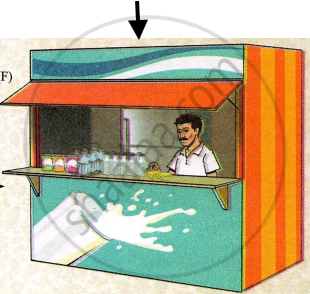 |
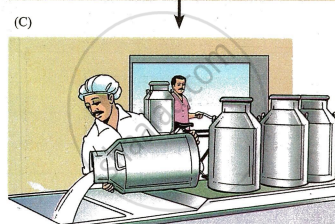
Answer the following questions after observing the pictures in these figures.
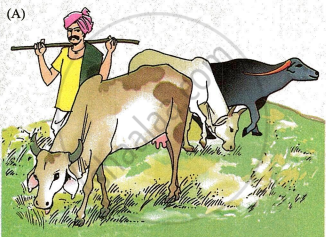
- What are the cows and the buffalo in picture A doing?
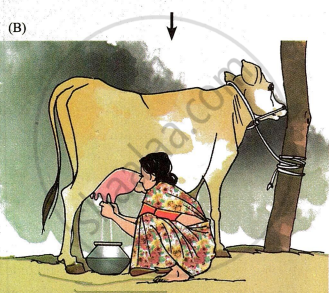
- What is being obtained in picture B?
- What is happening at the Milk Collection Centre in picture C?
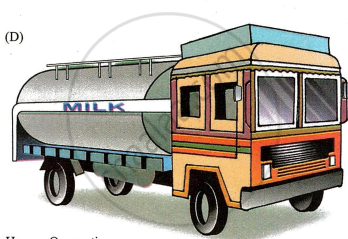
- In picture D, what is being transported? Where could the tanker be going?
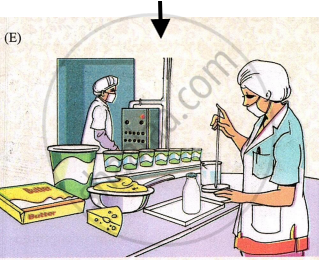
- Which products are seen in picture E? From what have these products been made?
- What else is happening in picture E?
- Out of the products shown in picture F, which products do you use?
- What would be the main difference between milk and milk products?
- Do these products perish quickly like milk?
|
|
|
|
|
|
Now look at the pictures again and answer the following questions.
- Which of these activities is undertaken to obtain a product from nature?
- Which product is obtained through it?
- How long does this product last?
- In which picture is the product obtained from nature being collected?
- Which service did the milk producer get through this activity?
- Where is the milk being taken? What happens to the milk thereafter?
- What milk products are seen in the picture?
- Who inspects these products?
- What does the shopkeeper do with these products?
- Which of these products are perishable and which are non-perishable?
- Will the price and weight of these products be same as that of the milk?
The teacher should hove o detailed discussion about this with students.
Use your brain power!
Milk is available at Rs 40 per litre while dahi at Rs 60 per kg and paneer at Rs 200 per kg. If both are obtained from milk, why is there so much difference in their prices?
Think a little!
Who examines us when we fall ill?
Who checks our examination papers?
Who prepares the designs of buildings?
Who produces machines?
Who looks after their maintenance and repairs?
 |
 |
 |
 |
 |
 |
 |
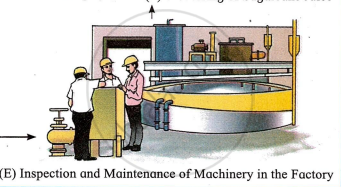 |
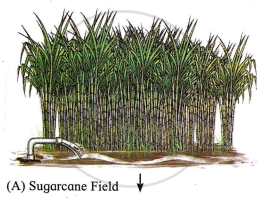
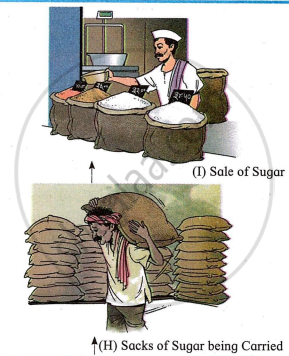
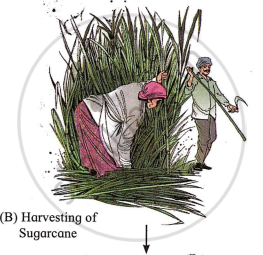
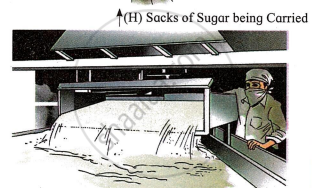
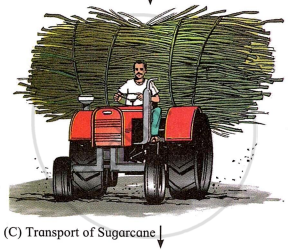
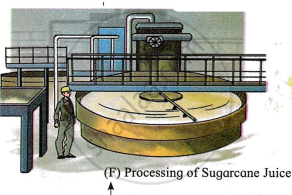
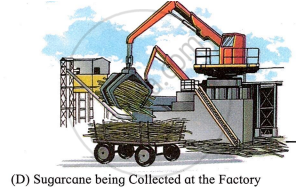
Look at the pictures in these figures carefully. We are learning about the classification of occupations. See if you can answer the following questions related to sugar production.
- Classify the occupations from primary to quaternary.
- Which raw material is used in the secondary occupation?
- Which is the finished product obtained in the secondary occupation?
- Which are the services in tertiary occupations?
- Which picture is related to a quaternary occupation? Can you name that occupation?
Try this activity.
Think of more such chains of occupations. Draw their pictures and classify them from primary to quaternary as above.
Think and Discuss
What effect does nature have on our occupations? Think a little. Give a thought to the following issues. Discuss them in the class. Write two paragraphs about it.
- There have been no rains at all ( drought).
- A storm strikes.
- There was an earthquake.
- Untimely rains.
- Good rains.
- Excessive rains and floods.
- All of a sudden, a volcano erupts.
- A tsunami hits.
Do it yourself!
Which occupations are found in your area?
Which occupation is practised on a large scale in your area?
Find out the types of jobs found in your area and the reasons behind the large-scale jobs.
Discuss and find the reasons behind a particular industry being located in your area.
Both human and natural factors affect occupations. Can you find those factors?
Obtain information about the damage caused to the environment through different occupations.
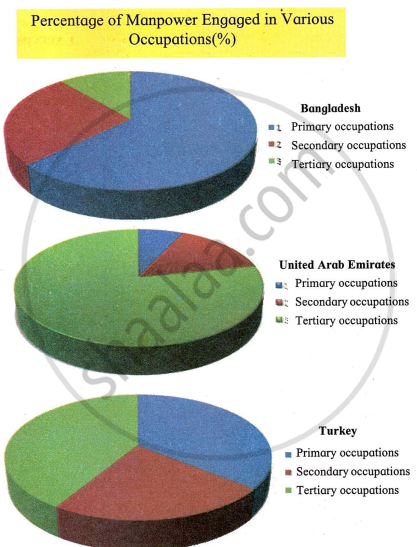
- Which country has more manpower engaged in primary occupations?
- Which country has more manpower engaged in secondary occupations?
- Which country has more manpower engaged in tertiary occupations?
- Which country has almost equal manpower engaged m all the occupations?
I can do this!
Name different occupations.
Tell the difference between various occupations.
|
|
|
|
|
|
|
|
Look at the pictures in these figures carefully. We are learning about the classification of occupations. See if you can answer the following questions related to sugar production.
- Classify the occupations from primary to quaternary.
- Which raw material is used in the secondary occupation?
- Which is the finished product obtained in the secondary occupation?
- Which are the services in tertiary occupations?
- Which picture is related to a quaternary occupation? Can you name that occupation?
Identify the factors that affect the various occupations.
Balbharati solutions for Geography Integrated [English] Standard 6 Maharashtra State Board 10 Human Occupations Exercises [Page 126]
Select the correct option:
Serving as a ______ is a tertiary type of occupation.
bus conductor
veterinary doctor
brick kiln worker
In the tropical areas, we mainly see ______ occupations.
primary
secondary
tertiary
Amol’s Granny sells papads and pickles. Which type of occupation is it?
primary
secondary
tertiary
Give reasons:
The type of occupation determines a person’s income.
Give reason:
Primary occupations are associated with developing countries while tertiary, with developed countries.
Give a reason:
Quaternary occupations are not commonly seen.
Activity
Visit a secondary occupation in your area. Gather information related to that occupation using the following points and note it down.
- Name of the occupation
- Raw material used
- Source of raw material
- Finished product
- Market for finished product
- Tertiary occupations required in it.
Solutions for 10: Human Occupations
Balbharati solutions for Geography Integrated [English] Standard 6 Maharashtra State Board chapter 10 - Human Occupations
Shaalaa.com has the Maharashtra State Board Mathematics Geography Integrated [English] Standard 6 Maharashtra State Board Maharashtra State Board solutions in a manner that help students grasp basic concepts better and faster. The detailed, step-by-step solutions will help you understand the concepts better and clarify any confusion. Balbharati solutions for Mathematics Geography Integrated [English] Standard 6 Maharashtra State Board Maharashtra State Board 10 (Human Occupations) include all questions with answers and detailed explanations. This will clear students' doubts about questions and improve their application skills while preparing for board exams.
Further, we at Shaalaa.com provide such solutions so students can prepare for written exams. Balbharati textbook solutions can be a core help for self-study and provide excellent self-help guidance for students.
Concepts covered in Geography Integrated [English] Standard 6 Maharashtra State Board chapter 10 Human Occupations are Introduction to Human Occupations, Primary Occupations, Secondary Occupations, Tertiary Occupations, Quaternary Occupations.
Using Balbharati Geography Integrated [English] Standard 6 Maharashtra State Board solutions Human Occupations exercise by students is an easy way to prepare for the exams, as they involve solutions arranged chapter-wise and also page-wise. The questions involved in Balbharati Solutions are essential questions that can be asked in the final exam. Maximum Maharashtra State Board Geography Integrated [English] Standard 6 Maharashtra State Board students prefer Balbharati Textbook Solutions to score more in exams.
Get the free view of Chapter 10, Human Occupations Geography Integrated [English] Standard 6 Maharashtra State Board additional questions for Mathematics Geography Integrated [English] Standard 6 Maharashtra State Board Maharashtra State Board, and you can use Shaalaa.com to keep it handy for your exam preparation.
