Advertisements
Chapters
1.1: Where the mind is without fear
1.2: The Thief’s Story
1.3: On Wings of Courage
1.4: All the World’s a Stage
1.5: Joan of Arc
1.6: The Alchemy of Nature
Unit Two
2.1: Animals
2.2: Three Questions
2.3: Connecting the Dots
2.4: The Pulley
2.5: Let’s March
▶ 2.6: Science and Spirituality
Unit Three
3.1: Night of the Scorpion
3.2: The Night I Met Einstein
3.3: Stephen Hawking
3.4: The Will to Win
3.5: Unbeatable Super Mom-Mary Kom
3.6: The Concert
Unit Four
4.1: A Thing of Beauty is a Joy For Ever
4.2: The Luncheon
4.3: World Heritage
4.4: The Height of the Ridiculous
4.5: The Old Man and The Sea: Book Review
4.6: The Gift of the Magi
Advertisements
Solutions for Chapter 2.6: Science and Spirituality
Below listed, you can find solutions for Chapter 2.6 of Maharashtra State Board Balbharati for English Kumarbharati Standard 10 Maharashtra State Board.
Balbharati solutions for English Kumarbharati Standard 10 Maharashtra State Board 2.6 Science and Spirituality Warming Up! [Page 89]
Get into pairs/groups and match the columns:
| ‘A’ | ‘B’ |
| (1) Science | The study of the basic nature of knowledge, reality and existence, especially as an academic subject. |
| (2) Religion | The study of nature of God and religious belief. |
| (3) Spirituality | The intellectual and practical activities in a systematic study of structure and behaviour of the natural world through experiment and observation. |
| (4) Philosophy | The belief in and worship of a superhuman controlling power God. |
| (5) Theology | The quality of being more concerned with the human spirit as opposed to material or physical things. |
Given below is an incomplete Quote. Complete it by choosing from the words SCIENCE/RELIGION/SPIRITUAL and make it meaningful:
______ without religion is lame; ______ without science is blind.
Given below is an incomplete Quote. Complete it by choosing from the words SCIENCE/RELIGION/SPIRITUAL and make it meaningful:
______ has outrun our ______ power, we have guided missiles, but misguided man.
Given below is an incomplete Quote. Complete it by choosing from the words SCIENCE/RELIGION/SPIRITUAL and make it meaningful:
On a ______ journey, we all have the same destination.
Given below is an incomplete Quote. Complete it by choosing from the words SCIENCE/RELIGION/SPIRITUAL and make it meaningful:
______ is meant to awaken man’s love for his Source - God!
Given below is an incomplete Quote. Complete it by choosing from the words SCIENCE/RELIGION/SPIRITUAL and make it meaningful:
______ provides a means of with the Creator of Heaven and Earth, in the language of your heart and soul.
Given below is an incomplete Quote. Complete it by choosing from the words SCIENCE/RELIGION/SPIRITUAL and make it meaningful:
______ is a beautiful gift to humanity; we should not distort it.
What’s the difference between science and technology? Discuss in pairs and tell your answer to the class.
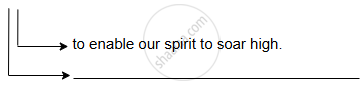
Do you think that science and faith are both important in our lives? Why? Discuss in your group and give a small presentation in front of the class.
We need science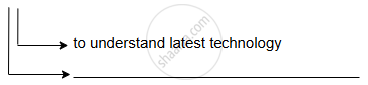
We need faith
Refer to a dictionary to find out the meanings of the following words.
Spirit - a person’s mind or feelings or soul.
- Spiritual
- Spirituality
- Spiritualism
- Spiritualist
Balbharati solutions for English Kumarbharati Standard 10 Maharashtra State Board 2.6 Science and Spirituality English Workshop [Pages 94 - 99]
Read ‘Part I’ and match the words in Column ‘A’ with associating words given in Column ‘B’.
| No | ‘A’ | ‘B’ | |
| (i) | Science and faith | (a) | Created by fact and faith |
| (ii) | Science | (b) | Success of societies |
| (iii) | Better Planet | (c) | Betterment of humanity |
| (iv) | Creations and Discoveries | (d) | Believers of science and religions |
| (v) | Conflict | (e) | Solves questions, discovers truth, conceives inventions |
Read ‘Part II’. Go through the given statement and say whether you agree or disagree with it.
The Space Research set up facility was planned at Allapi, Kerala
Read ‘Part II’. Go through the given statement and say whether you agree or disagree with it.
The person who could help and can be contacted was the Bishop.
Read ‘Part II’. Go through the given statement and say whether you agree or disagree with it.
It was quite easy to relocate so many people and destroy religious institutions for space research centre.
Read ‘Part II’. Go through the given statement and say whether you agree or disagree with it.
Dr. Kalam joined ISRO in 1970.
Read ‘Part II’. Go through the given statement and say whether you agree or disagree with it.
Science and spirituality seeks prosperity of the human life.
Go through ‘Part III’ and complete the following statement.
The essence of a happy life and a peaceful society lies in one sentence ______
Go through ‘Part III’ and complete the following statement.
To keep this planet liveable and the human race thriving, we have to ______.
Go through ‘Part III’ and complete the following statement.
Mahaswamiji’s greatest contribution is the ______.
Go through ‘Part III’ and complete the following statement.
We can remove the impurities obscuring our souls by ______.
Go through ‘Part III’ and complete the following statement.
The narrator, Srijan, realised that through Dr. Kalam’s words of wisdom ______.
Go through ‘Part III’ and complete the following statement.
Mahaswamiji possesses powers that kept him so strong were ______ or ______.
Choose the correct alternative for the given statements.
Dr. Kalam’s father was an ______.
teacher
scientist
farmer
imam
Dr. Kalam’s friends discussed on ______.
science and technology
discoveries and inventions
science and spirituality
community’s problems and solutions
According to Dr. Kalam, the need that is felt more than ever is ______.
a laboratory to conduct experiments.
a new technology to find results.
a dialogue among cultures, religions and civilizations.
a dialogue between people of different professions.
Dr. Kalam’s father was a symbol of ______.
trust and faith
simplicity and divinity
teacher and disciple
father and friend
Spirituality takes care of ______.
education, teaching and learning.
science, technology and sci-fi.
confusion, misery or failure.
crime, illiteracy and child labour.
How can academic brilliance diminish?
by disturbance and frustration.
by going off track.
by a coating of dust.
by losing focus and seriousness.
What was most astonishing about 102 year old Swamiji?
He was a great speaker and orator.
He was a great scientist.
He was a great admirer of technology.
He looked as steady and alert as any other youngster.
What Dr. Kalam gathered while swimming in silence at the shores of Mahapragyaji?
beautiful sea shores
tree lined beaches
sands of conscience
beautiful sun-set
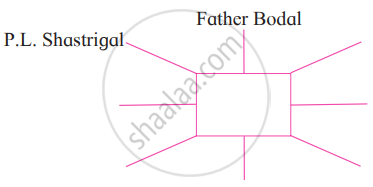
Among the three parts, there are people who touched and influenced the life of Dr. A. P. J. Kalam in one or the other ways. Complete the web chart by writing the names of such people.
Write the significance of the following year, as given in the text.
1960
Write the significance of the following year, as given in the text.
1970
Write the significance of the following year, as given in the text.
1980
Write the significance of the following year, as given in the text.
2009
Write the significance of the following year, as given in the text.
2012
Who said to whom and when?
“Can we give up God’s abode for such a great scientific mission?”
Who said to whom and when?
“And then God will shine through us.”
Who said to whom and when?
“I wonder what power Mahaswamiji possesses, that keeps him so strong.”
Answer the following in your own words, and write in your notebook.
What makes Dr. Kalam a humble personality?
How were different virtues inculcated in Dr. Kalam?
How did the Reverend relate and compare the work that he and Dr. Sarabhai did for people?
What was so remarkable about Dr Sri Sri Shivakumar Mahaswamiji?
Why is there an urgent need to replace ‘What can I take’ with ‘What can I give’?
In your notebook, write a short paragraph on the following covering up their profession and personality traits with examples.
Rev. Peter Bernard Pereira
In your notebook, write a short paragraph on the following covering up their profession and personality traits with examples.
Dr. Sri Sri Shivakumar Mahaswamiji
In your notebook, write a short paragraph on the following covering up their profession and personality traits with examples.
Dr. A. P. J. Abdul Kalam
Write in your own simple words what the following expression convey in the context they occur in the text.
Faith and fact can, together, create a better planet.
Write in your own simple words what the following expression convey in the context they occur in the text.
Dr. Kalam’s own life was nourished by multiple faiths.
Write in your own simple words what the following expression convey in the context they occur in the text.
But there was a major roadblock.
Write in your own simple words what the following expression conveys in the context they occur in the text.
Only when the dust is removed, does the mirror shine and the reflection becomes clear.
Write in your own simple words what the following expression convey in the context they occur in the text.
Through his (Kalam’s) words of wisdom, I was getting to learn from countless great minds.
Write in your own simple words what the following expression convey in the context they occur in the text.
He gathered the sands of conscience to be our guide, our best friend.
Write in your own simple words what the following expression convey in the context they occur in the text.
‘What can I take?’ is the thought which is responsible for all the wrong, seen around us.
From the lesson, pick out one word for the following.
increase the speed
From the lesson, pick out one word for the following.
point of view
From the lesson, pick out one word for the following.
nearness in space
From the lesson, pick out one word for the following.
a place of residence
From the lesson, pick out one word for the following.
eager to know everything
From the lesson, pick out one word for the following.
echoed loudly
From the lesson, pick out one word for the following.
giving away much to the needy
From the lesson, pick out one word for the following.
without making a difference
Arrange the following words in the alphabetical order.
inventions, indisputable, interactions, inequity, institutions, inquisitive, indiscriminately
Find from the lesson the noun forms of:
combine
Find from the lesson the noun forms of:
solve
Find from the lesson the noun forms of:
simple
Find from the lesson the noun forms of:
divine
Find from the lesson the noun forms of:
advance
Find from the lesson the noun forms of:
tranquil
Find from the lesson the noun forms of:
liveable
Find from the lesson the noun forms of:
strong
Match the word connectors with reference to part I, II, III respectively. Make sentences of each of these connectors.
| No | Word | Connector | |
| 1. | government | (a) | person |
| 2. | betterment of | (b) | curbs |
| 3. | pure and ethical | (c) | degradation |
| 4. | community’s | (d) | launch |
| 5. | religions | (e) | dialogue |
| 6. | astonishing | (f) | silence |
| 7. | technological | (a) | motivation |
| 8. | frank | (g) | aspect |
| 9. | social | (h) | life |
| 10. | faith | (i) | centre |
| 11. | inquisitive | (j) | officials |
| 12. | academic | (k) | problems |
| 13. | environmental | (l) | humanity |
| 14. | pin-drop | (m) | service |
| 15. | alternate | (n) | bodies |
| 16. | remarkable | (o) | evils |
| 17. | silent | (p) | advancement |
| 18. | famished | (q) | brilliance |
| 19. | unsuccessful | (s) | accommodation |
| 20. | space-research | (t) | discipline |
Simple sentence: subject + verb + object/complement/adverbial: Analysing a simple sentence is done by separating the subject and the predicate. The predicate is further analysed into -
- verb + object as in ‘A doctor treats patients’./‘He greeted the teacher.’
- verb + complement as in ‘They are very tired.’/‘I have a cold.’
- verb + adverbial as in (He walks slowly./Raj arrived late./The thief is hiding there.)
Say whether the predicates in the following sentence have an object/a complement/an adverbial.
There was silence.
Simple sentence: subject + verb + object/complement/adverbial: Analysing a simple sentence is done by separating the subject and the predicate. The predicate is further analysed into -
- verb + object as in ‘A doctor treats patients’./‘He greeted the teacher.’
- verb + complement as in ‘They are very tired.’/‘I have a cold.’
- verb + adverbial as in (He walks slowly./Raj arrived late./The thief is hiding there.)
Say whether the predicates in the following sentence have an object/a complement/an adverbial.
Alexander Bell invented the telephone.
Simple sentence: subject + verb + object/complement/adverbial: Analysing a simple sentence is done by separating the subject and the predicate. The predicate is further analysed into -
- verb + object as in ‘A doctor treats patients’./‘He greeted the teacher.’
- verb + complement as in ‘They are very tired.’/‘I have a cold.’
- verb + adverbial as in (He walks slowly./Raj arrived late./The thief is hiding there.)
Say whether the predicates in the following sentence have an object/a complement/an adverbial.
They have a holiday.
Simple sentence: subject + verb + object/complement/adverbial: Analysing a simple sentence is done by separating the subject and the predicate. The predicate is further analysed into -
- verb + object as in ‘A doctor treats patients’./‘He greeted the teacher.’
- verb + complement as in ‘They are very tired.’/‘I have a cold.’
- verb + adverbial as in (He walks slowly./Raj arrived late./The thief is hiding there.)
Say whether the predicates in the following sentence have an object/a complement/an adverbial.
The dancer danced gracefully.
Simple sentence: subject + verb + object/complement/adverbial: Analysing a simple sentence is done by separating the subject and the predicate. The predicate is further analysed into -
- verb + object as in ‘A doctor treats patients’./‘He greeted the teacher.’
- verb + complement as in ‘They are very tired.’/‘I have a cold.’
- verb + adverbial as in (He walks slowly./Raj arrived late./The thief is hiding there.)
Say whether the predicates in the following sentence have an object/a complement/an adverbial.
The milkman comes daily.
Simple sentence: subject + verb + object/complement/adverbial: Analysing a simple sentence is done by separating the subject and the predicate. The predicate is further analysed into -
- verb + object as in ‘A doctor treats patients’./‘He greeted the teacher.’
- verb + complement as in ‘They are very tired.’/‘I have a cold.’
- verb + adverbial as in (He walks slowly./Raj arrived late./The thief is hiding there.)
Say whether the predicates in the following sentence have an object/a complement/an adverbial.
The hostess served tea.
Simple sentence: subject + verb + object/complement/adverbial: Analysing a simple sentence is done by separating the subject and the predicate. The predicate is further analysed into -
- verb + object as in ‘A doctor treats patients’./‘He greeted the teacher.’
- verb + complement as in ‘They are very tired.’/‘I have a cold.’
- verb + adverbial as in (He walks slowly./Raj arrived late./The thief is hiding there.)
Say whether the predicates in the following sentence have an object/a complement/an adverbial.
The kite soared upwards.
Punctuate the following sentence to make it meaningful.
dinesh took a bus that stopped at nanded railway station after crossing somvar peth
Punctuate the following sentence to make it meaningful.
dr a p j abdul kalam was the past president of india by the way he was a great scientist orator and a humanitarian
Punctuate the following sentence to make it meaningful.
nouns are of different types common proper abstract concrete material
Punctuate the following sentence to make it meaningful.
what a lot of noise you all make said the teacher cant you keep quiet for a while
Punctuate the following sentence to make it meaningful.
wow how lovely that cake looks they said we cant wait to eat it
Copy the first paragraph on page 92 in your notebook, carefully. Encircle all the puctuation marks with a coloured pencil/pen.
“Dear children ...................... ‘amen’.
Project:
Read Dr. A.P.J. Abdul Kalam’s very renowned books ‘Wings of Fire’; and ‘Ignited Minds’, to find the following:
- Subject of the book
- Special features of the book
- Teachings/learnings/moral/message from the book
- Your own opinion/idea/comment on the book
Draft a speech that you would give at your School Assembly convincing junior students that the secret of true happiness lies in Giving and Sharing more than in Receiving and Taking.
Write it with the appropriate steps in your notebook.
Divide your class in two groups and have a Debate on the topic ‘Science and Spirituality can go hand in hand’.
Solutions for 2.6: Science and Spirituality
Balbharati solutions for English Kumarbharati Standard 10 Maharashtra State Board chapter 2.6 - Science and Spirituality
Shaalaa.com has the Maharashtra State Board Mathematics English Kumarbharati Standard 10 Maharashtra State Board Maharashtra State Board solutions in a manner that help students grasp basic concepts better and faster. The detailed, step-by-step solutions will help you understand the concepts better and clarify any confusion. Balbharati solutions for Mathematics English Kumarbharati Standard 10 Maharashtra State Board Maharashtra State Board 2.6 (Science and Spirituality) include all questions with answers and detailed explanations. This will clear students' doubts about questions and improve their application skills while preparing for board exams.
Further, we at Shaalaa.com provide such solutions so students can prepare for written exams. Balbharati textbook solutions can be a core help for self-study and provide excellent self-help guidance for students.
Concepts covered in English Kumarbharati Standard 10 Maharashtra State Board chapter 2.6 Science and Spirituality are Grammar, The Alphabet, Parts of Speech, Noun, Pronoun, Root Word, Prefix-suffix, Compound Words, Word Building, Punctuation, Speech, Pronunciation, Figures of Speech, Idioms and Phrases, Syllables, Tense, English Translation, Rhyme Scheme, Modal Auxiliary, Use ‘Not Only but Also’, Use ‘As Soon As’, ‘either ... or’ and ‘No Sooner ... Than’, Rhyming Words, Wh-questions, Add a Question Tag, Change the Voice, Make a Sentence, Use of Though, Although, Even Though and but, Spotting Errors, Verb, Adjective, Adverb, Preposition, Conjunction, Interjection, Determiners, Articles - A, An, The, Degrees of Comparison, Make a Sentence, Types of Sentences, Types of Sentences, Subject and Predicate, Direct-Indirect Speech, Clauses, Vocabulary, Synonyms, Antonyms, Homonyms, Homophones, Homographs, Register, Writing Skills, Speech Writing, Story Writing, Summary Writing, Dialogue Writing, Interview Questions, Report Writing, Note Making, Letter Writing, Notice Writing, View and Counterview, Tourist Leaflet, Article Writing, Information Transfer, Expansion of Ideas, Narration, Paragraph Writing, Reading Skills, Unseen Passage Comprehension, Unseen Poem Comprehension.
Using Balbharati English Kumarbharati Standard 10 Maharashtra State Board solutions Science and Spirituality exercise by students is an easy way to prepare for the exams, as they involve solutions arranged chapter-wise and also page-wise. The questions involved in Balbharati Solutions are essential questions that can be asked in the final exam. Maximum Maharashtra State Board English Kumarbharati Standard 10 Maharashtra State Board students prefer Balbharati Textbook Solutions to score more in exams.
Get the free view of Chapter 2.6, Science and Spirituality English Kumarbharati Standard 10 Maharashtra State Board additional questions for Mathematics English Kumarbharati Standard 10 Maharashtra State Board Maharashtra State Board, and you can use Shaalaa.com to keep it handy for your exam preparation.
