English
Karnataka Board PUCPUC Science Class 11

PUC Science Class 11 - Karnataka Board PUC Question Bank Solutions

Advertisements
[object Object]
[object Object]
Subjects
Popular subjects
Topics

Please select a subject first

Advertisements
Advertisements
< prev  4821 to 4840 of 4962  next > 

A 50 kg man is running at a speed of 18 km h−1. If all the kinetic energy of the man can be used to increase the temperature of water from 20°C to 30°C, how much water can be heated with this energy?

[10] Thermal Properties of Matter
Chapter: [10] Thermal Properties of Matter
Concept: undefined >> undefined

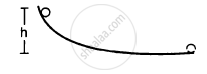
The track shown is figure is frictionless. The block B of mass 2m is lying at rest and the block A or mass m is pushed along the track with some speed. The collision between Aand B is perfectly elastic. With what velocity should the block A be started to get the sleeping man awakened?  

[6] System of Particles and Rotational Motion
Chapter: [6] System of Particles and Rotational Motion
Concept: undefined >> undefined

Advertisements

Consider the situation of the previous problem. Assume that the temperature of the water at the bottom of the lake remains constant at 4°C as the ice forms on the surface (the heat required to maintain the temperature of the bottom layer may come from the bed of the lake). The depth of the lake is 1.0 m. Show that the thickness of the ice formed attains a steady state maximum value. Find this value. The thermal conductivity of water = 0.50 W m−1°C−1. Take other relevant data from the previous problem.

[10] Thermal Properties of Matter
Chapter: [10] Thermal Properties of Matter
Concept: undefined >> undefined

A calorimeter contains 50 g of water at 50°C. The temperature falls to 45°C in 10 minutes. When the calorimeter contains 100 g of water at 50°C, it takes 18 minutes for the temperature to become 45°C. Find the water equivalent of the calorimeter.

[10] Thermal Properties of Matter
Chapter: [10] Thermal Properties of Matter
Concept: undefined >> undefined

You are driving a motorcycle on a horizontal road. It is moving with a uniform velocity. Is it possible to accelerate the motorcycle without putting higher petrol input rate into the engine?

[4] Laws of Motion
Chapter: [4] Laws of Motion
Concept: undefined >> undefined

Is it necessary to express all angles in radian while using the equation ω = ω0 + at ?

[4] Laws of Motion
Chapter: [4] Laws of Motion
Concept: undefined >> undefined

A car driver going at some speed v suddenly finds a wide wall at a distance r. Should he apply brakes or turn the car in a circle of radius r to avoid hitting the wall?

[4] Laws of Motion
Chapter: [4] Laws of Motion
Concept: undefined >> undefined

Can the centre of mass of a body be at a point outside the body?

[6] System of Particles and Rotational Motion
Chapter: [6] System of Particles and Rotational Motion
Concept: undefined >> undefined

The weight Mg of an extended body is generally shown in a diagram to act through the centre of mass. Does it mean that the earth does not attract other particles?

[6] System of Particles and Rotational Motion
Chapter: [6] System of Particles and Rotational Motion
Concept: undefined >> undefined

A circular road of radius r is banked for a speed v = 40 km/hr. A car of mass of m attempts to go on the circular road. The friction coefficient between the tyre and the road is negligible. 

(a) The are cannot make a turn without skidding.
(b) If the car turns at a speed less than 40 km/hr, it will slip down.

(c) If the car turns at the car is equal to \[\frac{\text{mv}^2}{\text{r}}\]

(d) If the car turns at the correct speed of 40 km/hr, the force by the road on the car is greater than mg as well as greater than \[\frac{\text{mv}^2}{\text{r}}\]

[4] Laws of Motion
Chapter: [4] Laws of Motion
Concept: undefined >> undefined

If the horizontal force needed for the turn in the previous problem is to be supplied by the normal force by the road, what should be the proper angle of banking?

[4] Laws of Motion
Chapter: [4] Laws of Motion
Concept: undefined >> undefined

A park has a radius of 10 m. If a vehicle goes round it at an average speed of 18 km/hr, what should be the proper angle of banking?

[4] Laws of Motion
Chapter: [4] Laws of Motion
Concept: undefined >> undefined

If the road of the previous problem is horizontal (no banking), what should be the minimum friction coefficient so that scooter going at 18 km/hr does not skid?

[4] Laws of Motion
Chapter: [4] Laws of Motion
Concept: undefined >> undefined

A circular road of radius 50 m has the angle of banking equal to 30°. At what speed should a vehicle go on this road so that the friction is not used?

[4] Laws of Motion
Chapter: [4] Laws of Motion
Concept: undefined >> undefined

All the particles of a body are situated at a distance R from the origin. The distance of the centre of mass of the body from the origin is

[6] System of Particles and Rotational Motion
Chapter: [6] System of Particles and Rotational Motion
Concept: undefined >> undefined

A body falling vertically downwards under gravity breaks in two parts of unequal masses. The centre of mass of the two parts taken together shifts horizontally towards

[6] System of Particles and Rotational Motion
Chapter: [6] System of Particles and Rotational Motion
Concept: undefined >> undefined

A body at rest breaks into two pieces of equal masses. The parts will move

[6] System of Particles and Rotational Motion
Chapter: [6] System of Particles and Rotational Motion
Concept: undefined >> undefined

A body moving towards a finite body at rest collides with it. It is possible that
(a) both the bodies come to rest
(b) both the bodies move after collision
(c) the moving body comes to rest and the stationary body starts moving
(d) the stationary body remains stationary, the moving body changes its velocity.

[6] System of Particles and Rotational Motion
Chapter: [6] System of Particles and Rotational Motion
Concept: undefined >> undefined

In a head-on elastic collision of two bodies of equal masses
(a) the velocities are interchanged
(b) the speeds are interchanged
(c) the momenta are interchanged
(d) the faster body slows down and the slower body speeds up.

[6] System of Particles and Rotational Motion
Chapter: [6] System of Particles and Rotational Motion
Concept: undefined >> undefined

A block at rest explodes into three equal parts. Two parts start moving along X and Y axes respectively with equal speeds of 10 m/s. Find the initial velocity of the third part.

[6] System of Particles and Rotational Motion
Chapter: [6] System of Particles and Rotational Motion
Concept: undefined >> undefined
< prev  4821 to 4840 of 4962  next > 
Advertisements
Share
Notifications

Englishहिंदीमराठी


      Forgot password?
Use app×