Please select a subject first
Advertisements
Advertisements
A steel plate of face area 4 cm2 and thickness 0.5 cm is fixed rigidly at the lower surface. A tangential force of 10 N is applied on the upper surface. Find the lateral displacement of the upper surface with respect to the lower surface. Rigidity modulus of steel = 8.4 × 10¹⁰ N m−2.
Concept: undefined >> undefined
Suppose the tube in the previous problem is kept vertical with A upward but the other conditions remain the same. the separation between the cross sections at A and B is 15/16 cm. Repeat parts (a), (b) and (c) of the previous problem. Take g = 10 m/s2.
Concept: undefined >> undefined
Advertisements
Suppose the tube in the previous problem is kept vertical with B upward. Water enters through B at the rate of 1 cm3/s. Repeat parts (a), (b) and (c). Note that the speed decreases as the water falls down.
Concept: undefined >> undefined
Four cylinders contain equal number of moles of argon, hydrogen, nitrogen and carbon dioxide at the same temperature. The energy is minimum in
Concept: undefined >> undefined
Show that the internal energy of the air (treated as an ideal gas) contained in a room remains constant as the temperature changes between day and night. Assume that the atmospheric pressure around remains constant and the air in the room maintains this pressure by communicating with the surrounding through the windows, doors, etc.
Use R = 8.314 J K-1 mol-1
Concept: undefined >> undefined
A metal block of heat capacity 80 J°C−1 placed in a room at 20°C is heated electrically. The heater is switched off when the temperature reaches 30°C. The temperature of the block rises at the rate of 2°C s−1 just after the heater is switched on and falls at the rate of 0.2°C s−1 just after the heater is switched off. Assume Newton's law of cooling to hold.
- Find the power of the heater.
- Find the power radiated by the block just after the heater is switched off.
- Find the power radiated by the block when the temperature of the block is 25°C.
- Assuming that the power radiated at 25°C represents the average value in the heating process, find the time for which the heater was kept on.
Concept: undefined >> undefined
Two stars each of one solar mass (= 2× 1030 kg) are approaching each other for a head on collision. When they are a distance 109 km, their speeds are negligible. What is the speed with which they collide? The radius of each star is 104 km. Assume the stars to remain undistorted until they collide. (Use the known value of G).
Concept: undefined >> undefined
A car weighs 1800 kg. The distance between its front and back axles is 1.8 m. Its centre of gravity is 1.05 m behind the front axle. Determine the force exerted by the level ground on each front wheel and each back wheel.
Concept: undefined >> undefined
The two ends of a spring are displaced along the length of the spring. All displacement have equal magnitudes. In which case or cases the tension or compression in the spring will have a maximum magnitude ?
(a) the right end is displaced towards right and the left end towards left
(b) both ends are displaced towards right
(c) both ends are displaced towards left
(d) the right end is displaced towards left and the left end towards right.
Concept: undefined >> undefined
Two equal masses are attached to the two ends of a spring of spring constant k. The masses are pulled out symmetrically to stretch the spring by a length x over its natural length. The work done by the spring on each mass is
Concept: undefined >> undefined
One end of a light spring of spring constant k is fixed to a wall and the other end is tied to a block placed on a smooth horizontal surface. In a displacement, the work done by the spring is \[\frac{1}{2}k x^2\] . The possible cases are
(a) at spring was initially compressed by a distance x and was finally in its natural length
(b) it was initially stretched by a distance x and and finally was in its natural length
(c) it was initially in its natural length and finally in a compressed position
(d) it was initially in its natural length and finally in a stretched position.
Concept: undefined >> undefined
If the sum of all the forces acting on a body is zero, is it necessarily in equilibrium? If the sum of all the forces on a particle is zero, is it necessarily in equilibrium?
Concept: undefined >> undefined
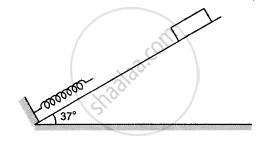
Following figure shows a spring fixed at the bottom end of an incline of inclination 37°. A small block of mass 2 kg starts slipping down the incline from a point 4⋅8 m away from the spring. The block compresses the spring by 20 cm, stops momentarily and then rebounds through a distance of 1 m up the incline. Find (a) the friction coefficient between the plane and the block and (b) the spring constant of the spring. Take g = 10 m/s2.
Concept: undefined >> undefined
A block of mass m moving at a speed ν compresses a spring through a distance x before its speed is halved. Find the spring constant of the spring.
Concept: undefined >> undefined
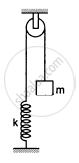
Consider the situation shown in the following figure. Initially the spring is unstretched when the system is released from rest. Assuming no friction in the pulley, find the maximum elongation of the spring.
Concept: undefined >> undefined
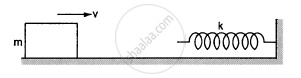
A block of mass m sliding on a smooth horizontal surface with a velocity \[\vec{\nu}\] meets a long horizontal spring fixed at one end and with spring constant k, as shown in following figure following. Find the maximum compression of the spring. Will the velocity of the block be the same as \[\vec{\nu}\] when it comes back to the original position shown?
Concept: undefined >> undefined
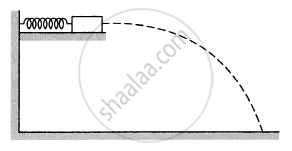
A small block of mass 100 g is pressed against a horizontal spring fixed at one end to compress the spring through 5 cm (figure following). The spring constant is 100 N/m. When released, the block moves horizontally till it leaves the spring. Where will it hit the ground 2 m below the spring?
Concept: undefined >> undefined
A uniform ladder of length 10⋅0 m and mass 16⋅0 kg is resting against a vertical wall making an angle of 37° with it. The vertical wall is frictionless but the ground is rough. An electrician weighing 60⋅0 kg climbs up the ladder. If he stays on the ladder at a point 8⋅00 m from the lower end, what will be the normal force and the force of friction on the ladder by the ground? What should be the minimum coefficient of friction for the electrician to work safely?
Concept: undefined >> undefined
Suppose the friction coefficient between the ground and
the ladder of the previous problem is 0.540. Find the
maximum weight of a mechanic who could go up and do
the work from the same position of the ladder.
Concept: undefined >> undefined
The door of an almirah is 6 ft high, 1⋅5 ft wide and weighs 8 kg. The door is supported by two hinges situated at a distance of 1 ft from the ends. If the magnitudes of the forces exerted by the hinges on the door are equal, find this magnitude.
Concept: undefined >> undefined
