Please select a subject first
Advertisements
Advertisements
A hollow sphere filled with water is used as the bob of a pendulum. Assume that the equation for simple pendulum is valid with the distance between the point of suspension and centre of mass of the bob acting as the effective length of the pendulum. If water slowly leaks out of the bob, how will the time period vary?
Concept: undefined >> undefined
A block of known mass is suspended from a fixed support through a light spring. Can you find the time period of vertical oscillation only by measuring the extension of the spring when the block is in equilibrium?
Concept: undefined >> undefined
Advertisements
A platoon of soldiers marches on a road in steps according to the sound of a marching band. The band is stopped and the soldiers are ordered to break the steps while crossing a bridge. Why?
Concept: undefined >> undefined
The force acting on a particle moving along X-axis is F = −k(x − vo t) where k is a positive constant. An observer moving at a constant velocity v0 along the X-axis looks at the particle. What kind of motion does he find for the particle?
Concept: undefined >> undefined
A student says that he had applied a force \[F = - k\sqrt{x}\] on a particle and the particle moved in simple harmonic motion. He refuses to tell whether k is a constant or not. Assume that he was worked only with positive x and no other force acted on the particle.
Concept: undefined >> undefined
The time period of a particle in simple harmonic motion is equal to the time between consecutive appearances of the particle at a particular point in its motion. This point is
Concept: undefined >> undefined
The time period of a particle in simple harmonic motion is equal to the smallest time between the particle acquiring a particular velocity \[\vec{v}\] . The value of v is
Concept: undefined >> undefined
The displacement of a particle in simple harmonic motion in one time period is
Concept: undefined >> undefined
The distance moved by a particle in simple harmonic motion in one time period is
Concept: undefined >> undefined
The motion of a particle is given by x = A sin ωt + B cos ωt. The motion of the particle is
Concept: undefined >> undefined
The displacement of a particle is given by \[\overrightarrow{r} = A\left( \overrightarrow{i} \cos\omega t + \overrightarrow{j} \sin\omega t \right) .\] The motion of the particle is
Concept: undefined >> undefined
A particle moves on the X-axis according to the equation x = A + B sin ωt. The motion is simple harmonic with amplitude
Concept: undefined >> undefined
Figure represents two simple harmonic motions.
The parameter which has different values in the two motions is
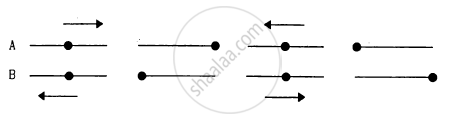
Concept: undefined >> undefined
The average energy in one time period in simple harmonic motion is
Concept: undefined >> undefined
A pendulum clock that keeps correct time on the earth is taken to the moon. It will run
Concept: undefined >> undefined
A wall clock uses a vertical spring-mass system to measure the time. Each time the mass reaches an extreme position, the clock advances by a second. The clock gives correct time at the equator. If the clock is taken to the poles it will
Concept: undefined >> undefined
A pendulum clock keeping correct time is taken to high altitudes,
Concept: undefined >> undefined
The bob of a pendulum at rest is given a sharp hit to impart a horizontal velocity \[\sqrt{10 \text{ gl }}\], where l is the length of the pendulum. Find the tension in the string when (a) the string is horizontal, (b) the bob is at its highest point and (c) the string makes an angle of 60° with the upward vertical.
Concept: undefined >> undefined
A pendulum clock keeping correct time is taken to high altitudes,
Concept: undefined >> undefined
A simple pendulum consists of a 50 cm long string connected to a 100 g ball. The ball is pulled aside so that the string makes an angle of 37° with the vertical and is then released. Find the tension in the string when the bob is at its lowest position.
Concept: undefined >> undefined
