Advertisements
Advertisements
Can the speed of a body be negative?
Concept: undefined >> undefined
Can a body have negative speed?
Concept: undefined >> undefined
Advertisements
Is the average speed during different time intervals for a uniform motion the same or different?
Concept: undefined >> undefined
During circular motion, which physical quantity of the body:
Remains constant
Concept: undefined >> undefined
The average time taken by a normal person to react to an emergency is one fifteenth of a second and is called the 'reaction time'. If a bus is moving with a velocity of 60 km/h and its driver sees a child running across the road, how much distance would the bus had moved before he could press the brakes? The reaction time of the people increases when they are intoxicated. How much distance had the bus moved if the reaction time of the driver were 1/2 s under the influence of alcohol?
Concept: undefined >> undefined
A girl had designed a clap switch for a science exhibition that enabled her to switch on or off an alarm just with clapping of hands. While testing her device in a hall, she noticed that once the alarm has sounded it followed with another one due to echo of the clap, that is, the sound reflected by the walls. She recorded the two soundings of alarm with her tape recorder and found out that time difference in between them is 0.1 s. If the distance of the walls be 15 m, calculate the speed of sound.
Concept: undefined >> undefined
For a body moving along a circular path, show that:
Linear speed = Angular velocity X radius of the circle
Concept: undefined >> undefined
A body covers half the distance with the speed A and the other half with speed B. What will be the average speed for the whole journey?
Concept: undefined >> undefined
A car travels 30 km at a uniform speed of 60 km/h and the next 30 km at a uniform speed of 20 km/h. What is its average speed?
Concept: undefined >> undefined
On a 120 km track, a train travels the first 40 km at a uniform speed of 30 km/h. How fast must the train travel the next 80 km, so as to average 60 km/h for the entire trip.
Concept: undefined >> undefined
In figure the position of a body times is shown . Calculate the speed of the body as it moves from 0 to A, A to B, B to C and i ts average speed .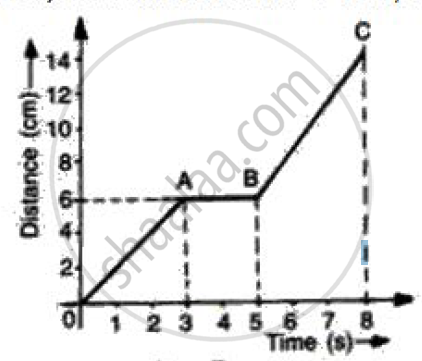
Concept: undefined >> undefined
A train travels the first 30km of its journey at 30km/h. Find the speed it should travel the next 90km to have an average speed of 60km/h.
Concept: undefined >> undefined
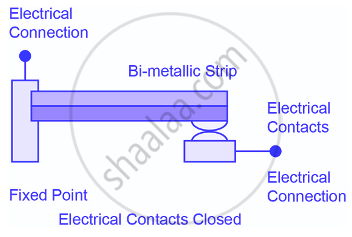
A bimetal strip is shown in the below diagram before heating. Draw a diagram to show how it bends on heating and on cooling.
Concept: undefined >> undefined
A bimetal strip is shown in the below diagram before heating. Draw a diagram to show how it bends on heating and on cooling.
Concept: undefined >> undefined
Distinguish between real and virtual image.
Concept: undefined >> undefined
Explain the following:
Why does not a Pyrex tumbler crack when hot water is poured in it?
Concept: undefined >> undefined
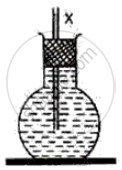
A round bottom flask containing coloured water, filtered with a stopper and a narrow glass tube is shown in the following diagram. What will happen to the water level X marked in the tube when it is placed in a hot water bath? Give a reason for your answer.
Concept: undefined >> undefined
Give reasons for the following:
When boiling water is poured into a glass bottle, it generally cracks.
Concept: undefined >> undefined
Distinguish between uniform velocity and variable velocity.
Concept: undefined >> undefined
The S.I. unit of velocity is ___________
Concept: undefined >> undefined
