Advertisements
Advertisements
Question
Distinguish between uniform velocity and variable velocity.
Advertisements
Solution
| Sr. No. | Uniform velocity | Variable velocity |
| 1. | If a body travels equal distances in equal intervals of time along a particular direction, then the body is said to be moving with a uniform velocity. | If a body travels unequal distances in a particular direction in equal intervals of time, or it moves equal distances in equal intervals of time but its direction of motion does not remain the same, then the velocity of the body is said to be variable (or non-uniform). |
| 2. | Example - A body, once started on a frictionless surface, moves with uniform velocity. | Example - The motion of a body in a circular path, even with uniform speed, is with variable velocity as the direction of motion of the body continuously changes with time. |
APPEARS IN
RELATED QUESTIONS
Observe the figure and answer the questions.
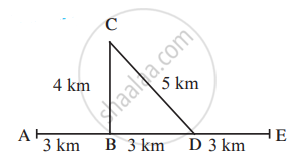
Sachin and Sameer started on a motorbike from place A, took the turn at B, did a task at C, travelled by the route CD to D and then went on to E. Altogether, they took one hour for this journey.
Find out the actual distance traversed by them and the displacement from A to E. From this, deduce their speed.
What was their velocity from A to E in the direction AE?
Can this velocity be called average velocity?
Define velocity.
A train travels from A to station B with a velocity of 100 km/h and returns from station B to station A with a velocity of 80 km/h. Its average velocity during the whole journey is ______ and its average speed is ______.
A body moves with an initial velocity of 5ms-1 and accelerates at 2ms -2. Its velocity after 10s is ______.
Define velocity.
Define velocity.
Distinguish between speed and velocity.
Define velocity.
Define velocity.
Define velocity.
