Please select a subject first
Advertisements
Advertisements
Define the following term:
Exudation
Concept: undefined >> undefined
Define the following term:
Hydathodes
Concept: undefined >> undefined
Advertisements
Give a reason/suitable explanation.
Guttation normally occurs during early mornings or late nights.
Concept: undefined >> undefined
The figure given below is a diagrammatic representation of a part of the cross-section of the root in the root hair zone. Study the same and then answer the questions that follow:

- The parts labelled as 1, 2, 3 and 4 are:
- Root hair, Xylem vessel, Soil particles, Cortex respectively.
- Xylem vessel, Soil particles, Root hair, Cortex respectively.
- Root hair, Xylem vessel, Cortex, Soil particles respectively.
- Cortex, Soil particles, Xylem vessel, Root hair respectively.
- The process that enables the passage of water from soil into the root hair is:
- Diffusion
- Active transport
- Osmosis
- Passive absorption
- The kind of force which exists between a liquid and any surface is called as:
- Cohesive force
- Adhesive force
- Capillarity
- Suction force
- The kind of force between the same kind of liquid molecules is:
- Capillary force
- Transpirational pull
- Adhesive force
- Cohesive force
- Sometimes exudation of water occurs from the margin of the leaves in the early morning or night. It is termed as:
- Transpiration
- Guttation
- Bleeding
- Osmosis
Concept: undefined >> undefined
Given below is the figure of a plant cell showing different kinds of pressure acting upon it. Study the figure and answer the questions that follow:

- In the figure, 1, 2 and 3 represent:
- Cytoplasm, Nucleus, Vacuole respectively
- Vacuole, Cytoplasm, Cell wall respectively.
- Cytoplasm, Cell membrane and vacuole respectively.
- Cytoplasm, Cell wall and Vacuole respectively.
- B in the figure represents:
- Osmotic pressure
- Turgor pressure
- Wall pressure
- Diffusion pressure
- A in the figure represents:
- irnbibition pressure
- Wall pressure
- Turgor pressure
- Osmotic pressure
- C in the figure represents:
- Turgor pressure
- Osmotic pressure
- Wall pressure
- Imbibition pressure
- Draw a neat and labelled diagram of a plasmolyzed plant cell.
Concept: undefined >> undefined
Differentiate between members of the following pair with reference to what is asked in the bracket.
Myopia and Hyperopia (type of lens used for correction).
Concept: undefined >> undefined
Aqueous humour, Vitreous humour, lris, Central canal
Concept: undefined >> undefined
Give biological reasons for the following statements:
The left ventricle of the heart has a thicker wall than the right ventricle.
Concept: undefined >> undefined
The diagram given below represents a section of the human heart. Answer the questions that follow:
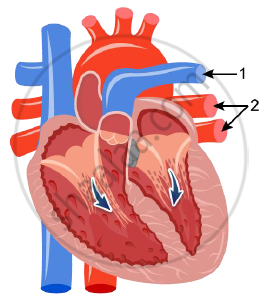
- Which parts of heart are in the diastolic phase? Give a reason to support your answer.
- Label the parts numbered 1 and 2 in the diagram. What type of blood flows through them?
- What causes the heart sounds ‘LUBB’ and ‘DUP’?
- Name the blood vessels that supply oxygenated blood to the heart muscles.
- Draw neat labelled diagrams of a cross section of an artery and a vein.
Concept: undefined >> undefined
State the exact location of the Chordae tendinae
Concept: undefined >> undefined
Differentiate between LUBB and DUP (names of the valves whose closure produce the sound)
Concept: undefined >> undefined
the Biological/technical term for The vein which drains the blood from the intestine to the liver.
Concept: undefined >> undefined
the Biological/technical term for Blood vessels carrying blood to the left atrium.
Concept: undefined >> undefined
The vein that carries oxygenated blood.
Concept: undefined >> undefined
fill in the blanks with suitable functions: Eustachian Tube and ______
Concept: undefined >> undefined
The diagram given below represents the human heart in one phase of its functions. Study the diagram carefully and answer the questions that follow:
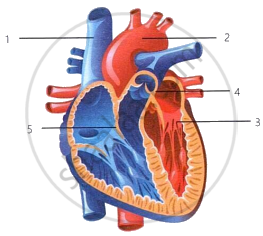
- Name the phase.
- Which part of the heart is contracting in this phase? Give a reason to support your answer.
- Name the parts labelled 1 to 4.
- What type of blood flows through 2?
- State the function of the part numbered ‘5’.
- Name the membrane that covers the heart.
Concept: undefined >> undefined
The exact location of the tricuspid valve
Concept: undefined >> undefined
The diagram below represents the simplified pathway of the circulation of blood. Study the same and answer the questions which follow:

(i) Name the blood vessels labelled 1 and 2.
(ii) State the function of blood vessels labelled 5 and 8.
(iii) What is the importance of the blood vessel labelled 6?
(iv) Which blood vessel will contain a high amount of glucose and amino acids after a meal?
(v) Draw a diagram of the different blood cells as seen in a smear of human blood.
Concept: undefined >> undefined
Explain Diapedesis.
Concept: undefined >> undefined
