Advertisements
Advertisements
Question
The diagram given below represents a section of the human heart. Answer the questions that follow :
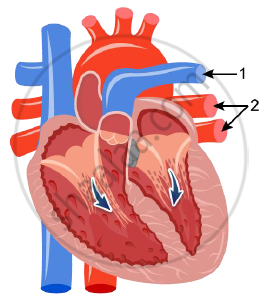
(i) Which parts of heart are in the diastolic phase? Give a reason to support your answer.
(ii) Label the parts numbered 1 and 2 in the diagram. What type of blood flows through them?
(iii) What causes the heart sounds ‘LUBB’ and ‘DUP’?
(iv) Name the blood vessels that supply oxygenated blood to the heart muscles.
(v) Draw neat labelled diagrams of a cross section of an artery and a vein.
Advertisements
Solution
(i) Ventricles are in diastolic phase. The arrows indicate blood entering the ventricles. During a ventricular diastole, the valves between atria and ventricles open which allow the entry of blood into the ventricles.
(ii) 1 – Pulmonary artery, 2 – Pulmonary veins
(iii) Closing of the bicuspid and tricuspid valves causes the ‘LUBB’ sound, and the closing of semilunar valves causes the ‘DUP’ sound.
(iv) Coronary artery supplies oxygenated blood to the heart muscles.
(v) Cross-section of an artery and a vein:

APPEARS IN
RELATED QUESTIONS
State the functions of blood in our body.
A blood vessel which has small lumen and thick wall is ______.
Give reason for the following:
The walls of the left ventricle are thicker than the walls of all other chambers.
Find out my partner.
| Group ‘A’ | Group ‘B’ |
| 1. Heart beats | a. 350 ml |
| 2. RBC | b. 7.4 |
| 3. WBC | c. 37°C |
| 4. Blood donation | d. 72 |
| 5. Normal body temperature | e. 50-60 lakh/mm3 |
| 6. pH of oxygenated blood | f. 5000-6000 per mm3 |
Explain with reasons.
Human blood is red coloured.
Why does the left ventricle possess a thicker wall than the right ventricle?
Choose the correct answer:
English physician who discovered blood circulation was ___________
Define the Veins.
Name the systems that carry out the different functions of the body.
All the waste products of the body are excreted through the circulatory system.
