Advertisements
Advertisements
प्रश्न
The diagram given below represents a section of the human heart. Answer the questions that follow :
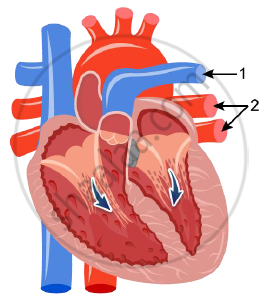
(i) Which parts of heart are in the diastolic phase? Give a reason to support your answer.
(ii) Label the parts numbered 1 and 2 in the diagram. What type of blood flows through them?
(iii) What causes the heart sounds ‘LUBB’ and ‘DUP’?
(iv) Name the blood vessels that supply oxygenated blood to the heart muscles.
(v) Draw neat labelled diagrams of a cross section of an artery and a vein.
Advertisements
उत्तर
(i) Ventricles are in diastolic phase. The arrows indicate blood entering the ventricles. During a ventricular diastole, the valves between atria and ventricles open which allow the entry of blood into the ventricles.
(ii) 1 – Pulmonary artery, 2 – Pulmonary veins
(iii) Closing of the bicuspid and tricuspid valves causes the ‘LUBB’ sound, and the closing of semilunar valves causes the ‘DUP’ sound.
(iv) Coronary artery supplies oxygenated blood to the heart muscles.
(v) Cross-section of an artery and a vein:

APPEARS IN
संबंधित प्रश्न
The blood from the heart is transported to all parts of the body by the ______.
Differentiate between LUBB and DUP (names of the valves whose closure produce the sound)
Give technical terms for The protective covering of the heart
The cells in our blood which destroy disease-causing germs are ______.
Why is it necessary to know the blood groups before giving transfusion?
Complete the following sentence with appropriate word:
The foundations of physiology were laid by the physician __________.
Respiration takes place because of its up and down movement.
Label the diagram given below to show the four main parts of the urinary system and answer the following questions.

- Which organ removes extra salts and water from the blood?
- Where is the urine stored?
- What is the tube through which urine is excreted out of the body?
- What are the tubes that transfer urine from the kidneys to the urinary bladder called?
Granulocytes are also known as ____________.
The heart is covered by ______.
