Advertisements
Advertisements
Question
Explain with reasons.
Human blood is red coloured.
Advertisements
Solution
Blood is red because it is composed of red cells known as red blood cells. Hemoglobin is a protein found within red blood cells. Each hemoglobin protein is composed of subunits known as hemes, which are responsible for the red colour of blood. Hemes, in particular, can bind iron molecules, and these iron molecules bind oxygen. Because of the interaction between iron and oxygen, blood cells are red. When iron is oxygenated, it turns red, and blood turns red as a result.
RELATED QUESTIONS
fill in the blanks with suitable functions: Eustachian Tube and ______
Which organ acts as a pump in the circulatory system?
The chief function of lymph nodes is to
Given below is a highly schematic diagram of the human blood circulatory system.
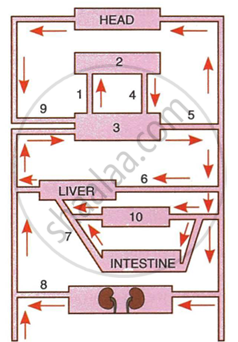 |
- Which part (state the number) represents the heart? Give reason in support of your answer.
- Which numbers represent the following, respectively?
Aorta Superior vena cava Hepatic portal vein Renal Vein Pulmonary artery Stomach
Given diagram shows a simple diagram of the circulation of blood in a mamma showing the
main blood vessels, the heart, lungs and body tissues. The blood vessel, labelled 6, contains
deoxygenated blood and the valve leading to it has three semi-lunar pockets.

(a) Name the blood vessels and organs marked by numbers 1 to 8.
(b) What is meant by the term ‘double circulation’ of blood in mammals?
(c) what is diastole?
[There is an “error” in the diagram. According to the usual practice the pulmonary (lung)
circulation is shown upward and the systemic downward, but here it is reversed].
Find out my partner.
| Group ‘A’ | Group ‘B’ |
| 1. Heart beats | a. 350 ml |
| 2. RBC | b. 7.4 |
| 3. WBC | c. 37°C |
| 4. Blood donation | d. 72 |
| 5. Normal body temperature | e. 50-60 lakh/mm3 |
| 6. pH of oxygenated blood | f. 5000-6000 per mm3 |
Name the Following
Oxygen is transported by the blood in the form of
Agranulocytes are about ______ % of total WBCs.
______ is an agranulocyte.
Ventricles have ______ walls when compared with those of auricles.
