Please select a subject first
Advertisements
Advertisements
Write the following in decimal form and say what kind of decimal expansion has:
`36/100`
Concept: undefined >> undefined
You know that `1/7=0.bar142857.` Can you predict what the decimal expansions of `2/7, 3/7, 4/7, 5/7, 6/7` are, Without actually doing the long division? If so, how?
[Hint: Study the remainders while finding the value of `1/7` carefully.]
Concept: undefined >> undefined
Advertisements
Express the following in the form `p/q`, where p and q are integers and q ≠ 0.
`0.bar6`
Concept: undefined >> undefined
Express 0.99999 .... in the form `p/q`. Are you surprised by your answer? With your teacher and classmates discuss why the answer makes sense.
Concept: undefined >> undefined
What can the maximum number of digits be in the repeating block of digits in the decimal expansion of `1/17`? Perform the division to check your answer.
Concept: undefined >> undefined
Look at several examples of rational numbers in the form `p/q` (q≠0), where p and q are integers with no common factors other than 1 and having terminating decimal representations (expansions). Can you guess what property q must satisfy?
Concept: undefined >> undefined
Write three numbers whose decimal expansions are non-terminating non-recurring.
Concept: undefined >> undefined
Find the remainder when x3 + 3x2 + 3x + 1 is divided by x+1.
Concept: undefined >> undefined
Find the remainder when x3 + 3x2 + 3x + 1 is divided by `x - 1/2`
Concept: undefined >> undefined
Find the remainder when x3 + 3x2 + 3x + 1 is divided by x.
Concept: undefined >> undefined
Find the remainder when x3 + 3x2 + 3x + 1 is divided by x + π.
Concept: undefined >> undefined
Find the remainder when x3 + 3x2 + 3x + 1 is divided by 5 + 2x.
Concept: undefined >> undefined
Find the remainder when x3 – ax2 + 6x – a is divided by x – a.
Concept: undefined >> undefined
Check whether 7 + 3x is a factor of 3x3 + 7x.
Concept: undefined >> undefined
In which quadrant or on which axis do each of the points (– 2, 4), (3, – 1), (– 1, 0), (1, 2) and (– 3, – 5) lie? Verify your answer by locating them on the Cartesian plane.
Concept: undefined >> undefined
Plot the points (x, y) given in the following table on the plane, choosing suitable units of distance on the axes.
| x | -2 | -1 | 0 | 1 | 3 |
| y | 8 | 7 | -1.25 | 3 | -1 |
Concept: undefined >> undefined
How would you rewrite Euclid’s fifth postulate so that it would be easier to understand?
Concept: undefined >> undefined
Does Euclid’s fifth postulate imply the existence of parallel lines? Explain.
Concept: undefined >> undefined
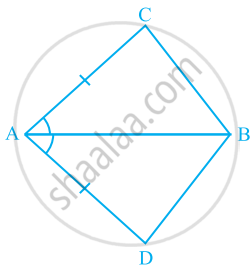
In quadrilateral ACBD, AC = AD and AB bisects ∠A (See the given figure). Show that ΔABC ≅ ΔABD. What can you say about BC and BD?
Concept: undefined >> undefined
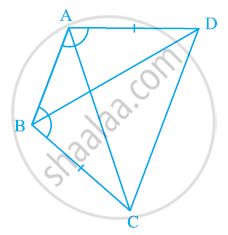
ABCD is a quadrilateral in which AD = BC and ∠DAB = ∠CBA (See the given figure). Prove that
- ΔABD ≅ ΔBAC
- BD = AC
- ∠ABD = ∠BAC.
Concept: undefined >> undefined
